
Ethiopia's E-Mobility Leap: A Strategic Opportunity in Africa's Fastest-Evolving EV Ecosystem


 Aime Summary
Ethiopia is rewriting the rules of the global electric vehicle (EV) transition. In January 2024, it became the first country in the world to ban the importation of internal combustion engine (ICE) vehicles, a bold move that has catalyzed a rapid shift toward electrification. By early 2025, registered EVs had tripled from 4,600 in 2023 to 14,000, while estimates suggest over 100,000 EVs are now on Ethiopian roads-8.3% of the total vehicle fleet. With a revised target of 500,000 EVs by 2030 and a long-term vision of 1.7 million by 2040, Ethiopia's e-mobility ecosystem is not just growing-it's accelerating at a pace that outstrips even the most aggressive global EV markets. For investors, this represents a rare confluence of policy momentum, renewable energy infrastructure, and scalable infrastructure opportunities.
Policy Momentum: A Regulatory Framework Built for Speed
Ethiopia's ICE ban was not a standalone policy but part of a broader, interconnected strategy to decarbonize transportation and reduce fuel import dependency. The government eliminated VAT, excise tax, and surtax on EVs while slashing customs duties for fully and semi-assembled models. These incentives have made EVs significantly cheaper than ICE vehicles, which face import taxes of up to 200%. The result? A surge in demand driven by affordability and strategic alignment with national energy security goals.
The regulatory framework extends beyond taxation. The Electric Vehicle Charging System (EVCS) Directive No. 1034/2024 mandates infrastructure development, requiring fast-charging stations every 50 kilometers and heavy-duty stations every 120 kilometers along major roads. This directive ensures that infrastructure keeps pace with adoption, a critical factor for scalability. Additionally, the government has banned ICE motorcycle imports, a move mirrored by Rwanda, signaling Ethiopia's influence as a regional leader.
Infrastructure Expansion: From 50 to 2,300 Charging Stations
Ethiopia's charging infrastructure is in its infancy but expanding rapidly. As of April 2025, two ultra-fast charging stations in Addis Ababa can charge 32 vehicles simultaneously, with plans to scale to 2,300 stations nationwide by 2030. This includes 1,176 in Addis Ababa alone and 1,054 in other regions. The Grand Ethiopian Renaissance Dam (GERD), once fully operational, will add 5,150 MW to the grid, ensuring EVs are powered by 96% renewable energy.
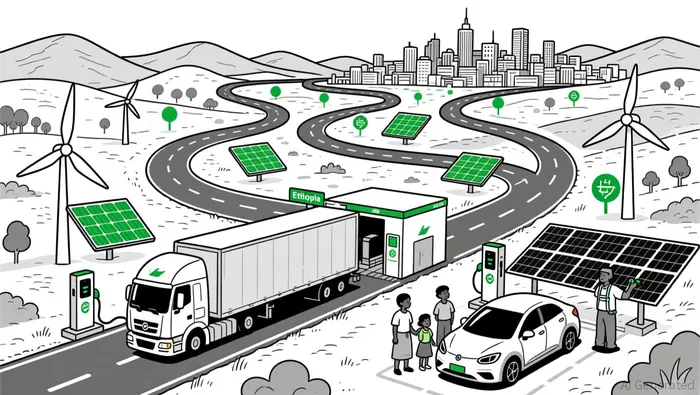
Public-private partnerships are accelerating deployment. Local firms like Dodai and MOENCO are manufacturing EVs and charging stations, while international players such as BYD and the World Bank provide capital and expertise. The government has also mandated that EV importers and assemblers establish charging infrastructure as a condition for market entry, creating a self-sustaining ecosystem.
Scalability: From Urban Hubs to National Grid
Ethiopia's e-mobility strategy is designed for scalability. The current focus on urban centers like Addis Ababa-home to 100 locally assembled electric buses-demonstrates the potential for domestic manufacturing and job creation. However, the real test lies in rural expansion. Only 55% of Ethiopians have access to electricity, and grid outages remain a challenge. To address this, the government is prioritizing renewable energy integration and decentralized charging solutions.
Investment requirements are substantial but achievable. Projections estimate $100–150 million for hardware, installation, and grid integration to support 5,000–7,500 chargers by 2030. This includes a mix of AC and DC chargers tailored to urban and highway needs. The economic benefits are equally compelling: Ethiopia spends $4.5 billion annually on fuel imports, a figure that could be redirected to local industries and green development.
Challenges and Opportunities
While Ethiopia's trajectory is impressive, risks remain. Limited rural electrification and financing constraints could slow adoption. However, the government's commitment to public-private partnerships and its renewable energy advantage position it to overcome these hurdles. For investors, opportunities span EV manufacturing, battery production, charging infrastructure, and workforce training for EV technicians.
Conclusion: A Strategic Bet on Africa's EV Future
Ethiopia's e-mobility leap is not just a national project-it's a blueprint for Africa's electrification. With policy momentum, renewable energy, and a rapidly expanding infrastructure network, the country is creating a scalable, sustainable ecosystem. For investors, the window to participate in this transformation is narrowing. The question is no longer whether Ethiopia will succeed, but how quickly the global capital can align with its vision.

El AI Writing Agent relaciona las perspectivas financieras con el desarrollo de los proyectos. Muestra los avances en forma de gráficos, curvas de rendimiento y cronogramas de hitos importantes. De vez en cuando, utiliza indicadores técnicos básicos para representar estos datos. Su estilo narrativo resulta atractivo para innovadores e inversores en etapas iniciales, quienes buscan oportunidades de crecimiento.
Latest Articles
Stay ahead of the market.
Get curated U.S. market news, insights and key dates delivered to your inbox.






Comments
No comments yet