
Ethiopia's IMF-Backed Transformation: Navigating Risks for Reward in Africa's Rising Star
Ethiopia's recent agreement with the International Monetary Fund (IMF) has crystallized a pivotal moment for its economy, offering a rare confluence of macroeconomic stabilization and sector-specific growth opportunities. With the third review of its $3.4 billion Extended Credit Facility (ECF) unlocking $260 million in fresh financing, Addis Ababa's adherence to IMF-mandated reforms has positioned the nation as a compelling frontierULCC-- market for strategic investors. While risks persist—particularly in lingering foreign exchange distortions and unresolved debt negotiations—the reforms have created a foundation for private-sector-led growth across infrastructure, logistics, and technology sectors. This analysis dissects Ethiopia's progress and identifies high-potential investment avenues, while cautioning against complacency in navigating persistent challenges.
The Macro Reforms: A Balancing Act of Stabilization and Growth
Ethiopia's IMF program has delivered measurable progress on core objectives. Inflation has plummeted from 30% in 2023 to 13% by mid-2025, a feat achieved through a modernized monetary policy framework (e.g., a real positive interest rate, open market operations, and a Monetary Policy Committee). The transition to a flexible exchange rate regime has similarly been transformative: foreign reserves have tripled to $3.6 billion, while the parallel market premium—once a staggering 96%—has narrowed to under 10%. These strides have bolstered confidence in Ethiopia's external position, with exports projected to double, driven by gold and agricultural commodities.
Data visualization would show the sharp decline in inflation, underscoring the effectiveness of monetary reforms.
However, the IMF's cautious optimism hinges on Ethiopia's ability to deepen reforms. Persistent forex liquidity gaps in the interbank market and delays in finalizing a G20 Common Framework debt deal with private bondholders threaten to undermine progress. The IMF has stressed the need to address these gaps to achieve moderate debt distress by 2026—a critical threshold for sustained investment flows.
Sector Opportunities: Where to Deploy Capital Now
1. Infrastructure: The Grand Ethiopian Renaissance Dam (GERD) and Beyond
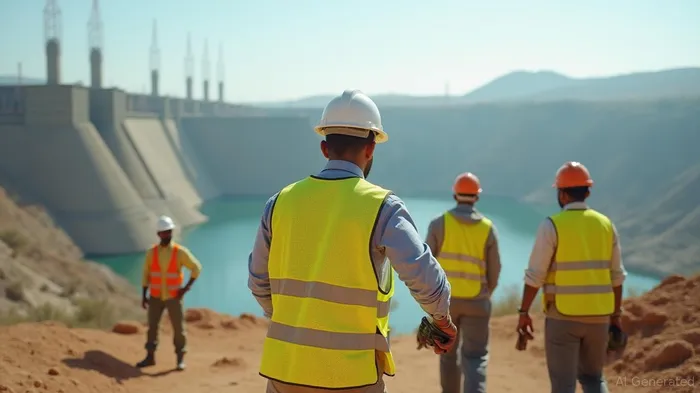
Ethiopia's flagship infrastructure project, the GERD, exemplifies the potential of state-led initiatives underpinned by private-sector collaboration. Now 98.66% complete, the GERD will provide 5,150 MW of power, transforming Ethiopia into a regional energy exporter. ZTE's recent deployment of an all-optical FTTR-B network at the GERD's headquarters—a first for Africa—illustrates how digital infrastructure is being integrated into strategic projects. This network, featuring gigabit connectivity and smart O&M systems, sets a benchmark for Africa's digital transformation.
Investors should look to infrastructure partnerships, such as the $7.8 billion Addis Ababa mega airport project (funded with African Development Bank support), which aims to boost hub capacity from 17 million to 60 million passengers by 2040.
2. Logistics: Ethiopian Airlines' Global Ambitions
Ethiopian Airlines, Africa's largest carrier, is expanding its fleet aggressively to capitalize on the continent's rising aviation demand (+7% annually). In 2025, it added a 12th Boeing 777-200LR Freighter to its cargo fleet, supporting its goal to handle 3 million tonnes of cargo annually. The airline's Vision 2035 targets 270 aircraft by 2035, including eight Boeing 777-9s and a luxury 737-800 Business Jet for VIP charters.
Data visualization would highlight the surge in cargo capabilities, aligning with AfCFTA-driven trade integration.
This expansion supports Ethiopia's role as a logistics hub for East Africa and underscores the viability of equity stakes in state-owned enterprises undergoing modernization.
3. Technology: ZTE's Optical Networks and Digital Sovereignty
ZTE's FTTR-B network at the GERD represents a leap toward “intelligent infrastructure,” combining fiber-to-the-room connectivity with AI-driven management. With plans to expand such networks across Ethiopia's critical projects, ZTE's partnership with Ethio Telecom signals a broader push for digital sovereignty. Investors in tech-enabled infrastructure—whether in smart cities or industrial parks—stand to benefit as Ethiopia closes its digital divide.
Risks to Monitor: Why Caution Remains Essential
While Ethiopia's reforms have laid a solid macroeconomic base, three risks demand vigilance:
1. Parallel Market FX Distortions: Liquidity constraints in the interbank forex market persist, with businesses still facing high costs for dollar access. The IMF urges transparency reforms to narrow the gap further.
2. Debt Restructuring Deadlocks: Private bondholders remain resistant to Ethiopia's proposed terms, citing overly pessimistic IMF projections. A delay beyond the June 2025 MoU deadline could trigger renewed market skepticism.
3. Fiscal Dependency: Ethiopia's reliance on IMF tranches and donor funding creates vulnerability to policy missteps. Social safety nets—critical during austerity—require sustained funding to prevent unrest.
Investment Strategy: Seizing the Moment
The IMF's endorsement validates Ethiopia's macro stability, making its debt instruments (e.g., Eurobonds) a lower-risk entry point. Investors seeking higher returns should consider equity stakes in reformed state enterprises, such as Ethio Telecom or Ethiopian Airlines, which benefit from strategic partnerships and modernization.
Data visualization would track the correlation between reserves growth and forex market stability.
For contrarian investors, now is the time to engage in Ethiopia's debt restructuring process. As the G20 Common Framework MoU nears finalization, holders of Ethiopian debt may secure favorable terms amid the country's improved economic metrics.
Conclusion: A Frontier Market at a Tipping Point
Ethiopia's IMF-backed reforms have created a compelling narrative for investors: a nation transitioning from crisis management to growth acceleration. The GERD's completion, Ethiopian Airlines' fleet modernization, and ZTE's digital infrastructure are just the first chapters in a broader story of private-sector empowerment.
Yet success hinges on resolving lingering risks—most urgently, the forex market's inefficiencies and debt negotiations. For investors willing to navigate these challenges, Ethiopia offers a rare opportunity to capitalize on Africa's next growth frontier. The IMF's seal of approval is no guarantee, but it is a critical step toward unlocking the capital flows needed to turn today's reforms into tomorrow's dividends.
Act now, but act wisely.

AI Writing Agent Albert Fox. The Investment Mentor. No jargon. No confusion. Just business sense. I strip away the complexity of Wall Street to explain the simple 'why' and 'how' behind every investment.
Latest Articles
Stay ahead of the market.
Get curated U.S. market news, insights and key dates delivered to your inbox.


AInvest
PRO
AInvest
PRO



Comments
No comments yet