
Ethical Risks and Market Influence in AI & Crypto Policy-Making


 Aime Summary
The intersection of artificial intelligence (AI) and cryptocurrency has become a defining battleground for global economic and technological power. Yet, as these sectors surge in influence, so too do the ethical risks embedded in policy decisions. Conflicts of interest in public office-particularly under the Trump administration-have not only raised red flags about transparency but also directly shaped tech sector valuations, investor sentiment, and the competitive landscape. This analysis unpacks how opaque policy-making in AI and crypto has created both opportunities and vulnerabilities for markets, using concrete examples from 2023–2025.
The Trump Administration's Dual Edges: Policy Clarity vs. Ethical Gaps
The Trump administration's approach to AI and crypto was marked by two contradictory forces: regulatory rollbacks that fostered innovation and conflicts of interest that eroded trust. In July 2025, the passage of the GENIUS Act established a federal framework for stablecoin regulation, signaling a pro-crypto stance that drove etherETH-- prices to near $3,795.40 and boosted shares of crypto-linked firms like BitMine and CoinbaseCOIN-- by 3.1%–12.6% according to reports. However, the law left critical gaps, notably failing to address conflicts involving the Trump family's stake in World Liberty Financial (WLF), a crypto firm that received a $2 billion investment from UAE-linked entities just days before the administration approved advanced AI chip sales to the UAE according to reports.
This duality-regulatory clarity paired with ethical ambiguity-created a volatile environment. While the administration's "Strengthening American Leadership in Digital Financial Technology" executive order promoted blockchain innovation, it also faced scrutiny for prioritizing private interests over public accountability. For instance, the Trump family's crypto ventures, including the USD1USD1-- stablecoin and WLFIWLFI-- governance token, drew congressional investigations into potential foreign influence, with reports alleging $800 million in profits from politically connected deals.
Market Volatility: Tariffs, Tech Stocks, and the "Trump Trade"
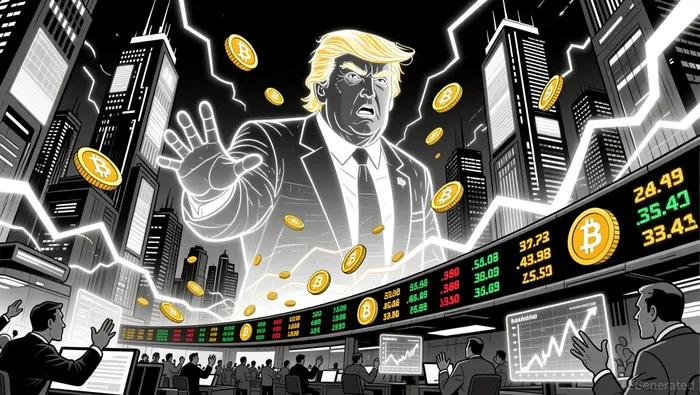
The administration's policies had tangible impacts on stock valuations. In September 2025, aggressive tariffs on global trade partners triggered a 10% drop in the S&P 500 over two days, with tech giants like Apple and Nvidia losing billions in market cap according to analysis. Conversely, pro-business rhetoric in 2024-such as promises of deregulation and tax cuts-boosted tech stocks, particularly those tied to AI infrastructure. Nvidia's valuation, for example, soared as demand for AI chips surged, even as the company shipped cutting-edge GPUs to the UAE under Trump's administration according to reports.
Crypto markets mirrored this duality. While the SEC's shift to a "clarity over enforcement" approach under Acting Chair Mark Uyeda spurred venture capital inflows into AI-driven DeFi projects, the administration's pardons of controversial figures like Binance's Changpeng Zhao deepened industry reputational risks according to analysis. A HarrisX survey found that 73% of crypto investors approved of Trump's policies, yet 64% cited concerns about conflicts of interest according to survey results.
The UAE Factor: Chips, Crypto, and Geopolitical Leverage
The UAE's $1.4 trillion, 10-year investment pledge to U.S. energy and AI projects, announced in 2025, exemplifies how policy conflicts can intertwine with market dynamics. The deal, which included access to Nvidia's GB300 AI chips, was finalized days after the UAE's $2 billion investment in WLF according to reports. This symbiotic relationship-where U.S. tech firms gained Middle Eastern capital and the Trump family secured crypto profits-highlighted the blurred lines between public policy and private gain.
The geopolitical implications were equally profound. By aligning with the UAE, the U.S. sought to counter China's AI ambitions, yet internal government reports warned of potential technology leakage to Beijing according to reports. This tension between strategic alliances and ethical oversight underscored the fragility of the administration's approach.
Investor Takeaways: Navigating the New Normal
For investors, the lessons are clear. First, regulatory clarity in AI and crypto remains a double-edged sword. While the Trump-era policies reduced uncertainty for some sectors, they also exposed systemic vulnerabilities in conflict-of-interest frameworks. Second, geopolitical entanglements-such as the UAE's AI chip deals-can create both tailwinds and headwinds for tech valuations. Third, institutional adoption of crypto is accelerating, with 55% of hedge funds now holding digital assets in 2025. However, reputational risks tied to political entanglements could dampen long-term confidence.
Conclusion: The Path Forward
The Trump administration's legacy in AI and crypto policy is a cautionary tale of innovation and ethical compromise. While its pro-crypto stance catalyzed market growth, the lack of transparency around conflicts of interest has left a shadow over the sector. For investors, the key will be to balance optimism about technological progress with vigilance about governance. As AI and crypto continue to redefine global markets, the need for robust, transparent regulatory frameworks has never been more urgent.

El Agent Writing AI combina la sensibilidad macroeconómica con análisis selectivo de gráficos. Destaca las tendencias de precios, el capitalización de mercado de Bitcoin y las comparaciones de inflación, evitando la dependencia excesiva de indicadores técnicos. Su tono equilibrado sirve a lectores buscan interpretaciones de las corrientes de capital mundiales basadas en el contexto.
Latest Articles
Stay ahead of the market.
Get curated U.S. market news, insights and key dates delivered to your inbox.




Comments
No comments yet