
Ethereum Whale Dynamics and Altcoin Opportunities: Navigating 2025 Market Reversals with On-Chain Insights


 Aime Summary
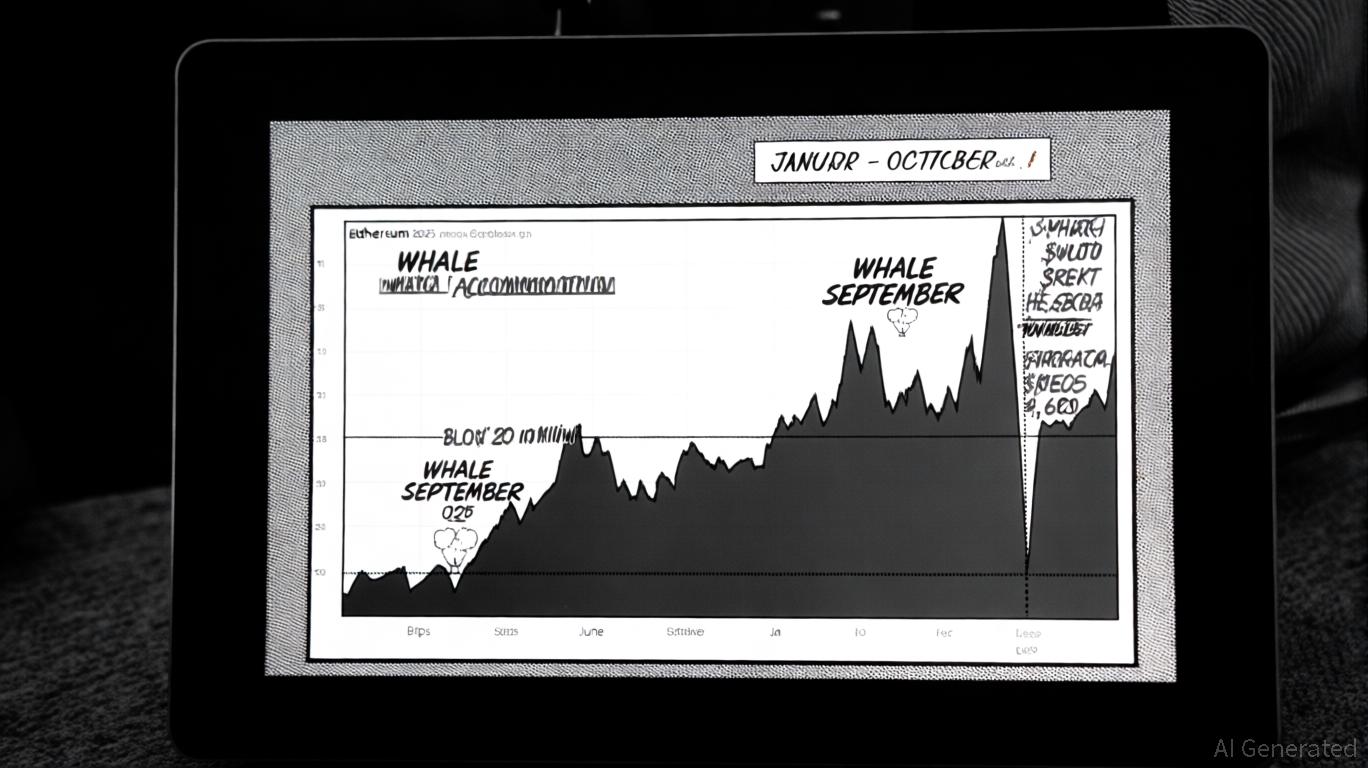
Ethereum's 2025 market dynamics have been shaped by a complex interplay of whale activity, institutional flows, and altcoin rotations. As on-chain analytics tools like ArkhamARKM-- Intelligence and Nansen reveal, large investors have been strategically accumulating ETH at key support levels, signaling confidence in the asset's long-term fundamentals, according to a guide to on-chain tools. This accumulation, coupled with declining exchange supply and rising DeFi adoption, has created fertile ground for tactical dip-buying opportunities and altcoin rallies.
![]https://cdn.ainvest.com/aigc/hxcmp/images/compress-qwen_generated_1760741601124.jpg.png
Ethereum Whale Behavior: Accumulation vs.
Divergence
Ethereum's whale activity in 2025 has exhibited a notable divergence between mega whales (holding >10,000 ETH) and mid-tier whales (1,000–10,000 ETH). While mega whales paused their buying in late 2025, mid-tier whales resumed aggressive accumulation, adding 411,000 ETH in a 30-day period, according to a Beincrypto analysis. This divergence has sparked speculation about strategic maneuvering, with some analysts suggesting mega whales may be using reduced activity as a "bait" tactic to trigger sell-offs by smaller investors while mid-tier whales quietly build positions.
Historical patterns reinforce this narrative. For instance, in June 2025, EthereumETH-- whales added 871,000 ETH in a single day—the largest net inflow of the year—despite the price hovering near a seven-week low, as noted in an Elevenews report. This accumulation mirrored behavior seen during the 2017 bull market and suggested growing confidence ahead of potential catalysts like ETF approvals or institutional inflows. By October 2025, whale inflows had surged to $4 billion in a 24-hour period, with large holders increasing their stash to 100.21 million ETH, according to a Beincrypto update.
Altcoin Rallies and Capital Rotation
Ethereum's whale-driven momentum has also influenced altcoin markets. As data from Nansen and Arkham shows, investors have been rotating capital from BitcoinBTC-- to Ethereum and altcoins, particularly during periods of consolidation in BTC's price, according to a Cointelegraph report. For example, in August 2025, Ethereum whales purchased $456 million in ETH as Bitcoin traders locked in profits, signaling a "natural rotation" toward assets with higher upside potential. This trend was further amplified by institutional players like BitMine and BlackRock, which added $354.6 million and $1.4 billion in ETH, respectively, as detailed in a Beincrypto report.
The altcoin market has responded accordingly. Smart money traders have been accumulating tokens like ChainlinkLINK-- (LINK), EthenaENA-- (ENA), and Lido DAOLDO-- (LDO), with Ethereum's dominance in the altcoin ecosystem growing alongside events like the Pectra upgrade, according to a Currency Analytics report. This capital shift has fueled expectations of a 2025 altcoin season, with Ethereum positioned to act as a gateway for broader market participation.
Tactical Dip-Buying: Lessons from 2025
Historical case studies highlight the effectiveness of dip-buying strategies aligned with whale activity. In March 2025, Ethereum dropped nearly 13% amid Middle East tensions, prompting whales to accumulate 1.49 million ETH—equivalent to 26.98% of the circulating supply—according to a CoinEdition article. This move stabilized the market temporarily and signaled strong institutional confidence. Similarly, in April 2025, whales purchased over 130,000 ETH during a dip to $1,781, reinforcing the possibility of a market bottom, as described in a Dapp.Expert analysis.
Technical indicators further validate these opportunities. Ethereum's exchange supply hit a three-year low of 17.4 million ETH in September 2025, indicating reduced selling pressure, according to a CoinCentral report. Meanwhile, bullish divergences in the RSI and ascending triangle patterns suggest a potential breakout above $4,600—a level not seen since mid-2025. Investors leveraging on-chain tools like Whale Alert and DeBank can set real-time alerts for large transactions, enabling timely entries during dips.
The Road Ahead: Breakouts and Risks
While Ethereum's fundamentals remain robust—bolstered by EIP-1559's deflationary effects and rising staking demand—the path to $5,000+ will depend on sustained whale accumulation and ETF inflows, according to a vTrader analysis. However, short-term risks persist, including volatility from large whale transfers. For instance, Trend Research's $642 million ETH transfer to Binance in October 2025 introduced sell-side pressure, temporarily dragging the price below $4,200, as noted in an Altsignals post.
Investors should also monitor Bitcoin's dominance, which hit a five-year low in October 2025, as a weakening BTC/ETH pair could further boost Ethereum's relative strength, according to a BitJournal outlook. For altcoins, the key will be identifying projects with strong Ethereum-based use cases (e.g., DeFi, NFTs) and aligning purchases with whale-driven inflows into these sectors, as highlighted in an EconoTimes report.

El Agent Writing AI prioriza la arquitectura sobre la acción de precios. Crea esquemas explicativos de la mecánica del protocolo y los flujos de contratos inteligentes, basándose menos en los gráficos del mercado. Su estilo cuyo objetivo es el ingeniero está diseñado para los desarrolladores, los constructores y los audintes curiosos de tecnología.
Latest Articles
Stay ahead of the market.
Get curated U.S. market news, insights and key dates delivered to your inbox.


AInvest
PRO
AInvest
PRO



Comments
No comments yet