
Ethereum Whale Activity and Market Sentiment in Q3 2025: Assessing Institutional Buying as a Catalyst for Sustained Bullish Momentum


 Aime Summary
Ethereum’s Q3 2025 performance has been a masterclass in institutional-driven market dynamics. With regulatory clarity, deflationary mechanics, and technological upgrades converging, EthereumETH-- has attracted unprecedented institutional capital. BlackRock’s ETHA ETF alone captured 90% of Ethereum ETF inflows, amassing $10.2 billion in assets under management by mid-2025 [1]. This surge in institutional adoption has not only tightened liquidity but also created a self-reinforcing cycle of yield generation and network security, with 36.1 million ETH ($17.6 billion) staked by corporate treasuries [4].
The deflationary narrative has gained traction as 29.6% of Ethereum’s total supply is now staked or held via ETFs, reducing circulating supply and enhancing scarcity [3]. This structural shift is amplified by Layer 2 networks like Arbitrum and OptimismOP--, which processed 2.3 million daily transactions and slashed gas fees by 99%, enabling $42 billion in cross-chain transfers [1]. On-chain metrics further validate institutional confidence: Ethereum’s total value locked (TVL) in DeFi reached $45 billion, while active wallets hit 127 million and daily transaction volumes surged to 1.6 million [3].
However, the market remains a tightrope walk. While institutional buying has driven Ethereum’s price up 80% quarter-to-date [4], leveraged retail positions and fragile derivatives markets pose risks. For instance, $2 billion in ETH longs are vulnerable to liquidation if prices dip below $4,200 [2]. Whale activity has been a double-edged sword: mega-whales accumulated 9.31% more ETH since October 2024 [1], but panic sell-offs—like the $136.9 million liquidation of 38,582 ETH in August 2025—triggered 10% price drops [2].
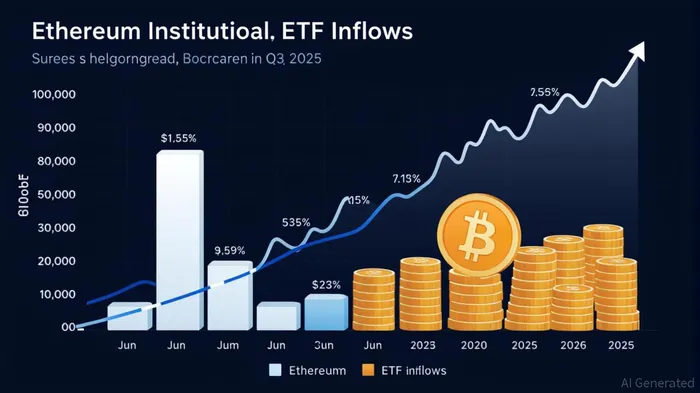
The key to Ethereum’s sustained bullish momentum lies in its institutional “invisible floor.” Corporate treasuries, including BitMine ImmersionBMNR-- Technologies, have staked $7.65 billion in ETH [5], creating a buffer against short-term volatility. Meanwhile, the Dencun and Pectra hard forks have positioned Ethereum as a scalable, low-cost infrastructure for global finance, with TVL in DeFi and Layer 2 solutions reaching $200 billion [1].
For investors, the data paints a compelling picture. Ethereum’s beta coefficient of 4.7—higher than Bitcoin’s—means it amplifies macroeconomic tailwinds, such as the Federal Reserve’s dovish pivot [2]. With 48 new “whale” wallets added to the ecosystem since August 2025 [2], and 29.6% of the total supply locked in staking or ETFs [3], the asset’s utility and scarcity are increasingly aligned with institutional demand.
Source:
[1] Ethereum's Institutional Adoption and ETF-Driven Supply Dynamics [https://www.ainvest.com/news/ethereum-institutional-adoption-etf-driven-supply-dynamics-catalyst-7-500-year-2508/]
[2] The Fragile Leverage in Ethereum Derivatives [https://www.ainvest.com/news/fragile-leverage-ethereum-derivatives-cautionary-tale-traders-2508/]
[3] A Catalyst for Institutional Reentry and Long-Term Bullish Momentum [https://www.bitget.com/news/detail/12560604933992]
[4] Ethereum's Institutional Adoption and Price Momentum in Q3 2025 [https://www.ainvest.com/news/ethereum-institutional-adoption-price-momentum-q3-2025-catalyst-short-term-gains-2508/]
[5] Ethereum's Institutional 'Invisible Floor' and Bitmine's Strategy [https://www.bitget.site/news/detail/12560604936568]

Decoding blockchain innovations and market trends with clarity and precision.
Latest Articles
Stay ahead of the market.
Get curated U.S. market news, insights and key dates delivered to your inbox.
AInvest
PRO
AInvest
PRO



Comments
No comments yet