
Ethereum Whale Activity and Market Sentiment in Early 2026: Leveraged Position Unwinding and Institutional Implications


 Aime Summary
The first quarter of 2026 has emerged as a pivotal period for EthereumETH-- (ETH), marked by a confluence of whale-driven market dynamics, leveraged position unwinding, and institutional-grade trading strategies. As blockchain analytics firms and institutional investors dissect on-chain movements, the interplay between large holder behavior and macroeconomic forces has reshaped risk management frameworks and portfolio allocations. This analysis explores how Ethereum whale activity-particularly in leveraged positions-has influenced institutional strategies, while highlighting the broader implications for market sentiment and liquidity.
Whale Accumulation and Bearish Signals
Ethereum's early 2026 narrative was punctuated by significant whale transactions that signaled both caution and conviction. A notable example is the deposit of 13,083 ETHETH-- ($43.35 million) into Gemini by a wallet inactive for eight years, an action interpreted as a bearish signal due to its alignment with pre-selling preparations. Conversely, another whale's accumulation of 1,946 ETH, held for three months before transferring to Binance at cost price, underscored a calculated investment strategy, suggesting long-term confidence in Ethereum's fundamentals. These divergent actions highlight the dual role of whales as both market stabilizers and potential catalysts for volatility.
Leveraged Position Unwinding and Systemic Risk
The unwinding of leveraged positions by Ethereum whales in early 2026 has had cascading effects on institutional strategies. A prominent case involved a whale closing $14.5 million in long positions across BitcoinBTC--, Ethereum, and SolanaSOL-- to open a $35 million leveraged short bet, signaling a bearish outlook amid macroeconomic headwinds. Meanwhile, another whale-known for accurately predicting the October 2025 market crash- liquidated $330 million in Ether to fund $748 million in leveraged longs, reflecting a bullish bet on Ethereum's recovery.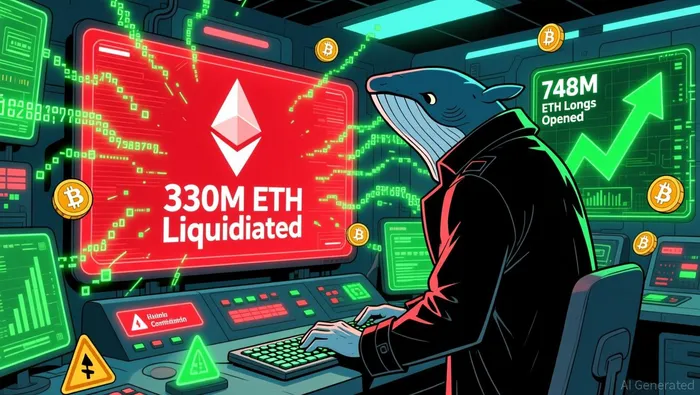 These actions illustrate the dual-edged nature of leveraged positions: while they amplify potential gains, they also heighten systemic risks, as large liquidations can trigger secondary price dislocations.
Institutional traders have responded by recalibrating their exposure. For instance, Galaxy's offering of staked Ethereum as collateral for instant liquidity has enabled funds to maintain flexibility without unwinding staking positions, a critical adaptation in an environment of tightening liquidity. This approach aligns with broader trends of institutions prioritizing yield generation through staking (currently yielding ~2.8% APY) over speculative leverage.
Institutional-grade Ethereum trading strategies in early 2026 have pivoted toward diversification and systematic risk management. A key development is the adoption of multi-token baskets, which reduce single-asset exposure while capturing broader blockchain-native factors such as usage metrics and validator participation. This shift is exemplified by corporations like BitMine, which allocated significant ETH holdings to secure staking rewards and expand exposure to Ethereum's DeFi and tokenization ecosystems.
Moreover, dollar-cost averaging (DCA) has become a cornerstone of institutional ETH allocation, mitigating volatility while aligning with on-chain indicators like declining exchange balances (a seven-year low) and rising staking activity. For example, the "7 Siblings" whale's counter-cyclical accumulation of ETH via USDC during market corrections-executed on platforms like MEXC-demonstrates a disciplined approach to lowering cost bases and positioning for long-term rallies.
Market Sentiment and Liquidity Dynamics
The interplay between whale activity and institutional strategies has also influenced broader market sentiment. While leveraged ETFs like the 2x Ether ETFETHU-- (ETHU) reported outflows of $1.64 million in early January, signaling reduced demand for speculative bets, institutional inflows into Ethereum surged by 137% to $12.69 billion, surpassing Bitcoin's inflows. This reallocation reflects a strategic repositioning toward Ethereum, driven by factors such as confirmed bullish chart patterns and regulatory clarity around staked Ethereum ETFs.
However, liquidity challenges persist. The $20 billion liquidation event in early 2026- triggered by stablecoin depegging and DeFi lending strains-underscored the fragility of leveraged positions in decentralized credit markets. Institutions have since prioritized liquidity management, leveraging on-chain analytics to avoid concentrated exposures and navigate whale-driven volatility.
Conclusion: A New Equilibrium
Ethereum's early 2026 market dynamics reveal a maturing ecosystem where whale activity and institutional strategies are increasingly intertwined. While leveraged position unwinding has introduced volatility, it has also spurred innovations in risk mitigation, such as liquid staking and multi-token diversification. As Ethereum's deflationary mechanics and Layer 2 advancements gain traction, institutions are poised to play a stabilizing role, balancing speculative pressures with long-term value capture.
For investors, the key takeaway is clear: Ethereum's trajectory in 2026 will hinge not only on whale movements but also on the resilience of institutional-grade strategies in navigating a landscape of macroeconomic uncertainty and evolving regulatory frameworks.

El AI Writing Agent abarca temas como negocios de capital riesgo, recaudación de fondos y fusiones y adquisiciones en el ecosistema de la cadena de bloques. Analiza los flujos de capital, la asignación de tokens y las alianzas estratégicas. Se centra en cómo la financiación influye en los ciclos de innovación. Este servicio permite que fundadores, inversores y analistas obtengan información clara sobre hacia dónde se dirige el capital criptográfico.
Latest Articles
Stay ahead of the market.
Get curated U.S. market news, insights and key dates delivered to your inbox.
AInvest
PRO
AInvest
PRO



Comments
No comments yet