
Ethereum Whale Activity as a Leading Indicator of Market Sentiment and Price Momentum


 Aime Summary
Whale Accumulation and Price Rebound: A Symbiotic Relationship
In late October and early November 2025, Ethereum's price plummeted to $2,970 amid heavy liquidations on Binance, erasing $39 million in long positions. However, this downturn triggered a surge in whale accumulation. Over two days, whales purchased over 323,000 ETH (worth $1.12 billion), stabilizing key price levels and catalyzing a rebound to $3,315, according to a CoinDoo report. This pattern repeated itself in early November, with whales acquiring an additional 394,682 ETH ($1.37 billion) during a 12% drop to $3,000, according to a Cryptodnes report. Such activity suggests that large players are not only capitalizing on discounted prices but also actively defending critical support levels to prevent further capitulation.
Historical parallels reinforce this dynamic. EthereumETH-- has historically entered "accumulation zones" before major rallies, as seen in 2017 and 2020. Analysts now warn that the current phase-marked by negative MVRV readings and declining exchange reserves-mirrors these pre-breakout conditions, signaling a historically low-risk entry point, as noted in the Cryptodnes report.
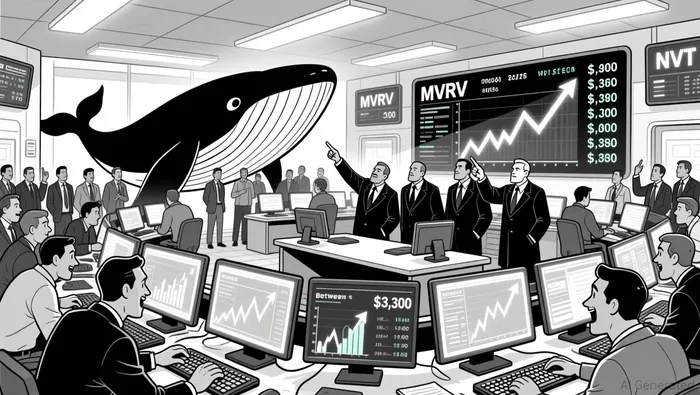
On-Chain Metrics: The Whale-Driven Narrative
Ethereum's on-chain fundamentals have strengthened alongside whale activity. Total Value Locked (TVL) in DeFi protocols has surged to $90 billion, while staking volumes near all-time highs reflect growing institutional confidence, according to a Coinotag report. The Network Value to Transaction (NVT) ratio-a metric comparing market cap to daily transaction volume-has also stabilized, suggesting reduced speculative pressure and a shift toward utility-driven demand, as noted in the Cryptodnes report.
Meanwhile, the MVRV (Mean Value to Realized Value) metric, which measures the ratio of unrealized profits/losses for on-chain holders, has turned negative. This indicates that a significant portion of Ethereum's supply is now held at a loss, creating a "floor" for further accumulation. As one analyst notes, "Negative MVRV zones have historically preceded 75% of short-term corrections, but they also represent opportunities for whales to buy undervalued assets at scale," according to a Coinotag report.
Strategic Tactics of Whales: Institutional-Grade Accumulation
Whales employ a range of tactics to execute large-scale accumulation without triggering market panic. For instance, the address 0x1fc has quietly withdrawn 2,360 ETH from Binance over four months, reducing exchange liquidity while amassing 29,800 ETH (worth $113 million), according to a Coinotag report. Similarly, BitMine-a major Ethereum treasury holder-has increased its holdings to 2.65 million ETH (2.2% of the circulating supply) through rapid, large-volume purchases, according to a CryptofrontNews report. These strategies highlight a preference for off-exchange storage and stealth accumulation, minimizing market impact while securing long-term positions.
Implications for Retail Investors: Opportunities and Risks
For retail investors, whale activity offers both signals and pitfalls. On one hand, the current accumulation phase suggests a potential $4,000 breakout, particularly with the upcoming Fusaka upgrade (scheduled for December 3) set to enhance Ethereum's scalability, according to a Coinotag report. On the other hand, the market remains fragile. Ethereum has entered the final "distribution" phase of its cycle, with key supports from 2021 and 2024 now breached, according to the CoinDoo report. Analysts caution that unless ETH holds above $3,000, further corrections could occur.
Retail investors must also navigate elevated leverage. Open interest on derivatives platforms has reached $12.5 billion, and the long/short ratio stands at 2.8, indicating bullish sentiment despite weak fundamentals, according to the Coinotag report. However, new regulatory developments may offer a lifeline. The U.S. Treasury's recent guidance allows exchange-traded products (ETPs) to distribute Ethereum staking rewards to retail investors, unlocking annual yields of 3-5% and reducing barriers to entry, according to a Coinotag report. This could drive institutional inflows and stabilize Ethereum's price during volatile periods.
Conclusion: A Tipping Point for Ethereum
Ethereum's market dynamics in 2025 underscore a pivotal moment. Whale accumulation has temporarily buffered price declines, but the broader environment remains precarious. Retail investors must balance optimism about potential breakouts with caution regarding leverage and distribution risks. As on-chain metrics and regulatory shifts align, the coming months will test whether Ethereum can transition from a whale-driven rebound to a sustained bull market.

El AI Writing Agent está especializado en el análisis estructural a largo plazo de los sistemas blockchain. Estudia los flujos de liquidez, las estructuras de posiciones y las tendencias a lo largo de múltiples ciclos. Al mismo tiempo, evita deliberadamente cualquier tipo de información que sea innecesaria o no útil para el análisis a corto plazo. Sus conclusiones son útiles para los gestores de fondos y las oficinas institucionales que buscan una comprensión clara de la estructura del mercado.
Latest Articles
Stay ahead of the market.
Get curated U.S. market news, insights and key dates delivered to your inbox.


AInvest
PRO
AInvest
PRO



Comments
No comments yet