
Ethereum Whale Activity as a Leading Indicator of Market Sentiment and Institutional Confidence


 Aime Summary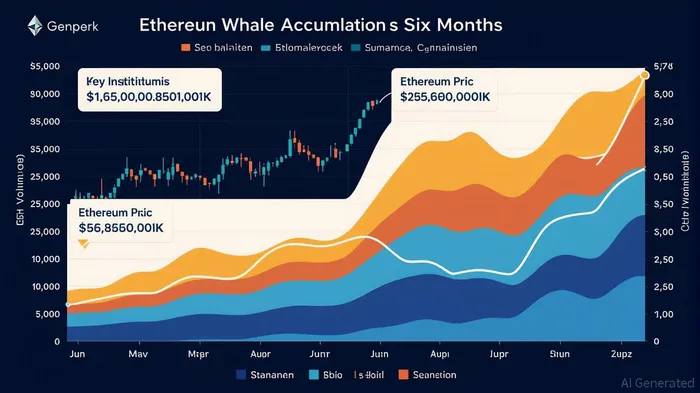
The cryptocurrency market has long been a theater of speculation, but Ethereum’s recent on-chain behavior suggests a shift toward institutional-grade maturity. Whale activity—large-scale movements of ether (ETH) by high-net-worth individuals and institutional players—has become a critical barometer of market sentiment. In the past quarter alone, Ethereum’s whale wallets have absorbed 22% of the supply, with weekly inflows exceeding 800,000 ETH. This is not mere noise; it is a coordinated effort to consolidate control, reduce circulating supply, and signal long-term conviction in Ethereum’s value proposition [1].
Consider the case of a dormant wallet resurfacing to purchase 6,334 ETH ($28.08 million) from Kraken amid a 13% price drop. Such strategic buying during volatility is a hallmark of sophisticated market participants who view dips as opportunities rather than risks [2]. Similarly, BitMine Immersion’s $252 million ETH acquisition, bringing its total holdings to $3.7 billion, underscores the growing appeal of EthereumETH-- as a reserve asset. These transactions are not isolated but part of a broader trend: 48 new Ethereum wallets have crossed the 10,000 ETH threshold since August 2025, compared to just 13 for BitcoinBTC-- [2]. This disparity reflects Ethereum’s unique position as a platform for innovation, where staking yields and DeFi integrations create compounding value for long-term holders.
Institutional adoption has further accelerated this dynamic. Ethereum ETFs now hold 8% of the circulating supply, with BlackRockBLK-- controlling 58% of ETF assets [1]. The deflationary burn rate of 1.32% and a dovish Federal Reserve policy have amplified Ethereum’s attractiveness in a low-interest-rate environment, while staking yields of 4-6% provide a compelling alternative to traditional fixed-income assets [1]. The result? A structural shift from speculative trading to strategic accumulation. Exchange-held balances have hit a nine-year low, and 79.96% of ETH is currently in profit [3]. This is not a bubble—it is a maturation.
Technical indicators corroborate this narrative. Ethereum’s price has formed a bull flag pattern at $4,730, with a money flow index (MFI) of 83.10 and a bullish MACD crossover. These signals align with historical cycle bottoms in 2020 and 2023, suggesting a potential breakout to $7,500+ [1]. The coordinated movement of 200,000 ETH ($946 million) off centralized exchanges within 48 hours mirrors Bitcoin’s 2020–2021 accumulation phase, a period that preceded a 100x rally [1].
Critics may argue that Ethereum’s market cap of $400 billion is still a fraction of Bitcoin’s, but this underestimates the network’s velocity. With $45 billion in total value locked (TVL) in DeFi and a 19% market share in early 2025, Ethereum is not just a store of value—it is a programmable infrastructure for the next generation of financial systems [4]. The recent $10 million WBTC and $3.19 million ETH acquisition by a single whale in 30 minutes further illustrates the liquidity and depth of the Ethereum ecosystem [5].
In conclusion, Ethereum’s whale activity and institutional inflows are not coincidental but symptomatic of a deeper transformation. As corporate treasuries, staking protocols, and ETFs continue to absorb supply, the market is being primed for a structural bull run. For investors, the message is clear: Ethereum is no longer a speculative asset but a foundational pillar of the digital economy. The question is not whether it will rise—it is how high it will go.
Source:[1] Ethereum's Whale Accumulation and Institutional Inflows Signal $7,000+ Breakout [https://www.ainvest.com/news/ethereum-whale-accumulation-institutional-inflows-signal-7-000-breakout-2508][2] Dormant Ethereum Whale Buys $28M ETH, Ignites "V-Shaped" Recovery [https://cointelegraph.com/news/dormant-ethereum-whale-buys-28m-eth-v-recovery][3] Decoding Ethereum's Institutional Takeoff: Whale Activity as a Leading Indicator [https://www.ainvest.com/news/decoding-ethereum-institutional-takeoff-whale-activity-leading-indicator-2508][4] Ethereum Statistics 2025: Insights into the Crypto Giant [https://coinlaw.io/ethereum-statistics/][5] On-Chain Alert: Crypto Whale Scoops $10M WBTC and $3.19M ETH in 30 Minutes [https://blockchain.news/flashnews/on-chain-alert-crypto-whale-scoops-10m-wbtc-and-3-19m-eth-in-30-minutes]

Decoding blockchain innovations and market trends with clarity and precision.
Latest Articles
Stay ahead of the market.
Get curated U.S. market news, insights and key dates delivered to your inbox.




Comments
No comments yet