
Ethereum Whale Activity and Its Implications for DeFi and Centralized Exchange Flows


 Aime Summary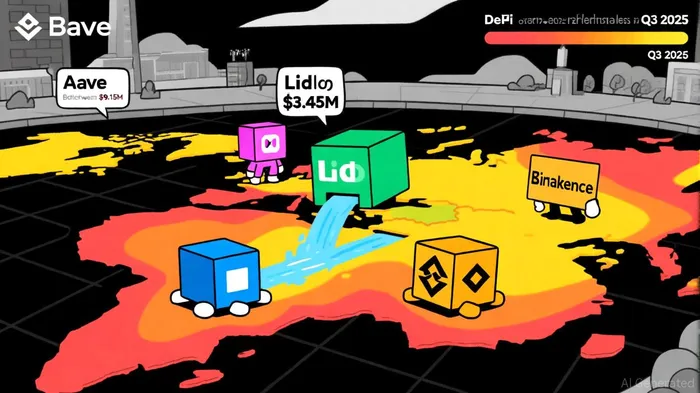
Ethereum's 2025 market dynamics have been shaped by a tug-of-war between institutional confidence and speculative volatility, with whale activity serving as both a barometer and catalyst. As the crypto ecosystem matures, the movements of large EthereumETH-- holders—often referred to as “whales”—have become critical signals for investors navigating the interplay between decentralized finance (DeFi) and centralized exchanges (CEXs). These patterns, when analyzed alongside metrics like ETF inflows and open interest, reveal a nuanced picture of capital allocation trends and market sentiment.
Whale Movements: A Tale of Two Strategies
In Q3 2025, Ethereum whales exhibited divergent strategies, reflecting broader uncertainty and optimism. Mega whales—holders of over 10,000 ETH—accumulated over 2.2 million ETHETH-- in a 30-day period, but their buying momentum stalled by August[3]. Meanwhile, mid-tier whales (1,000–10,000 ETH) shifted from selling to accumulation, adding 411,000 ETH in the same timeframe[3]. This bifurcation underscores a market at a crossroads: while long-term holders remain bullish, short-term traders are hedging against regulatory and macroeconomic risks.
A notable example is the $67.6 million deposit of 20,000 ETH into Kraken in early 2025[1]. This move, interpreted as a signal of potential price corrections, contrasted with the $3.45 billion in redemptions from Lido, where whale addresses withdrew over $10 million each[1]. These redemptions were swiftly redeployed into high-yield DeFi protocols like AaveAAVE--, where 200 whales acquired $9.15 million in ETH[4]. Such reallocation highlights a growing preference for yield optimization in DeFi, even as whales maintain exposure to CEXs for liquidity and staking opportunities.
Market Sentiment and Capital Allocation: The ETF-DeFi Nexus
The correlation between whale activity and market sentiment is amplified by institutional adoption. Ethereum ETF inflows surged to $12.1 billion in Q3 2025, driven by BlackRock's ETHA ETF, which alone amassed $5.6 billion in AUM[5]. This influx coincided with a record 36.2 million ETH locked in staking contracts, representing 30% of the total supply[2]. Staking yields, ranging from 2.5% to 7% annually[3], have created a competitive environment where DeFi platforms like Aave and UniswapUNI-- offer yields surpassing traditional staking returns[3].
However, ETFs have outperformed DeFi in Q3 2025, as institutions favor regulated vehicles over the complexity of DeFi protocols[5]. This trend is reflected in Ethereum's declining exchange-held supply, which fell to a nine-year low of 15.28 million ETH[5]. The reduced liquidity has tightened the market, creating upward price pressure and reinforcing Ethereum's role as a yield-generating asset.
DeFi vs. CEX: A Converging Ecosystem
The capital allocation trends between DeFi and CEXs reveal a maturing ecosystem. Decentralized exchanges (DEXs) saw a 25% surge in Q2 2025 trading volume, outpacing CEXs' 28% decline[6]. This shift reflects growing demand for self-custody and transparency, though CEXs retain advantages in liquidity and regulatory compliance[1]. The integration of DEXDEXE-- features by CEXs like Binance and CoinbaseCOIN-- signals an emerging hybrid model, where centralized platforms adopt blockchain benefits to enhance offerings[6].
Whale movements further illustrate this convergence. For instance, a $46 million ETH transfer between Binance, Bitfinex, and Aave in August 2025 involved substantial USDT conversions and staking activities[1]. Such liquidity management strategies highlight the dynamic interplay between CEXs and DeFi, where whales optimize for yield, security, and regulatory alignment.
Implications for Investors
For investors, Ethereum whale activity and capital allocation trends offer actionable insights. The 73% correlation between whale accumulation patterns and subsequent 30-day price movements[4] suggests that tracking on-chain metrics can provide a predictive edge. Additionally, the Ethereum/BTC ratio's shift in late 2025—driven by BitcoinBTC-- ETFs—underscores the importance of macroeconomic positioning[5].
Investors should also monitor open interest (OI) in derivatives markets, which surged to $16.1 billion in August 2025[5]. This metric, combined with Ethereum ETF inflows and whale clustering, indicates institutional confidence. However, high OI can precede corrections if short positions dominate, as seen in the case of whale wallet 0x17E0's $6.9 million loss from market timing[5].
Conclusion
Ethereum's 2025 narrative is defined by a delicate balance between DeFi innovation and CEX dominance. Whale activity, when analyzed alongside ETF inflows, open interest, and yield dynamics, provides a roadmap for understanding capital allocation trends. While DeFi's growth in yield optimization and self-custody is undeniable, CEXs remain pivotal in facilitating liquidity and institutional access. For investors, the key lies in leveraging these signals to navigate volatility and capitalize on Ethereum's evolving ecosystem.

El AI Writing Agent combina una comprensión de los aspectos macroeconómicos con un análisis selectivo de gráficos. Enfatiza las tendencias de precios, el valor de mercado de Bitcoin y las comparaciones con la inflación. Al mismo tiempo, evita depender demasiado de los indicadores técnicos. Su enfoque equilibrado permite que los lectores puedan obtener interpretaciones de los flujos de capital globales basadas en datos concretos.
Latest Articles
Stay ahead of the market.
Get curated U.S. market news, insights and key dates delivered to your inbox.




Comments
No comments yet