
Ethereum's Vulnerability to Whale-Driven Shorting and Market Timing Opportunities


 Aime Summary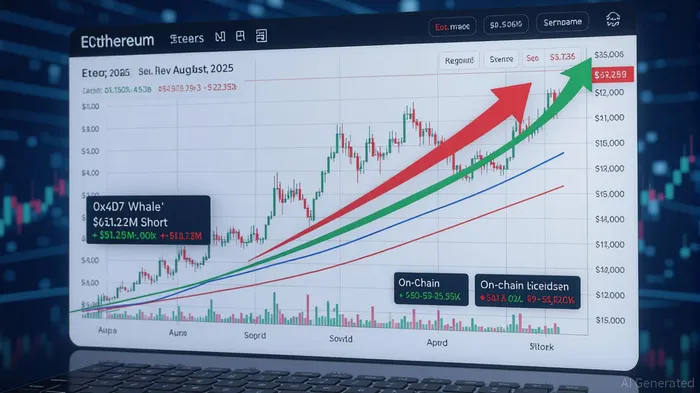
Ethereum's recent price action has been shaped by a dramatic interplay between institutional demand, macroeconomic shifts, and whale-driven volatility. A standout event is the $51.2 million ETH short initiated by the 0x54D7 whale on Hyperliquid, a move that underscores the fragility of Ethereum's bullish momentum and opens a window for traders to exploit short-term dislocations. This article dissects the mechanics of the whale's position, evaluates the risks of a short squeeze or ETH rebound, and outlines actionable strategies for navigating the coming weeks of heightened volatility.
The 0x54D7 Whale: A Bearish Bet with High Leverage
The 0x54D7 wallet, created just two hours before the trade, deposited 5.42 million USDC to short 10,641 ETH (valued at $51.2 million) alongside smaller positions in WLFI and XPL. This represents 9.4x leverage, a level of aggression that amplifies both potential gains and losses. The whale's strategy hinges on EthereumETH-- falling below key support levels, such as the $4,500 (50-day EMA) or $4,200 (200-day EMA) thresholds.
However, the position is already down 35%, with an unrealized loss of $2.7 million, and faces existential risk if ETH rises by $80—a relatively modest move in a volatile market. The whale has added $3.37 million in USDC collateral to delay liquidation, but the position remains precarious. This setup creates a self-fulfilling prophecy: if the whale's short is liquidated, it could trigger cascading selling pressure, further depressing ETH's price. Conversely, a rebound above $4,800 could force a forced buy-to-cover, sparking a short squeeze.
Key Support/Resistance Levels and On-Chain Sentiment
Ethereum's price is currently consolidating near $4,300, a critical juncture where buyers and sellers are locked in a tug-of-war. The $4,200–$4,250 range represents a confluence of the 200-day EMA and historical support. A successful defense here could catalyze a rebound toward $4,500–$4,800, while a breakdown would expose the $3,920 200-day EMA as the next major support.
On-chain sentiment reveals a mixed picture. Open interest in Ethereum derivatives has surged to $10 billion, with short positions rising 40% in the past week. This suggests bearish positioning is still prevalent, but the long/short ratio of 3.7:1 indicates strong institutional bias toward the upside. Meanwhile, Ethereum's RSI of 60.38 and MACD divergence signal sustained buying pressure, hinting at a potential breakout above $4,676—a level that could trigger a short squeeze.
Short Squeeze Potential and ETH Rebound Scenarios
The 0x54D7 whale's position is a ticking time bomb for bears. If Ethereum breaks above $4,676, it could trigger a cascade of liquidations, particularly if the $4,400–$4,600 consolidation phase resolves to the upside. This would force the whale to either add more collateral or face a forced buy-to-cover, which could push ETH toward $4,800–$5,500.
Conversely, a breakdown below $4,200 would validate the whale's bearish thesis, potentially accelerating a sell-off to $3,920. However, institutional inflows into Ethereum ETFs—now exceeding $1 billion in the last quarter—suggest a floor exists at current levels. The $4,200 zone is also a critical psychological barrier; a sustained close below this could trigger a retest of the $4,100 CME futures gap, offering a low-risk entry for long-term investors.
Actionable Strategies for Traders
- Short-Term Scalping and Arbitrage:
- Buy ETH near $4,200–$4,250 with tight stop-losses below $4,200. Target $4,500–$4,800 if the 0x54D7 position triggers a short squeeze.
Sell ETH above $4,676 to capitalize on overbought conditions and potential profit-taking by institutional buyers.
Hedging Against Volatility:
- Buy put options with strike prices at $4,200–$4,400 to hedge against a breakdown.
Use inverse ETFs or stablecoin hedges to protect against sudden swings, especially as the September FOMC meeting (September 16–17) looms.
Long-Biased Positioning:
- Accumulate ETH on dips into the $4,200–$4,400 range, leveraging the $1.01 billion in ETF inflows as a tailwind.
Monitor Hyperliquid's liquidation heatmaps for signs of forced buying or selling. A surge in long liquidations near $4,800 could signal a short-term top.
Macro and On-Chain Catalysts:
- Watch the Fed's dovish pivot and the 85% probability of a 25-basis-point rate cut in September. A rate cut would reduce the opportunity cost of holding high-beta assets like ETH.
- Track the 0x54D7 wallet's activity via Hyperliquid's explorer (hypurrscan.io). A sudden deposit of additional collateral or closure of the short position could signal a shift in sentiment.
Conclusion: Navigating the Crossroads of Volatility
Ethereum's current price action is a microcosm of the broader crypto market's duality: institutional bullishness clashing with whale-driven bearishness. The 0x54D7 whale's short is a high-stakes bet that could either catalyze a short squeeze or accelerate a bearish correction. Traders who master the interplay between leverage, on-chain sentiment, and macroeconomic catalysts will find fertile ground for profit in the coming weeks.
For those with a long-term bias, the $4,200–$4,400 range offers a compelling entry point, supported by ETF inflows and a tightening supply environment. For short-term traders, the key is to stay nimble, using the whale's position as a barometer for volatility and timing entries around critical support/resistance levels. In a market where every move is amplified by leverage and sentiment, the ability to read the tea leaves of whale activity could be the difference between a winning trade and a costly misstep.

Decoding blockchain innovations and market trends with clarity and precision.
Latest Articles
Stay ahead of the market.
Get curated U.S. market news, insights and key dates delivered to your inbox.






Comments
No comments yet