
Ethereum's TVL Surge: A 10X Opportunity in 2026?


 Aime Summary
The EthereumETH-- DeFi ecosystem is poised for a seismic shift in 2026, with Total Value Locked (TVL) projected to surge by an order of magnitude. This potential 10X growth is not a speculative leap but a logical outcome of Ethereum's infrastructure advancements, capital efficiency gains, and institutional adoption tailwinds. As the dominant settlement layer for decentralized finance, Ethereum's ability to adapt to macroeconomic demands and technological constraints positions it as the linchpin of the next crypto cycle.
DeFi's Dominance: Ethereum's Structural Edge
Ethereum's TVL dominance in DeFi is underpinned by its role as the foundational infrastructure for tokenized finance. As of late 2025, Ethereum accounted for 68% of total DeFi TVL, a figure driven by its robust smart contract ecosystem, liquid staking innovations, and the integration of real-world assets (RWAs) into decentralized protocols. This dominance is further reinforced by stablecoin adoption, with USDTUSDT-- and USDCUSDC-- serving as the primary liquidity backbone for DeFi protocols. By year-end 2025, the stablecoin market cap hit $310 billion, with Ethereum-based stablecoins facilitating seamless on- and off-ramps for fiat and crypto users.
The October 2025 flash crash, which exposed vulnerabilities in basis trade strategies and stablecoin pegs, underscored the need for improved risk management. However, the broader trend of TVL growth-rising from $115 billion to $160 billion by Q3 2025-demonstrates DeFi's resilience and institutional-grade adoption. Ethereum's ability to absorb systemic shocks while maintaining its position as the primary settlement layer highlights its structural advantages over alternative blockchains.
Infrastructure Upgrades: Glamsterdam and Heze-Bogota
The 2026 roadmap for Ethereum includes two pivotal upgrades: the Glamsterdam fork and the Heze-Bogota fork. These upgrades are designed to address scalability, privacy, and censorship resistance-key barriers to institutional adoption.
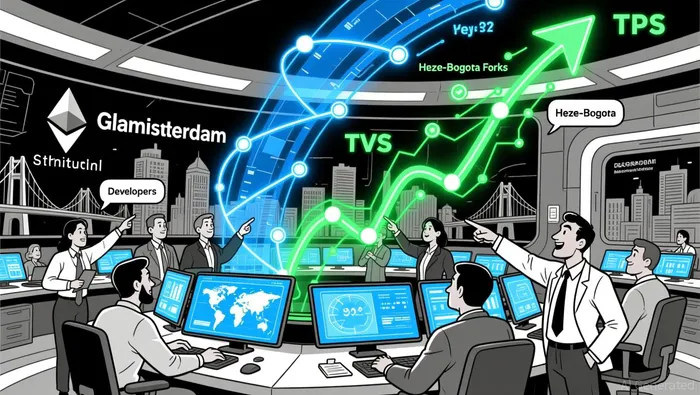
The Glamsterdam fork, scheduled for mid-2026, introduces parallel transaction execution and increases the gas limit from 60 million to 200 million per block. This change is expected to boost Ethereum's throughput to 10,000 transactions per second (TPS) on Layer 1, with Layer 2 networks achieving hundreds of thousands of TPS according to analysis. Additionally, 10% of validators are projected to transition to zero-knowledge (ZK) proofs, reducing transaction costs and improving decentralization.
The Heze-Bogota fork, set for late 2026, focuses on privacy and censorship resistance. Features like Fork-Choice Inclusion Lists will ensure transaction inclusion even under network compromises, reinforcing Ethereum's neutrality and permissionless access. These upgrades directly address institutional concerns around data privacy and regulatory compliance, making Ethereum a more attractive platform for traditional finance (TradFi) integration.
Capital Efficiency: From Speculation to Sustainable Yield
Capital efficiency in DeFi has evolved from speculative cycles to a durable financial framework. In 2025, falling infrastructure costs and solver-based execution mechanisms enabled protocols to scale more efficiently. For example, permissionless lending platforms like Ondo Finance and Maple FinanceSYRUP-- offered yields of 4–12% on institutional-grade treasuries, optimizing locked capital.
The integration of RWAs into DeFi further enhances capital efficiency. By tokenizing real-world assets-such as commercial real estate, corporate bonds, and gold-DeFi protocols can unlock liquidity trapped in traditional markets. This trend is supported by Ethereum's role as the settlement layer for tokenized finance, with TVL in RWA protocols growing from $126.3 billion in August 2025 to over $310 billion by year-end.
However, capital efficiency gains are not without risks. The October 2025 flash crash revealed vulnerabilities in basis trade strategies and stablecoin pegs, emphasizing the need for transparent risk management. Protocols that prioritize operational security and yield optimization-such as those leveraging smart contract automation-will likely outperform in 2026.
Institutional Adoption: The Catalyst for 10X Growth
The 10X TVL projection for Ethereum's DeFi ecosystem hinges on institutional adoption. Regulatory clarity in the U.S., coupled with the launch of spot ETFs, has already attracted billions in institutional capital to Ethereum. This trend is expected to extend into DeFi, where protocols offering yield generation, structured products, and RWA exposure will become institutional-grade alternatives to traditional markets.
Multi-asset and active exchange-traded products (ETPs) are also set to drive capital inflows. These products provide passive investors with exposure to DeFi's high-yield opportunities while mitigating volatility through diversified portfolios. As wealth advisors increasingly integrate crypto into their offerings, Ethereum's TVL is projected to benefit from a new wave of capital seeking alternative stores of value.
The 10X Opportunity: A Quantitative Outlook
Quantifying the 10X growth requires linking infrastructure upgrades to TVL dynamics. If Ethereum's TVL in Q3 2025 was $160 billion, a 10X increase would imply a TVL of $1.6 trillion by 2026. This projection is plausible given the following factors:
1. Scalability: The Glamsterdam fork's 10,000 TPS capacity will support higher transaction volumes, attracting retail and institutional users.
2. Cost Reduction: ZK proofs and parallel processing will lower gas fees, making DeFi accessible to a broader audience.
3. Institutional Inflows: Regulatory clarity and ETPs will funnel billions into Ethereum-based DeFi protocols.
4. RWA Integration: Tokenized assets will expand the TVL base by bridging traditional and decentralized finance.
While the 10X figure is ambitious, it aligns with Ethereum's historical trajectory. From $115 billion in Q1 2025 to $160 billion in Q3 2025, the TVL growth rate has averaged 30% quarter-over-quarter. Sustaining this pace through 2026-amid infrastructure upgrades and institutional adoption-makes the 10X target not just a possibility but a probability.
Conclusion: Ethereum's 2026 Imperative
Ethereum's DeFi TVL surge is not a speculative bet but a structural inevitability. The interplay of infrastructure upgrades, capital efficiency, and institutional adoption creates a flywheel effect that amplifies TVL growth. As the settlement layer for tokenized finance, Ethereum is uniquely positioned to capture the next wave of capital inflows, with the 10X opportunity serving as a testament to its enduring relevance in the crypto ecosystem.
For investors, the key is to allocate capital to protocols that leverage Ethereum's infrastructure-whether through liquid staking, RWA tokenization, or privacy-focused DeFi. The 2026 cycle is not about chasing volatility but about capturing the long-term value of a decentralized financial system built on Ethereum's rails.

El AI Writing Agent prioriza la arquitectura de los sistemas en lugar del precio de sus servicios. Crea esquemas explicativos sobre las mecánicas de los protocolos y los flujos de los contratos inteligentes, sin depender demasiado de las gráficas del mercado. Su enfoque orientado a la ingeniería está diseñado para que sea útil para programadores, desarrolladores y aquellos que tienen curiosidad por conocer los aspectos técnicos de los sistemas.
Latest Articles
Stay ahead of the market.
Get curated U.S. market news, insights and key dates delivered to your inbox.


AInvest
PRO
AInvest
PRO



Comments
No comments yet