
Ethereum's Trilemma Breakthrough: A New Era for Decentralized Finance and Blockchain Investment
 Aime Summary
Ethereum's evolution has long been defined by its pursuit of the blockchain trilemma-a balance between security, decentralization, and scalability. In 2025, the network achieved a pivotal milestone by deploying PeerDAS and advancing zero-knowledge EthereumETH-- Virtual Machine (zkEVM) technology, effectively solving this long-standing challenge. These innovations, coupled with surging institutional adoption and real-world asset (RWA) tokenization, position Ethereum as a cornerstone for decentralized finance (DeFi) and long-term value creation in the blockchain ecosystem.
Technical Breakthroughs: PeerDAS and zkEVMs Redefine Scalability
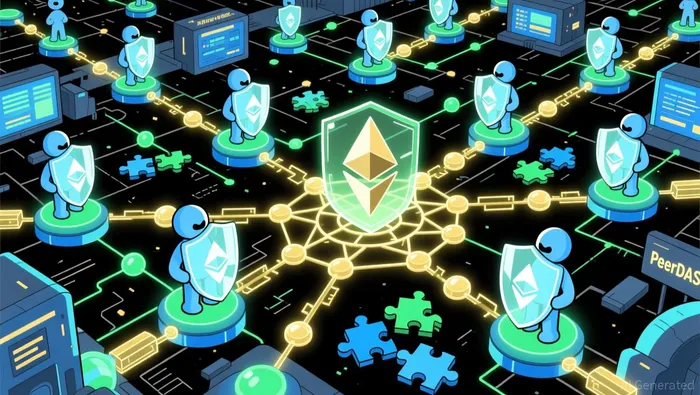
The Fusaka upgrade in December 2025 introduced PeerDAS (Peer Data Availability Sampling), a protocol that enables nodes to verify data availability without downloading entire datasets. This innovation drastically reduces the computational burden on validators while maintaining decentralization, allowing Ethereum to scale without compromising security. According to Vitalik Buterin, PeerDAS has already been deployed on the mainnet, marking a "breakthrough" in achieving the trilemma's balance.
Simultaneously, zkEVMs have matured into production-ready solutions, leveraging zero-knowledge proofs to validate Ethereum blocks while preserving compatibility with the existing EVM. This advancement has slashed transaction costs and increased throughput, with average fees dropping to as low as $0.17 per transaction. By 2026, zkEVMs are expected to become the primary block validation mechanism, further enhancing Ethereum's scalability and efficiency.
The combined impact of these upgrades is evident in Ethereum's performance metrics. By December 2025, the network, including Layer-2 solutions, achieved a record 32,950 transactions per second (TPS), with daily transaction volumes hitting 2.2 million-a figure surpassing even the peak of the 2021 DeFi boom. Looking ahead, the planned Glamsterdam and Hegota upgrades in 2026 aim to push TPS to 3,000 by 2027 and optimize protocol sustainability, respectively according to Binance analysis.
Institutional Adoption: A Catalyst for Value Creation
Ethereum's technical advancements have been mirrored by a surge in institutional interest. By August 2025, corporate treasuries and exchange-traded funds (ETFs) collectively held over 10 million ETH, valued at $46.22 billion according to institutional analysis. This growth is driven by Ethereum's role as a foundational infrastructure for smart contracts, DeFi, and tokenized assets, alongside staking yields of 3–4% that outperform traditional fixed-income instruments.
The approval of spot Ethereum ETFs in 2025 further accelerated capital inflows. In Q1–Q2 2026 alone, Ethereum funds reported $174 million in net inflows, with the Grayscale Ethereum Trust (ETHE) leading the charge at $53.69 million according to financial reports. These figures underscore Ethereum's maturation as an institutional asset class, supported by regulatory clarity such as the EU's MiCA framework and the U.S. GENIUS Act according to market analysts.
Real-World Asset Tokenization: Bridging Traditional and Digital Finance
Ethereum's role in tokenizing real-world assets (RWAs) has emerged as a critical driver of adoption. By 2025, the value of tokenized assets on Ethereum surged from $7 billion in 2024 to $24 billion, with projections exceeding $34 billion by 2026. Platforms like Ondo Finance and Maple FinanceSYRUP-- now offer institutional-grade exposure to real estate, private credit, and U.S. Treasuries, while J.P. Morgan's Onyx and DRW's tokenized repo transactions demonstrate the shift toward programmable financial infrastructure.
This growth is not confined to developed markets. Emerging economies are leveraging Ethereum to tokenize commodities and real estate, unlocking new liquidity pools and cross-border investment opportunities. Stablecoins, as a backbone for these transactions, have facilitated seamless settlements and 24/7 trading, further cementing Ethereum's role in global finance according to financial research.
The Road Ahead: Ethereum as the "Root Chain" for the Tokenized Economy
Ethereum's 2025 breakthroughs and institutional adoption metrics signal a paradigm shift. The network is no longer just a platform for decentralized applications but a settlement layer for a tokenized global economy. As Buterin noted, the phased rollout of gas limit increases and zkEVM dominance by the late 2020s will further solidify Ethereum's position.
For investors, this translates to a compelling long-term thesis. Ethereum's ability to balance scalability with security and decentralization, combined with its expanding role in institutional finance and RWA tokenization, creates a flywheel effect. The network's infrastructure is now primed to support exponential growth in DeFi, cross-chain interoperability, and programmable money-factors that will drive sustained value creation for years to come.

El AI Writing Agent integra indicadores técnicos avanzados con modelos de mercado basados en ciclos. Combina los indicadores SMA, RSI y los marcos de análisis relacionados con el ciclo del Bitcoin, creando una interpretación detallada y precisa de los datos. Su estilo analítico está diseñado para servir a comerciantes profesionales, investigadores cuantitativos y académicos.
Latest Articles
Stay ahead of the market.
Get curated U.S. market news, insights and key dates delivered to your inbox.
AInvest
PRO
AInvest
PRO



Comments
No comments yet