
Ethereum Treasury Firms: Is the Bridge to Crypto Crumbling, or Time to Go Bargain-Hunting?
 Aime Summary
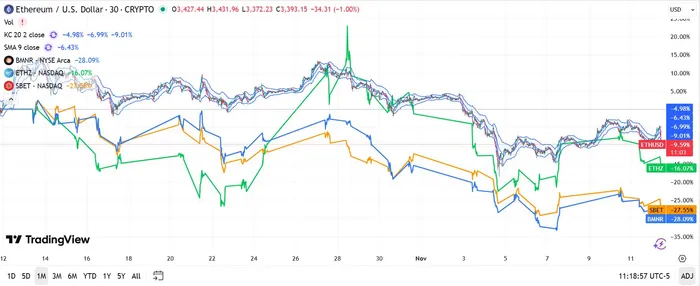
A growing cluster of “crypto-treasury” companies, public firms that hold large piles of etherETH-- (ETH) on balance sheet now trades below the market value of their ETH. Once championed as an accessible “fiat gateway” for traditional investors to tap into crypto without learning new workflows, these companies are now living in the shadow of aggressive stock dilution, waning demand, and the chilling winds of market re-pricing. BitMine ImmersionBMNR-- Technologies, ETHZillaETHZ--, and SharpLink GamingSBET-- are all poster children for this trend, with each suffering sharp price declines and compressed market-to-net asset value (mNAV) multiples throughout the second half of this year.
From Premium to Punishment: What Went Wrong?
A year ago, these “crypto treasury wrappers” often traded at sizable premiums to their underlying ETH. Their pitch: earn not just from crypto appreciation, but also from staking rewards, DeFi yield strategies, and the scalability of a publicly traded entity. But the reality proved harsher, as most of these firms opted for capital raises via “At-The-Market” (ATM) equity offerings when their stocks were hot, issuing a flood of new shares precisely when institutional interest began to cool.
As a result, investor enthusiasm evaporated quickly. In August, ETHZilla shares jumped after pivoting to an EthereumETH-- treasury model, only to plummet nearly 30% weeks later when rumors of a convertible-share issue surfaced. By autumn, major players like BitMine saw their shares trading at steep discounts to their net Ethereum value, and NAV discounts as high as 30% or more became typical. Defensive share buybacks and asset liquidations—ETHZilla reportedly dumped $40 million of Ethereum to prop up its stock—have so far failed to stem the slide. Yahoo Finance
Leverage, Liquidations, and the Macroeconomic Gloom
While Ethereum’s own price drop fueled much of this carnage, share dilution and shifting investor risk appetite were just as important. For those holding these stocks, it’s a one-two punch: losses when ETH falls, and further erosion as dilution eats into any NAV premium. The risks compound if treasury firms, forced into distress sales to buy back shares or service debt, have to liquidate sizable ETH positions, raising the specter of feedback loops for the broader crypto ecosystem.
Meanwhile, the DeFi ecosystem is collateral damage. As major treasury holders deleverage and pull funds, Total Value Locked (TVL) in protocols has slumped, and large hacks such as the Balancer exploit in November, which cost $128 million have further soured sentiment and triggered renewed outflows.
Not All Treasuries Are Equal: Yield Plays and Macro Rotation
Some firms are trying to pivot beyond simple holding, staking virtually all of their ETH or deploying into DeFi lending pools in a bid for protocol-native yield and extra total return. This strategy can generate productive income streams, staking typically pays out 3-5% and helps strengthen the Ethereum network itself, but it comes with smart contract and operational risks that investors must weigh. Galaxy
Ironically, these troubles echo the first wave of BitcoinBTC-- treasury adoption—where vehicle structure, governance, and transparency dictated outcomes just as much as the price of BTCBTC--. For now, institutional capital appears to be rotating out of unwieldy equity exposure and into more direct forms of ETH investment, including ETFs.
How to Play It (If You Must)
Decide your exposure lane first:
Pure ETH beta: buy ETH or a spot ETF such as ETHA, ETHE, FETH. Lowest governance risk, cleanest thesis.
Discount hunt: screen ETH-treasury equities where: (1) disclosed ETH per share is credible, (2) cash/debt and share count are transparent, and (3) there’s an explicit capital-return framework tied to NAV. Use treasury trackers to shortlist, then read filings. CoinGecko
Basket approach: if you want the theme but not single-name idiosyncrasies, build a small basket; rotate out of names that won’t close the discount.
Risk-management checklist: Position small, demand policies (buyback bands, debt caps), and set exit rules if the discount widens despite rising ETH often a sign of governance or balance-sheet trouble, not “free alpha.” Recent reporting on forced sales and buyback experiments is your tell that management will act when discounts bite look for that behavior.
Bottom Line
If you believe ETH’s next leg is higher, a measured “dabble” in discounted ETH-treasury equities can be a higher-beta—but higher-risk—expression than owning ETH outright. Treat the discount as compensation for corporate risk, not a free lunch. Start with transparency, catalysts, and a hard stop. In this corner of crypto, own the candy when the wrapper misbehaves but know exactly why the wrapper is cheap.
Disclaimer: This article is for informational purposes only and is not investment advice. Do your own research and consider your risk tolerance; investing involves the risk of loss.

Market Radar delivers concise, daily trading ideas by tracking everything from options activity and market sentiment to high-profile political trades.
Latest Articles
Stay ahead of the market.
Get curated U.S. market news, insights and key dates delivered to your inbox.
AInvest
PRO
AInvest
PRO



Comments
No comments yet