
Ethereum's Testnet Evolution: Strategic Implications for Pectra Readiness and Validator Infrastructure


 Aime Summary
Ethereum’s ongoing technical evolution has positioned it as a cornerstone of the blockchain ecosystem, with its recent testnet transitions and protocol upgrades offering a compelling investment case for early adopters. The Pectra upgrade, activated in May 2025, and the subsequent shift from Holesky to Hoodi testnets, reflect a strategic focus on scalability, validator efficiency, and institutional adoption. These developments not only address historical bottlenecks but also create a foundation for sustained growth in decentralized finance (DeFi) and enterprise applications.
Testnet Evolution: From Holesky to Hoodi
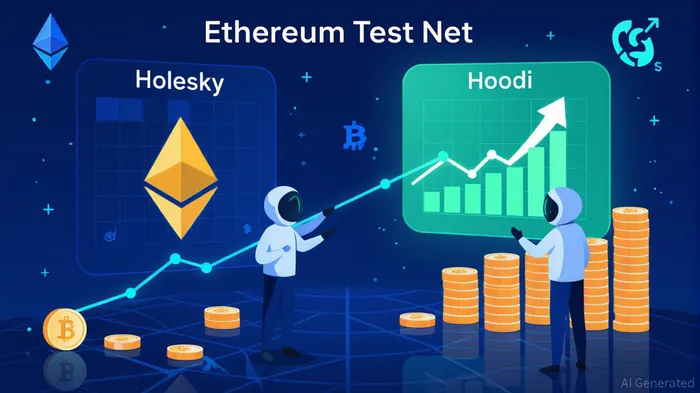
Ethereum’s testnet landscape underwent a critical transformation in 2025. The decommissioning of Holesky—a testnet plagued by inactivity leaks and validator exit bottlenecks—marked the end of an era. In its place, Hoodi emerged as a more stable and modular testnet, designed to support the Pectra and upcoming Fusaka upgrades [1]. Hoodi’s architecture includes 11 EthereumETH-- Improvement Proposals (EIPs) critical for Fusaka, ensuring smoother testing of validator infrastructure and data availability mechanisms [3]. This transition underscores Ethereum’s commitment to aligning testnet environments with real-world operational demands, reducing risks for developers and investors alike.
The Pectra upgrade itself introduced groundbreaking changes, including EIP-7251, which allows validators to stake between 32 and 2,048 ETH, streamlining operations and improving profitability [3]. By doubling blob throughput (EIP-7691), Pectra also enhanced Layer 2 scalability, reducing transaction costs for rollups like Arbitrum and OptimismOP-- [3]. These improvements directly benefit investors by lowering barriers to entry for DeFi participation and enterprise adoption.
Validator Infrastructure: Efficiency and Resilience
Validator performance metrics highlight Ethereum’s operational maturity. As of Q2 2025, the average uptime of validators stood at 99.2%, with Figment reporting a 99.9% participation rate, driven by robust infrastructure and slashing avoidance strategies [4]. The Pectra upgrade further accelerated this trend by reducing validator activation time from 12 hours to 13 minutes via EIP-6110 [3]. Such efficiency gains are critical for institutional investors seeking reliable staking returns.
The migration from MEV-Boost to Commit-Boost in August 2025 further illustrates Ethereum’s focus on modular infrastructure. Commit-Boost streamlines block-building processes, enhancing security and operational efficiency for validators [4]. This shift not only prepares the network for future upgrades but also reduces the technical complexity for new entrants, broadening the staking ecosystem.
Investment Case: Capitalizing on Network Upgrades
The Pectra and Fusaka upgrades have catalyzed a surge in Ethereum’s staking economy. Total value locked (TVL) in restaking protocols reached $86 billion by Q3 2025, with EigenLayer alone securing $15 billion [2]. This growth is fueled by institutional capital flowing into Ethereum ETFs and liquid staking derivatives, leveraging the network’s deflationary supply model and efficiency gains [1].
For early adopters, the key opportunities lie in:
1. Scalability-Driven Demand: Pectra’s blob throughput enhancements and Fusaka’s gas limit increases have reduced Layer 2 fees by 53% quarter-over-quarter, boosting TVS to $16.28 billion [2].
2. Validator Flexibility: The ability to stake larger ETH amounts (up to 2,048 ETH) lowers operational costs and attracts institutional players [3].
3. Institutional Adoption: Ethereum’s regulatory clarity and infrastructure upgrades have made it a preferred asset for institutional portfolios, with staked ETH growing 4% QoQ to 35.7 million (29.6% of supply) [3].
However, risks persist. The validator exit queue reached an all-time high of 875,000 ETH, raising concerns about sell pressure [5]. Yet, this liquidity is offset by a parallel surge in entries, indicating a dynamic but resilient ecosystem [5]. The shift to liquid restaking also allows validators to optimize yields across DeFi protocols, mitigating risks associated with static staking.
Conclusion
Ethereum’s testnet evolution and protocol upgrades have created a robust foundation for long-term value creation. The Pectra and Fusaka upgrades, coupled with institutional adoption and validator efficiency gains, present a compelling investment case for early adopters. While challenges like exit queues and market volatility remain, the network’s technical resilience and scalability advantages position it as a strategic asset in the digital economy. Investors who align with Ethereum’s roadmap are likely to benefit from its continued dominance in the blockchain space.
Source:
[1] Ethereum to Shut Down Holešky, Its Largest Testnet Ever,
https://www.cryptoninjas.net/news/ethereum-to-shut-down-holesky-its-largest-testnet-ever/
[2] Ethereum's Staking Renaissance: How Yield Innovation,
https://www.ainvest.com/news/ethereum-staking-renaissance-yield-innovation-institutional-adoption-reshaping-crypto-landscape-2508/
[3] Ethereum Developers Activate Pectra Upgrade with 11 Changes to ...
https://www.theblock.co/post/353407/ethereum-pectra-upgrade
[4] We migrated our Ethereum infrastructure from MEV-Boost to Commit-Boost,
https://stakely.io/blog/we-migrated-our-ethereum-infrastructure-from-mev-boost-to-commit-boost

Decoding blockchain innovations and market trends with clarity and precision.
Latest Articles
Stay ahead of the market.
Get curated U.S. market news, insights and key dates delivered to your inbox.






Comments
No comments yet