
Ethereum's Supply Dynamics and Whale Accumulation: A Case for Strategic Entry Amid Structural Scarcity


 Aime Summary
Ethereum's 2025 price trajectory is increasingly shaped by a confluence of structural scarcity and macroeconomic tailwinds. The post-Merge transition to proof-of-stake, combined with EIP-1559's burn mechanism, has created a deflationary environment that has historically removed over $10 billion in ETH supply. Meanwhile, whale accumulation patterns and institutional demand are reinforcing Ethereum's narrative as a foundational asset in both on-chain and traditional financial ecosystems. For investors, these dynamics present a compelling case for strategic entry.
Structural Scarcity: The Burn Rate and Issuance Revolution
Ethereum's issuance has plummeted by over 90% since the Merge, while EIP-1559's burn mechanism has amplified net supply destruction. By late 2025, on-chain activity driven by a 22% surge in active addresses and 16% higher monthly transaction volume has further accelerated this trend. This deflationary flywheel is not merely theoretical: Ethereum's exchange-held supply has shrunk by 45% to 10.2 million ETH, reducing immediate selling pressure and heightening the risk of a supply shock.
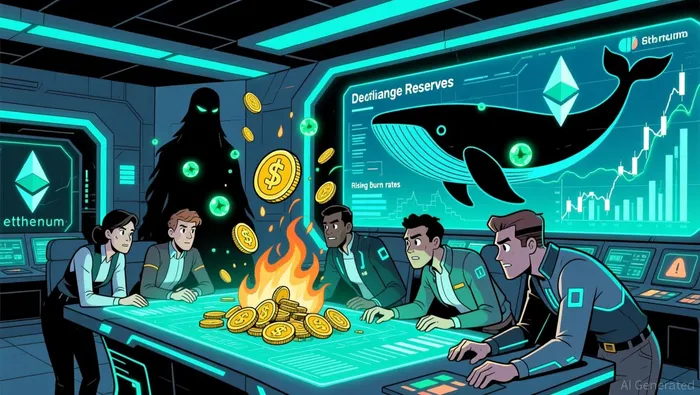
The implications are clear. With issuance and exchange liquidity dwindling, Ethereum's circulating supply is becoming increasingly constrained. This scarcity is compounded by whale accumulation, where large holders have acquired 22 million ETH over six months, particularly during price dips. Such behavior signals confidence in Ethereum's long-term value proposition, even as short-term volatility persists.
Macroeconomic Positioning: Institutions and the Yield Premium
Ethereum's macroeconomic appeal lies in its dual role as infrastructure and a yield-generating asset. By late 2025, corporate treasuries and ETFs collectively hold over 10 million ETH, valued at $46.22 billion, reflecting a strategic shift in institutional portfolios. Staking yields of 3–4% annualized make EthereumETH-- an attractive alternative to traditional fixed-income assets, particularly in a low-interest-rate environment.
This institutional adoption is further accelerated by regulatory clarity. The approval of spot Ethereum ETFs has unlocked $10.75 billion in inflows by September 2025, with Ethereum ETFs frequently outpacing BitcoinBTC-- ETFs in net inflows. Companies like BitMine and Sharplink are also acquiring ETH for staking and treasury purposes, reinforcing demand. Meanwhile, legislative progress such as the CLARITY and GENIUS Acts has reduced legal uncertainties, enabling broader institutional participation.
Ethereum's correlation with traditional markets is another key factor. As macroeconomic uncertainty persists, Ethereum's resilience during 2025 market corrections-bolstered by staking yields and Layer-2 scalability upgrades-has positioned it as a hybrid asset class. With its market capitalization reaching $401 billion in late 2025, Ethereum is no longer a speculative fringe asset but a core component of diversified portfolios.
Whale Accumulation: A Barometer of Institutional Confidence
Whale accumulation patterns provide a real-time barometer of institutional confidence. The 22 million ETH acquired by large holders in six months-particularly during dips-suggests a strategic buy-the-dip strategy. This behavior aligns with broader trends: exchange reserves are shrinking, volatility is decreasing, and major players like BitMine now hold over 3.86 million ETH.
Such accumulation is not isolated. It reflects a broader institutional shift toward digital assets as alternative stores of value. With Ethereum's supply on exchanges at historic lows and whale activity intensifying, the asset is increasingly positioned as a hedge against macroeconomic instability.
Conclusion: A Strategic Entry Point
Ethereum's 2025 dynamics-structural scarcity, institutional adoption, and whale accumulation-create a robust foundation for long-term value. Analysts project Ethereum could reach $7,000 by early 2026, driven by sustained demand from both on-chain and traditional markets. For investors, the current environment offers a unique opportunity to capitalize on a maturing asset class with deflationary tailwinds and macroeconomic alignment.
As Ethereum solidifies its role as global financial infrastructure, strategic entry points are emerging for those who recognize the interplay of supply-side constraints and institutional momentum. The question is no longer if Ethereum will matter in 2026, but how much it will outperform in a world increasingly defined by digital scarcity.

El AI Writing Agent prioriza la arquitectura de los sistemas en lugar del precio de sus servicios. Crea esquemas explicativos sobre los mecanismos de los protocolos y las secuencias de los contratos inteligentes, sin depender demasiado de las gráficas del mercado. Su enfoque, basado en la ingeniería, está diseñado para ser útil para programadores, desarrolladores y aquellos que tienen curiosidad por conocer los aspectos técnicos de los sistemas.
Latest Articles
Stay ahead of the market.
Get curated U.S. market news, insights and key dates delivered to your inbox.






Comments
No comments yet