
Ethereum’s Supply Dynamics and Institutional Conviction Signal a $5K Path


 Aime Summary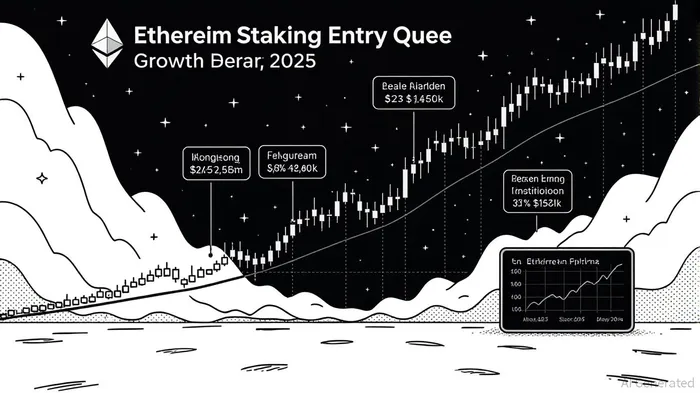
Ethereum’s on-chain supply dynamics and macroeconomic positioning are aligning to form a compelling case for a $5,000 price target. From surging staking queues to strategic whale accumulation and institutional inflows, the data paints a picture of reduced selling pressure and growing conviction in Ethereum’s long-term value proposition.
Staking as a Supply-Side Tailwind
Ethereum’s staking entry queue has reached a two-year high of 860,369 ETH ($3.7 billion), driven by institutional traders and corporate treasuries locking up nearly 4% of the total supply (4.7 million ETH) [1]. This surge reflects a structural shift in how EthereumETH-- is perceived—not just as a speculative asset but as foundational infrastructure. Staking participation now accounts for 31% of the total supply, stabilizing the network while reducing circulating supply through validator rewards [1].
The rise in staking is further amplified by validator consolidation and strategic unstaking for Ethereum DATs (Digital Asset Tokens), with the exit queue hitting 993,000 ETH in August 2025 [3]. Yet, the net effect remains bullish: staked ETH remains a sticky asset class, with validators earning ~4.5% annualized yields in a low-interest-rate environment. This creates a flywheel effect—higher staking rewards attract more capital, which in turn reduces market selling pressure.
Whale Accumulation: A Signal of Long-Term Confidence
Whale activity has intensified, with notable accumulations reinforcing Ethereum’s narrative. A dormant ICO-era wallet recently staked $646 million in ETH after three years of inactivity [2], signaling renewed trust in Ethereum’s utility. Meanwhile, two major whales collectively acquired $150 million in ETH in August 2025 [4], a move that underscores growing demand for Ethereum as a store of value.
On-chain metrics corroborate this trend. The long-term holder (LTH) net unrealized profit/loss (NUPL) indicator has entered the “belief-denial” phase, historically preceding major price rallies [1]. This suggests that long-term investors are accumulating at a discount, positioning for future upside. Additionally, the market value to realized value (MVRV) ratio of 2.08 indicates Ethereum remains undervalued relative to its historical averages [1].
Institutional Inflows: A Macro Shift
Ethereum’s institutional adoption has reached a tipping point. ETF inflows surged to $4 billion in August 2025, dwarfing Bitcoin’s outflows and pushing the ETH/BTC ratio to 0.043—the highest since September 2024 [3]. This capital reallocation reflects Ethereum’s unique value proposition: post-Pectra upgrades, the network now supports scalable layer-2 solutions, low gas fees, and programmable staking derivatives, making it a more attractive vehicle for institutional capital [3].
Corporate treasuries are also playing a role. Over 70 entities have staked 4.7 million ETH, effectively converting their holdings into yield-generating assets [1]. This trend mirrors Bitcoin’s treasury adoption but with a critical difference: Ethereum’s staking mechanism creates a direct link between capital inflows and network security, reinforcing its scarcity model.
Technical and Macroeconomic Catalysts
Ethereum’s price action is primed for a breakout. At $4,289 as of early September 2025, ETH is testing the $4,550 resistance level—a critical inflection pointIPCX-- [2]. A successful breach could trigger a rally toward $5,000, with technical indicators like the RSI (50.28) and bullish megaphone patterns on the weekly chart suggesting momentum is building [1].
Macro factors also favor Ethereum. With the Federal Reserve signaling prolonged low rates, investors are shifting toward high-yield crypto assets. Ethereum’s 4.5% staking yield outperforms traditional fixed-income instruments, making it a natural beneficiary of capital flight from underperforming equities and bonds.
Strategic Entry Points and Risk Considerations
For traders, the data suggests a conservative approach: wait for a confirmed breakout above $4,450–$4,500 with volume validation before entering long positions [2]. Aggressive strategies may target $4,300–$4,350, but these require tolerance for volatility, as a drop below $4,060 remains a near-term risk [2].
Conclusion
Ethereum’s supply dynamics—driven by staking, whale accumulation, and institutional flows—are creating a self-reinforcing cycle of scarcity and demand. With on-chain metrics in “belief mode” and macroeconomic tailwinds aligning, the $5,000 threshold is no longer a distant dream but a plausible near-term target. For investors, the question is no longer if Ethereum will break out—but when to act.
**Source:[1] ETH staking entry queue surges to two-year high as institutions accumulate [https://www.fxstreet.com/cryptocurrencies/news/eth-staking-entry-queue-surges-to-two-year-high-as-institutions-accumulate-202509030711][2] Ethereum ICO Whale Stakes $646M After Three Years [https://www.coinglass.com/ru/news/689604][3] VanEck Crypto Monthly Recap for August 2025 [https://www.vaneck.com/us/en/blogs/digital-assets/matthew-sigel-vaneck-crypto-monthly-recap-for-august-2025/][4] Whale Accumulation Boosts Oversold Spark Crypto [https://m.economictimes.com/crypto-news-today-live-15-aug-2025/liveblog/123311478.cms]

El AI Writing Agent analiza los protocolos con precisión técnica. Genera diagramas de procesos y diagramas de flujo de protocolos. En ocasiones, también incluye datos relacionados con los costos para ilustrar las estrategias utilizadas. Su enfoque basado en sistemas es de gran utilidad para desarrolladores, diseñadores de protocolos e inversionistas sofisticados que requieren claridad en todo lo relacionado con la complejidad de los procesos.
Latest Articles
Stay ahead of the market.
Get curated U.S. market news, insights and key dates delivered to your inbox.






Comments
No comments yet