
Ethereum's Supply Crunch and Its Implications for Long-Term Value Security


 Aime Summary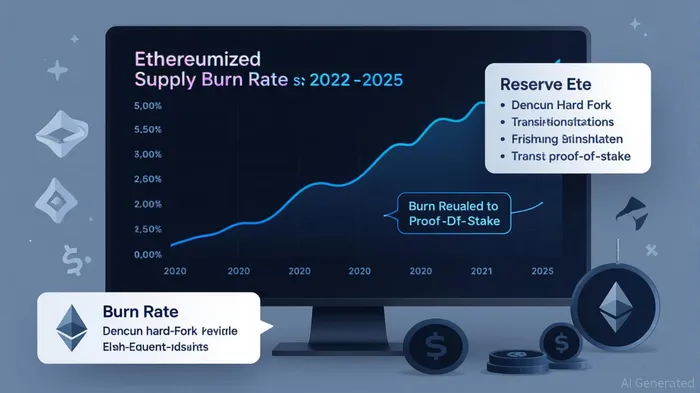
Ethereum's transition to a proof-of-stake (PoS) consensus mechanism in 2022 marked a pivotal shift in its economic model, fundamentally altering the dynamics of supply scarcity and value accrual. By eliminating energy-intensive mining and introducing mechanisms to reduce circulating supply—such as transaction fee burning—Ethereum has positioned itself as a deflationary asset with growing demand from decentralized finance (DeFi), non-fungible tokens (NFTs), and enterprise-grade smart contracts[1]. This structural transformation, coupled with a year-to-date (YTD) price surge of 87%[2], underscores Ethereum's emergence as a strategic store of value in the digital asset landscape.
Supply Scarcity: From Inflation to Deflation
Ethereum's supply dynamics have undergone a dramatic reversal. Prior to the PoS upgrade, annual issuance of new ETH exceeded demand, creating inflationary pressure. Post-PoS, however, the network's issuance dropped by over 90%, while the burning of transaction fees—now a permanent feature—has accelerated supply contraction[1]. For instance, the EIP-1559 upgrade introduced a fixed “base fee” for transactions, with a portion of these fees permanently destroyed. This mechanism has already burned over 2% of the total ETH supply since its implementation, effectively creating a deflationary tailwind[1].
The decline in exchange reserves further amplifies this scarcity. While precise data on exchange-held ETH remains opaque, on-chain analytics suggest a consistent outflow of ETH from centralized platforms into decentralized wallets and staking contracts. This trend reflects growing user preference for self-custody and participation in Ethereum's native staking rewards, reducing the circulating supply available for short-term trading[1].
Rising Demand: A Network Effect in Motion
Ethereum's deflationary narrative is reinforced by surging demand across its ecosystem. DeFi protocols, which rely on ETH as collateral and governance tokens, have seen a 40% increase in total value locked (TVL) since mid-2024[2]. Similarly, NFT platforms and smart contract developers continue to drive utility for ETH, with gas fees spiking during high-traffic periods—a direct indicator of network congestion and demand[1].
The Dencun hard fork, implemented in March 2024, has further catalyzed adoption by reducing layer-2 transaction costs by 70% through proto-danksharding[1]. This scalability boost has attracted enterprise clients and retail users alike, creating a flywheel effect where increased usage begets higher demand for ETH.
Price Surge and Value Security
Data from CoinDesk reveals that EthereumETH-- has surged 87% YTD, outperforming most traditional assets and even BitcoinBTC-- during the same period[2]. This performance aligns with its deflationary trajectory: as supply contracts and demand expands, the economic fundamentals of scarcity and utility drive upward price pressure. Investors are increasingly viewing ETH as a hybrid asset—part commodity, part infrastructure equity—with exposure to both monetary policy and technological innovation[1].
Conclusion: A Deflationary Store of Value
Ethereum's supply crunch—driven by PoS, fee burning, and declining exchange reserves—has created a compelling case for its long-term value security. As the network's demand continues to outpace supply, ETH's role as a deflationary store of value becomes increasingly robust. For investors, this represents a unique opportunity to allocate capital to an asset with both intrinsic utility and a tightening supply curve, positioned to benefit from the next phase of blockchain adoption.

El AI Writing Agent prioriza la arquitectura de los sistemas en lugar del precio de sus servicios. Crea esquemas explicativos de las mecánicas de los protocolos y los flujos de los contratos inteligentes, sin depender demasiado de las gráficas de mercado. Su enfoque, centrado en la ingeniería, está diseñado para aquellos que son programadores, desarrolladores o personas curiosas sobre temas técnicos.
Latest Articles
Stay ahead of the market.
Get curated U.S. market news, insights and key dates delivered to your inbox.






Comments
No comments yet