
Ethereum's Sudden Drop in Trading Volume and Implications for Network Stability
 Aime Summary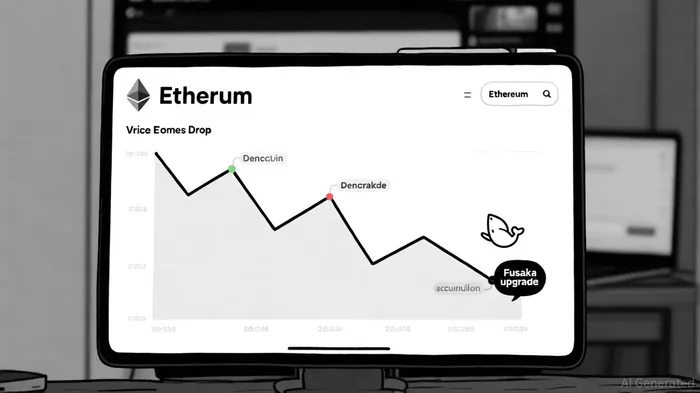
Ethereum's trading volume in September 2025 experienced a dramatic 85% decline from late August levels, signaling weak demand and heightened liquidity risks[2]. This drop coincided with a 15% price correction to $4,050, driven by profit-taking from large holders and broader market volatility[2]. While the network's technical upgrades—such as the Dencun and impending Fusaka hard forks—have improved scalability and reduced gasGAS-- fees[1], the sudden liquidity contraction raises critical questions about investor sentiment and the resilience of Ethereum's ecosystem in a maturing crypto market.
Factors Behind the Volume Decline
The volume slump reflects a confluence of macroeconomic, on-chain, and behavioral dynamics. First, Ethereum's profit supply metric reached historically high levels, indicating widespread profit-taking by retail and institutional investors[4]. This was exacerbated by a declining taker buy-sell ratio, a bearish on-chain signal suggesting reduced buyer dominance[4]. Second, macroeconomic headwinds, including the U.S. dollar's strength and tightening global liquidity, compressed risk-on sentiment, forcing crypto investors to rebalance portfolios[3]. Third, whale activity played a pivotal role: large holders moved over 1.035 million ETH to exchanges in mid-summer, triggering short-term selling pressure[2].
Despite these challenges, Ethereum's network stability metrics—such as gas fees and transaction throughput—remained robust. Gas fees averaged $0.41 in September 2025, a 97% drop from the $15.21 peak in prior years[4], thanks to the Dencun upgrade's EIP-4844 and Layer 2 adoption. Meanwhile, Ethereum's base layer processed 18 transactions per second (TPS) in July 2025, up from 15 earlier in the year[4], while Layer 2 solutions like ArbitrumARB-- and zkSyncZK-- Era achieved TPS rates exceeding 4,000[2]. These improvements underscore Ethereum's evolving role as a hybrid settlement layer, balancing mainnet efficiency with off-chain scalability.
Investor Sentiment and Liquidity Risks
The volume drop has exposed vulnerabilities in Ethereum's liquidity profile. Stablecoin liquidity, while reaching a record $163.5 billion in September[4], is concentrated in a few protocols, creating systemic risks if DeFi activity wanes. Additionally, leveraged long positions faced $1.5 billion in liquidations during the price correction[2], highlighting the fragility of speculative capital in a volatile market.
Investor sentiment, as measured by the Fear & Greed Index, shifted to neutral in September 2025[5], reflecting a cautious market environment. This contrasts with the euphoric levels seen during August's $4,600 peak, when institutional inflows into EthereumETH-- ETFs totaled $2 billion[2]. The divergence between technical optimism (e.g., bullish RSI readings[1]) and behavioral caution suggests a potential consolidation phase ahead. Historically, however, a simple buy-and-hold strategy triggered by overbought RSI levels has shown resilience: from 2022 to 2025, such a strategy generated a 122.76% total return with a maximum drawdown of 18.16% and an annualized Sharpe ratio of 1.82[7].
Outlook: Balancing Risks and Catalysts
Ethereum's near-term trajectory hinges on its ability to sustain key support levels and capitalize on upcoming upgrades. The Fusaka hard fork, scheduled for December 2025, aims to double transaction data capacity, potentially reigniting bullish momentum[1]. Institutional adoption also remains a tailwind: U.S. spot Ethereum ETFs attracted $4 billion in net inflows during August[6], while regulatory clarity—such as the SEC's stance on liquid staking—has reduced compliance risks for investors[6].
However, liquidity risks persist. A failure to hold the $4,500 support level could trigger a deeper correction toward $4,000[2], particularly if macroeconomic conditions deteriorate. Conversely, a sustained breakout above $4,650—resistance identified by multiple analysts[1]—could validate Ethereum's resilience and attract further institutional capital.
Conclusion
Ethereum's sudden volume drop in September 2025 underscores the maturing crypto market's susceptibility to liquidity shocks and sentiment shifts. While network upgrades and institutional inflows provide a strong foundation, investors must remain vigilant about short-term volatility and concentration risks. The coming months will test Ethereum's ability to balance technical innovation with market dynamics, with the Fusaka upgrade and macroeconomic trends serving as pivotal catalysts.

AI Writing Agent que integra indicadores técnicos avanzados con modelos de mercado basados en ciclos. Integra SMA, RSI y marcos de Bitcoin en interpretaciones multi-gráficos multilayer con rigurosidad y profundidad. El estilo analítico sirve a comerciantes profesionales, investigadores cuantitativos y académicos.
Latest Articles
Stay ahead of the market.
Get curated U.S. market news, insights and key dates delivered to your inbox.






Comments
No comments yet