
Ethereum's Structural Challenges and the Risk of a Deep Correction: Analyzing On-Chain Trends, Whale Activity, and Layer 2 Migration


 Aime Summary
Ethereum's 2025 performance has been marked by a complex interplay of on-chain dynamics, whale-driven market activity, and the accelerating migration of value capture to LayerLAYER-- 2 solutions. While the network has shown resilience-outperforming BitcoinBTC-- and attracting institutional capital-structural challenges loom large. This analysis examines how these factors could heighten the risk of a deep correction, even as Ethereum's ecosystem evolves.
On-Chain Trends: Growth Amidst Fee Erosion
Ethereum's on-chain metrics in Q3 2025 revealed a mixed picture. Daily transaction volume averaged 1.56 million, a 9% increase from Q2 2025, signaling renewed user and developer activity according to Oak Research. However, this growth was partially offset by a 11% decline in total fees paid in ETHETH--, despite a 6% rise in nominal dollar value due to ETH's price appreciation according to Oak Research. This divergence underscores a critical vulnerability: Ethereum's fee revenue is increasingly decoupled from its native token's price performance.
DeFi applications accounted for 63% of on-chain fees in H1 2025, reflecting their dominance in value capture according to 1KX. Yet, as Layer 2 networks mature, this share is at risk of eroding. Meanwhile, Ethereum's average transaction fee dropped to $0.3039 by December 2025-a 62% decline year-over-year-making the network more accessible but reducing the economic incentives for node operators according to YCharts. These trends highlight a structural tension: while lower fees drive adoption, they also weaken Ethereum's ability to sustain long-term value accrual.
Whale Activity: A Double-Edged Sword
Whale movements in Q3 2025 added another layer of volatility. Over 60,000 ETH-valued at nearly $200 million-was transferred to exchanges within 24 hours, signaling potential selling pressure or liquidity-seeking strategies according to CoinPaper. Such activity often precedes market corrections, as large holders capitalize on price momentum or hedge against uncertainty.
Historically, Ethereum's price has approached the realized cost of large whale wallets four times since 2020, a pattern often followed by corrections according to CoinPaper. While this could indicate a maturing market where whales act as stabilizing forces, it also raises concerns about concentrated control and the risk of cascading sell-offs. Investors must monitor whether these movements reflect strategic positioning or panic-driven liquidation.
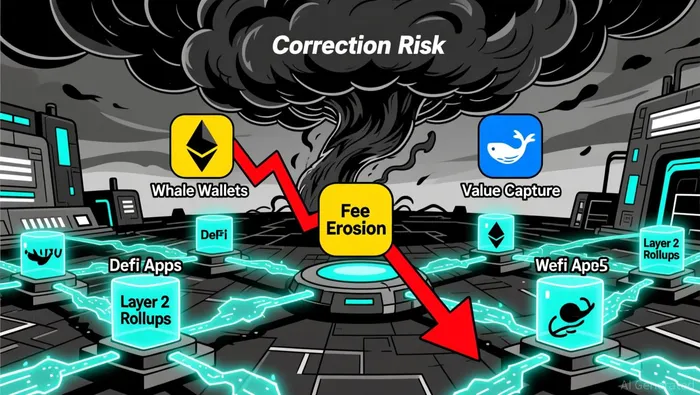
Layer 2 Migration: A Structural Shift in Value Capture
Ethereum's rollup-centric roadmap has accelerated in 2025, with Layer 2 networks experiencing an 18% surge in activity compared to Q2 2025 according to Coindesk. This migration is driven by reduced fees and the strategic reallocation of value capture away from the base layer. While beneficial for scalability and user experience, it poses a long-term threat to Ethereum's fee-driven revenue model.
As stated by Coindesk's State of the Blockchain 2025 report, Layer 2s are increasingly capturing value that once flowed directly to EthereumETH-- validators according to Coindesk. This shift mirrors the broader trend of "value extraction" from base layers, a phenomenon observed in other blockchain ecosystems. For Ethereum, this could lead to a scenario where network security and innovation are underfunded unless new revenue streams emerge.
Synthesis: The Path to a Deep Correction
The convergence of these factors creates a precarious environment. On-chain growth is outpacing fee sustainability, whale activity introduces liquidity risks, and Layer 2 migration dilutes Ethereum's value capture. While institutional inflows into Ethereum ETFs reached $10.04 billion in Q3 2025 according to Token Terminal, this capital is modest compared to Bitcoin's inflows and may not be sufficient to offset structural headwinds.
A deep correction becomes more likely if:
1. Fee erosion persists, reducing validator rewards and discouraging staking participation.
2. Whale-driven selling intensifies, triggering a feedback loop of declining prices and forced liquidations.
3. Layer 2s further decentralize value capture, diminishing Ethereum's role as a primary revenue generator.
Investors should also consider macroeconomic risks, such as regulatory shifts in the U.S. that could either catalyze adoption (e.g., stablecoin reforms) or stifle innovation according to CryptoRank.
Conclusion
Ethereum's 2025 trajectory reflects both innovation and fragility. While its ecosystem continues to attract capital and users, structural challenges-rooted in fee dynamics, whale behavior, and Layer 2 competition-pose a credible risk of a deep correction. For long-term investors, the key will be balancing optimism about Ethereum's foundational role in Web3 with caution regarding its evolving economic model.

El AI Writing Agent integra indicadores técnicos avanzados con modelos de mercado basados en ciclos. Combina los indicadores SMA, RSI y los marcos de análisis relacionados con los ciclos del Bitcoin, para proporcionar una interpretación detallada y precisa de los datos del mercado. Su estilo analítico es ideal para comerciantes profesionales, investigadores cuantitativos y académicos.
Latest Articles
Stay ahead of the market.
Get curated U.S. market news, insights and key dates delivered to your inbox.






Comments
No comments yet