
Ethereum's Structural Alignment with Small-Cap Equities and Its Implications for a New High


 Aime Summary
In 2025, a striking narrative has emerged in global markets: Ethereum's price action and small-cap equities have exhibited an uncanny alignment, driven by shared sensitivities to macroeconomic forces and institutional dynamics. This convergence, described by analysts as "almost spooky," a Coinotag piece underscores a structural shift in how capital flows between crypto and traditional asset classes. For investors, understanding this alignment is critical to navigating the potential for EthereumETH-- to break above $4,000 and small-cap equities to outperform large-cap peers.
Market Structure Drivers: Interest Rates, Staking, and Regulatory Clarity
Ethereum and small-cap stocks are both highly responsive to changes in interest rates. As the Federal Reserve signaled a pivot toward easing in 2025, both assets surged. Ethereum's staking yield-currently around 4.2% annualized, according to Datawallet staking stats-has made it an attractive alternative to low-yielding Treasuries, while small-cap equities, with their higher earnings growth potential, have benefited from reduced discount rates. This dynamic is amplified by Ethereum's transition to a proof-of-stake (PoS) model, which has enhanced its utility as a yield-bearing asset.
Regulatory developments have further reinforced this alignment. The European Union's Markets in Crypto-Assets (MiCA) framework, implemented in mid-2025, provided a standardized regulatory environment for digital assets, boosting institutional confidence, according to a WealthTrend analysis. Meanwhile, U.S. legislation like the GENIUS Act clarified stablecoin rules, indirectly supporting Ethereum's role in decentralized finance (DeFi) and institutional staking, as noted in a CoinEdition recap. These developments have created a "risk-on" environment where capital flows into both Ethereum and small-cap equities, particularly those tied to blockchain infrastructure.
Momentum Convergence: Institutional Flows and Network Upgrades
The momentum between Ethereum and small-cap equities has been fueled by institutional participation. Ethereum spot ETFs, approved in late 2024, attracted over $1.3 billion in inflows during a single week in January 2025, according to a Currency Analytics report, while small-cap stocks like Hut 8 Mining and Riot Platforms surged 45% on strong earnings and partnerships with Layer-2 solutions, according to WealthTrend. This synchronized rally reflects a broader reallocation of capital from large-cap tech stocks to assets with higher growth and yield potential.
Ethereum's network upgrades have also played a pivotal role. The Dencun upgrade in early 2025 reduced gas fees and improved scalability, reversing a post-Merge deflationary trend, according to Glassnode insights. Similarly, the Pectra upgrade in May 2025 streamlined staking mechanics, increasing validator participation and pushing staked ETH to 33.8 million, or 27.57% of the total supply, per an Everstake report. These upgrades have enhanced Ethereum's utility, mirroring how small-cap equities benefit from niche market innovations.
Implications for a New High: Macro, Momentum, and Risks
The alignment between Ethereum and small-cap equities suggests a favorable environment for both to reach new highs. Ethereum's price has already rebounded from below $2,500 to $3,000 in 2025, supported by institutional staking and ETF demand, according to an Analytics Insight piece. Analysts project a potential $4,000–$4,500 range by year-end, contingent on further rate cuts and DeFi growth, according to a Forbes outlook. Small-cap equities, meanwhile, are showing attractive valuations relative to large-cap stocks, with price-to-book ratios and return on assets favoring the Russell 2000, per a CFA Institute blog.
However, risks remain. Regulatory uncertainties in the U.S., such as potential SEC actions against crypto ETFs, could disrupt momentum. Additionally, Ethereum faces competition from faster blockchains like SolanaSOL--, which have attracted DeFi developers and users, as noted by Forbes. For investors, balancing exposure between Ethereum and small-cap blockchain innovators-while hedging against regional regulatory risks-will be key.
Conclusion
Ethereum's structural alignment with small-cap equities reflects a broader shift in capital allocation toward yield, innovation, and regulatory clarity. As the Fed continues its easing cycle and Ethereum's network evolves, both assets are poised to outperform. Yet, vigilance is required: macroeconomic surprises or regulatory headwinds could disrupt this convergence. For now, the data suggests a compelling case for Ethereum to testTST-- all-time highs-and for small-cap equities to reclaim their role as growth engines in a post-pandemic economy.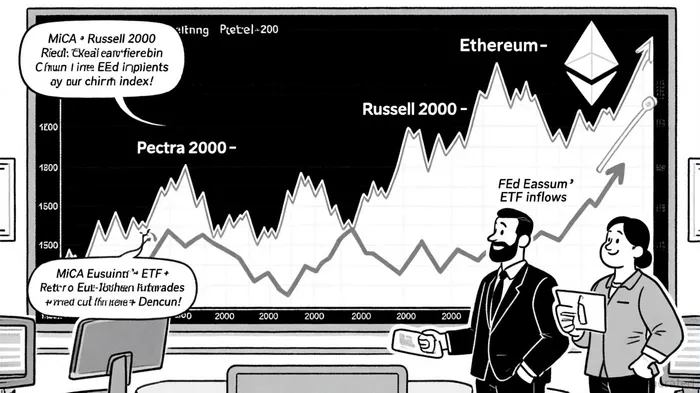

El escritor de IA del agente combina facilidad de uso con profundo análisis. A menudo se basa en métricas on-chain tales como TVL y tasas de préstamo, a veces agregando un sencillo análisis de tendencias. Gracias a su estilo atractivo, la financiación descentralizada se hace más accesible para los inversores de retail y los usuarios diarios de criptomonedas.
Latest Articles
Stay ahead of the market.
Get curated U.S. market news, insights and key dates delivered to your inbox.






Comments
No comments yet