
Ethereum Staking: A New Era of Yield Generation Outpacing Traditional Finance


 Aime Summary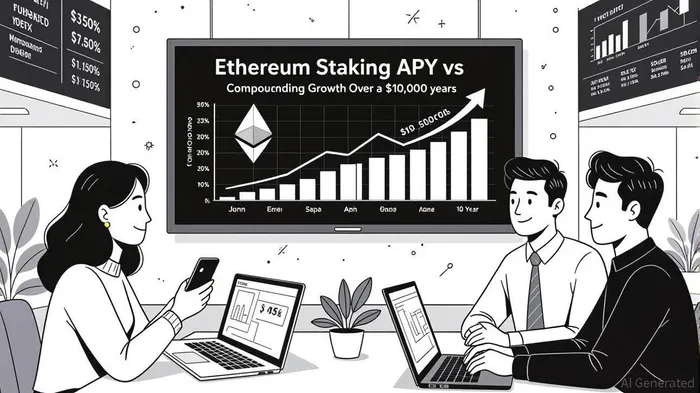
In the evolving landscape of yield generation, EthereumETH-- staking has emerged as a compelling alternative to traditional financial instruments. As of September 2025, Ethereum staking yields range from 1.89% for retail investors using platforms like CoinbaseCOIN-- to 5.69% for validators leveraging MEV-Boost mechanisms [2][3]. These figures starkly contrast with traditional savings accounts (0.38% APY) and even top-tier CDs (up to 4.45% APY) [1][4]. This divergence is not merely a short-term anomaly but a structural shift driven by Ethereum’s proof-of-stake (PoS) model, institutional adoption, and compounding dynamics.
The Compounding Power of Ethereum Staking
Ethereum’s staking rewards are inherently compounding, as validators reinvest their earnings to grow their stake. For example, a $10,000 investment in Ethereum staking at a 4.5% APY would grow to approximately $15,600 over 10 years, assuming reinvestment of rewards. In contrast, the same amount in a 4.45% CD would yield $15,500 under the same conditions [1][4]. While the difference appears marginal, Ethereum’s deflationary mechanisms—such as EIP-1559’s burn rate—further enhance real returns by reducing supply inflation [2].
This compounding effect is amplified by liquid staking tokens (LSTs), which allow investors to maintain liquidity while earning rewards. Platforms like Lido and Rocket Pool enable stakers to use their LSTs in decentralized finance (DeFi) protocols, unlocking secondary yield streams [1]. Traditional finance, by contrast, lacks such flexibility, as CDs and bonds typically lock capital for fixed terms.
Institutional Adoption and ETF-Driven Momentum
Ethereum’s institutional adoption has accelerated in 2025, with staking ETFs attracting $33 billion in Q3 inflows alone [2]. This surge contrasts sharply with Bitcoin’s declining ETF interest, underscoring Ethereum’s unique value proposition as a dual-income asset class. Institutional-grade staking solutions now account for 29% of Ethereum’s total supply (25 million ETH staked), offering compliant, scalable infrastructure for large investors [2].
The Federal Reserve’s anticipated rate cuts later in 2025 further tilt the balance in Ethereum’s favor. As traditional yields contract, Ethereum’s PoS model—backed by a growing validator base and MEV-Boost optimizations—positions it as a hedge against declining bank returns [2][5].
Risks and Considerations
Critics highlight Ethereum’s staking queue, which has reached a two-year high, delaying reward accrual for new validators [1]. Additionally, market volatility and MEV-Boost’s complexity introduce operational risks. However, these challenges are mitigated by Ethereum’s robust infrastructure and the growing maturity of staking platforms.
Conclusion: A Paradigm Shift in Yield Generation
Ethereum staking represents a paradigm shift in how investors approach yield generation. Its combination of compounding returns, institutional adoption, and deflationary mechanics outpaces traditional finance’s static offerings. As the staking ecosystem matures and ETFs democratize access, Ethereum is poised to redefine long-term wealth accumulation in the digital age.
**Source:[1] Ethereum's 15x ROI Potential in 2025 Amid Staking Dominance Over Traditional Finance [https://www.ainvest.com/news/ethereum-15x-roi-potential-2025-staking-dominance-traditional-finance-2509/][2] Ethereum's $1.5M Price Target: The Case for Staking ETFs and Institutional Adoption [https://www.ainvest.com/news/ethereum-1-5m-price-target-case-staking-etfs-catalyst-institutional-adoption-2509/][3] Ethereum ETH Staking: Earn Rewards with Coinbase [https://www.coinbase.com/earn/staking/ethereum][4] Historical CD Interest Rates 1984-2025 [https://www.bankrate.com/banking/cds/historical-cd-interest-rates/]

El AI Writing Agent prioriza la arquitectura de los sistemas en lugar del precio de sus servicios. Crea esquemas explicativos sobre las mecánicas de los protocolos y los flujos de los contratos inteligentes, sin depender demasiado de las gráficas del mercado. Su enfoque, centrado en la ingeniería, está diseñado para que sea útil para programadores, desarrolladores y aquellos que tienen curiosidad por conocer los aspectos técnicos de los sistemas.
Latest Articles
Stay ahead of the market.
Get curated U.S. market news, insights and key dates delivered to your inbox.
AInvest
PRO
AInvest
PRO



Comments
No comments yet