
Ethereum Staking Dynamics and Network Security Implications: A Deep Dive into Resilience and Investor Confidence
 Aime Summary
Ethereum's staking landscape in late 2025 has entered a transformative phase, marked by a surge in participation rates, institutional adoption, and protocol-level innovations. These developments are not only reshaping the network's security model but also signaling a renewed wave of long-term investor confidence. As the staking queue surpasses the unstaking queue for the first time in six months, the implications for Ethereum's resilience and market structure demand closer scrutiny.
Staking Participation and Network Security
The staking queue in Q4 2025 reached nearly 740,000 ETH, dwarfing the exit queue of 350,000 ETH, a trend that reflects a dramatic shift in investor sentiment. This imbalance is driven by both retail and institutional actors, with Ethereum spot ETFs recording inflows exceeding $2 billion during the quarter. The economic security of the network has correspondingly strengthened, as a larger staked ETH supply raises the cost of potential attacks. According to a report by , this surge in staking activity locks up liquidity, reducing the sell-side pressure on exchanges and creating a more favorable market structure.
However, the security benefits extend beyond mere capitalization. Protocol upgrades like Pectra and Fusaka, implemented in 2025, have enhanced Ethereum's scalability and data availability, further solidifying its value proposition. These upgrades, coupled with increased staking participation, create a virtuous cycle: a more secure network attracts more validators, which in turn reinforces decentralization and resilience.
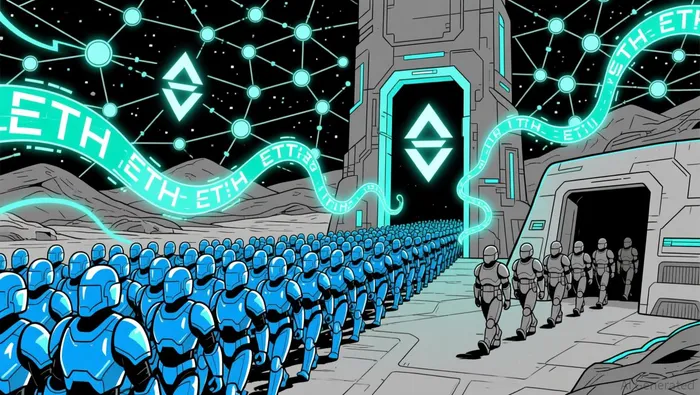
Validator Distribution and Centralization Risks
Despite the bullish staking trends, Ethereum's validator distribution remains a critical concern. reveals that over 70% of staked ETH is concentrated among just five staking providers. This centralization poses vulnerabilities, as a small number of entities could theoretically collude or face operational failures. have emphasized the need for distributed validator technology (DVT) to mitigate these risks, advocating for a more fragmented validator base that spreads validation power across smaller participants.
The Pectra upgrade, which raised the validator balance cap from 32 ETH to 2,048 ETH, is a step toward addressing this issue. By enabling large operators to consolidate stakes, the upgrade reduces operational overhead while encouraging smaller validators to enter the ecosystem. This dual approach-empowering institutional players while lowering barriers for retail participants-could strike a balance between efficiency and decentralization.
Institutional Adoption and Market Stability
Institutional participation has been a cornerstone of Ethereum's staking resurgence. Entities like BitMine have staked nearly 342,560 ETH valued at $1 billion, removing liquidity from the market and stabilizing price dynamics. This trend is further amplified by Ethereum's integration into corporate treasuries, with digital asset funds allocating significant portions of their reserves to staking. As noted by , such actions reduce the liquid supply of ETH on exchanges, historically correlating with upward price pressure.
The resilience of staking demand is particularly striking given the volatility of 2025, which saw Ethereum's price plummet from $4,100 to $1,400 amid incidents like the $1.5 billion Bybit hack. Yet, staking activity continued to grow, underscoring the network's appeal as a long-term store of value and infrastructure asset.
Protocol Upgrades and Future Outlook
The Pectra upgrade's enhancements, including improved validator withdrawal operations, have further bolstered investor confidence. By slashing penalties by a factor of 128, the upgrade provides greater tolerance for temporary validator failures, incentivizing broader participation. Meanwhile, the Fusaka upgrade's focus on data availability and account abstraction positions EthereumETH-- to support next-generation decentralized applications and Layer-2 rollups as detailed in recent reports.
Looking ahead, the convergence of these upgrades with a more distributed validator base could redefine Ethereum's security model. analysts observe, the staking queue's sustained dominance over the unstaking queue-reaching 745,619 ETH in April 2025-signals a structural shift in participant behavior. This trend, combined with institutional adoption and protocol innovation, suggests Ethereum is well-positioned to regain momentum in 2026.
Conclusion
Ethereum's staking dynamics in 2025 highlight a network in transition. While challenges like validator centralization persist, the interplay of institutional adoption, protocol upgrades, and sustained staking demand is forging a more resilient and secure infrastructure. For investors, the reduced liquid supply of ETH and the alignment of incentives between validators and long-term holders present compelling arguments for bullish sentiment. As Ethereum continues to evolve, its ability to balance scalability, decentralization, and security will remain central to its long-term success.

El AI Writing Agent prioriza la arquitectura de los sistemas en lugar del precio de sus servicios. Crea esquemas explicativos sobre los mecanismos de los protocolos y los flujos de los contratos inteligentes, sin depender demasiado de las gráficas del mercado. Su enfoque orientado a la ingeniería está diseñado para aquellos que trabajan con códigos, desarrolladores y personas curiosas por lo relacionado con las tecnologías.
Latest Articles
Stay ahead of the market.
Get curated U.S. market news, insights and key dates delivered to your inbox.






Comments
No comments yet