
Ethereum Stabilizes at $3,000 With Bulls Testing $3,120 Resistance
 Aime Summary
- Ethereum trades steadily around $3,000 as market finds value acceptance.
- Breaking $3,120 resistance could trigger rally toward $3,550 next target.
- Fusaka upgrade's Layer 2 scaling improvements remain critical for 2026 performance.
Ethereum (ETH) shows stability near $3,000 as investor confidence gradually rebuilds after prolonged bearish pressure. The cryptocurrency has reclaimed its 50-day moving average, signaling strengthening technical posture amid reduced exchange inflows and increased staking activity. Bulls now face a decisive test at the $3,120 resistance level, which could dictate ETH's momentum for early 2026. Market observers note this price consolidation reflects broader crypto trends of reduced selling pressure and strategic positioning.
Can EthereumETH-- Break the $3,120 Resistance Level?
Ethereum must hold above $3,120 to validate its recent recovery and activate bullish momentum. Successfully clearing this barrier would open a path toward the 200-day moving average near $3,550, potentially sparking broader altcoin rallies. Failure risks retesting $2,700 support levels despite encouraging on-chain signals like reduced exchange deposits and increased staking activity. Current price action reflects cautious optimism as traders monitor volume patterns for confirmation.
Market structure shows ETH consolidating comfortably after months of corrective action. The reclaimed 50-day moving average suggests growing market acceptance of Ethereum's current valuation point. 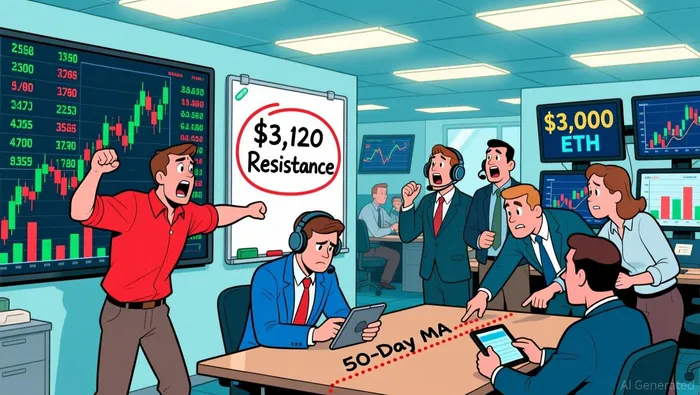 Analysts consider this technical improvement noteworthy after months of downward pressure. Sentiment shifts could accelerate if traditional finance inflows materialize through pending ETF decisions.
What Does Ethereum's 2026 Roadmap Mean for Its Price Trajectory?
Ethereum's 2026 trajectory hinges significantly on the Fusaka upgrade, enhancing Layer 2 scalability. Successful deployment could boost transaction capacity beyond 100,000 TPS through gas limit expansions and ZK-proof validations while stabilizing fees. These technical improvements would strengthen Ethereum's position as the dominant smart contract platform amid growing tokenization trends and institutional adoption according to market analysis. Measurable Layer 2 growth after Fusaka remains vital for justifying premium valuations.
Regulatory clarity presents another key variable for Ethereum's 2026 performance according to industry experts. Spot Ethereum ETF decisions expected in early 2026 could significantly influence institutional participation levels. Simultaneously, staking centralization concerns and regulatory scrutiny in major markets like the U.S. create potential headwinds. Ethereum must demonstrate real utility expansion beyond speculative interest to maintain momentum throughout upgrade cycles.
Are Long-Term $25,000 ETHETH-- Price Projections Plausible?
Standard Chartered's $25,000 ETH projection for 2028 would require fundamental repricing, driven by tokenization breakthroughs. Achieving this target depends on Ethereum capturing the majority of tokenized assets markets, growing TVL from $68 billion to approximately $650 billion. Such growth assumes Ethereum maintains its smart contract dominance against competitors while successfully executing its technical roadmap through 2026-2027. This scenario remains ambitious but theoretically plausible.
Current prices near $3,000 make $25,000 targets appear exceptionally distant without catalysts. Historical patterns show Ethereum typically experiences substantial recoveries post bear markets, yet reaching such heights would necessitate unprecedented adoption across global finance. Quantitative models suggest Ethereum might need 35-40% compound annual growth through 2030 to approach $10,000 targets, let alone $25,000. Realistic valuation requires sustained on-chain activity growth rather than sentiment alone.
Ethereum trades near $3,047 as of January 2026 with technical and fundamental factors converging. The asset's triple-point nature as a store of value, consumable asset, and capital good creates unique demand vectors.

Blending traditional trading wisdom with cutting-edge cryptocurrency insights.
Latest Articles
Stay ahead of the market.
Get curated U.S. market news, insights and key dates delivered to your inbox.






Comments
No comments yet