
Ethereum's Short Squeeze and Institutional Bullishness: A Strategic Entry Point for Long-Term Capital


 Aime Summary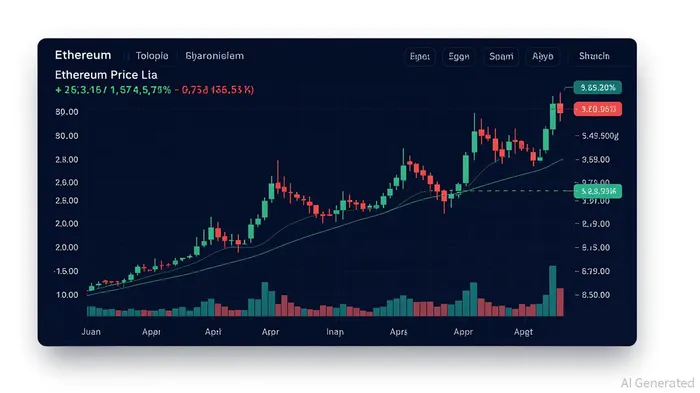
Ethereum's market dynamics in Q3 2025 reveal a compelling narrative of institutional conviction and speculative fragility. As the crypto market navigates a divergence between derivatives-driven volatility and on-chain fundamentals, EthereumETH-- has emerged as a high-conviction asset for long-term capital. This article explores how strategic investors can leverage short liquidation dynamics and macro-institutional flows to identify a robust entry point in Ethereum, balancing risk with growth potential.
The Short Squeeze: Derivatives Volatility as a Catalyst
Ethereum's derivatives market has become a battleground for leveraged traders, with short liquidations intensifying as the asset approaches key psychological levels. In August 2025, a $259 million short liquidation event occurred as Ethereum neared $4,620, triggering a sharp price rebound. Coinglass data further underscores the fragility of bearish positions: a drop below $4,000 could trigger $1.223 billion in long liquidations, while a breakout above $4,300 risks $1.336 billion in short liquidations. These figures highlight the high leverage embedded in derivatives markets, where institutional and retail traders are increasingly exposed to sudden directional shifts.
The negative funding rates (-0.02% on Binance) and a long/short ratio of 1.35 indicate a risk-averse environment, with short sellers dominating speculative activity. However, this bearish positioning creates a self-fulfilling prophecy: as Ethereum's price stabilizes near critical support levels, the forced liquidation of short positions can accelerate upward momentum. For investors, this dynamic presents a unique opportunity to capitalize on short-term volatility while aligning with long-term on-chain trends.
Institutional Bullishness: ETF Inflows and Whale Accumulation
While derivatives markets oscillate between fear and greed, Ethereum's on-chain fundamentals tell a different story. Over 1.2 million ETH has been withdrawn from exchanges in a single month, with the 30-day net outflow averaging -40,000 ETH. This trend reflects a strategic shift from speculative trading to long-term ecosystem participation, driven by Ethereum's dominance in DeFi (65% TVL) and staking yields (3–5% annually).
Institutional adoption has further accelerated, with Ethereum ETFs attracting $8.5 billion in inflows since May 2025. BlackRock's ETHAETHA-- fund alone added $318 million in a single day, while corporate entities like SharpLink GamingSBET-- now hold 280,706 ETH ($867 million). These inflows, combined with a 9.31% increase in mega whale holdings since October 2024, signal a structural shift in Ethereum's value proposition. Unlike Bitcoin's speculative narrative, Ethereum's utility in DeFi, stablecoins, and tokenized real-world assets (RWAs) has made it a hybrid asset—both a store of value and a foundational infrastructure layer.
Strategic Entry Points: Balancing Liquidation Dynamics and Institutional Flows
The key to a high-conviction Ethereum trade lies in harmonizing short-term liquidation dynamics with long-term institutional flows. Historical data from July 2025 illustrates this interplay: a $4.1 billion inflow into Ethereum ETFs coincided with a 50% price rally, narrowing Ethereum's gap with BitcoinBTC-- as a store of value. During this period, Ethereum's price resilience was reinforced by whale accumulation and staking activity, which reduced circulating supply and tightened liquidity.
Investors should focus on defined swing trading ranges, using key support/resistance levels ($4,000–$4,300) as entry points. Options hedging can mitigate downside risk, particularly as Ethereum approaches liquidation clusters. For example, a long call option with a strike price of $4,200 could capitalize on a potential short squeeze while capping losses if the price dips below $4,000.
Additionally, allocating capital to Ethereum-based DeFi protocols and RWAs offers a dual benefit: earning staking yields (3–5%) while participating in Ethereum's utility-driven growth. With DeFi TVL reaching $95 billion in August 2025, investors can diversify exposure beyond spot and derivatives markets, leveraging Ethereum's role as a foundational asset.
Regulatory Tailwinds and Macroeconomic Catalysts
Ethereum's institutional adoption is further bolstered by regulatory clarity. The SEC's custody and staking guidance, coupled with in-kind redemption mechanisms for ETFs, has reduced legal ambiguities and enhanced liquidity. Meanwhile, macroeconomic tailwinds—such as Federal Reserve signals of rate cuts in September 2025—have fueled risk-on sentiment, pushing Ethereum to an all-time high of $4,880.
Conclusion: A High-Conviction Trade for the Long-Term
Ethereum's current market environment is a textbook example of a bull market inflection pointIPCX--. While derivatives volatility introduces short-term noise, the underlying on-chain strength—driven by institutional inflows, whale accumulation, and regulatory progress—creates a stable base for long-term growth. For investors, the strategic entry point lies in leveraging short liquidation dynamics to time price rebounds while aligning with Ethereum's utility-driven fundamentals.
Actionable Steps for Investors:
1. Enter Ethereum positions near $4,000–$4,300 with a stop-loss below $3,900 to capitalize on short liquidation clusters.
2. Allocate 10–15% of capital to Ethereum-based DeFi protocols to earn staking yields and diversify exposure.
3. Use options hedging to protect against downside risk, particularly as Ethereum approaches key resistance levels.
4. Monitor ETF inflows and whale activity for signals of sustained institutional accumulation.
In a market where speculation and fundamentals often clash, Ethereum's unique position as both a speculative asset and a foundational infrastructure layer makes it a rare high-conviction trade. For long-term capital, the time to act is now.

Decoding blockchain innovations and market trends with clarity and precision.
Latest Articles
Stay ahead of the market.
Get curated U.S. market news, insights and key dates delivered to your inbox.


AInvest
PRO
AInvest
PRO



Comments
No comments yet