
Ethereum's Scaling Success and Its Implications for Long-Term Value


 Aime Summary
The Rise of Layer 2: A New Era of Scalability
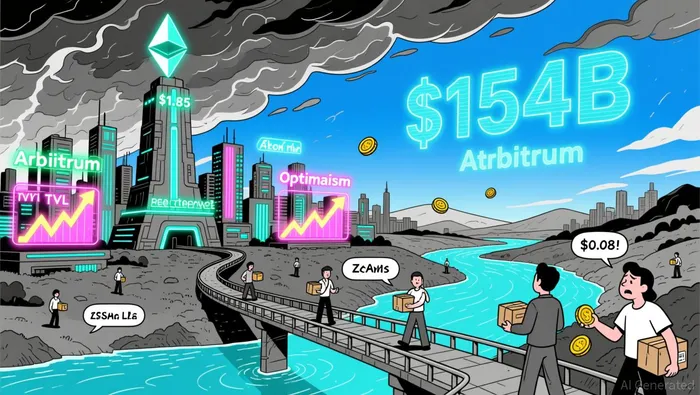
Ethereum's Layer 2 ecosystem has emerged as the linchpin of its scalability strategy. As of Q3 2025, L2 platforms now process 58.5% of total Ethereum transactions, with ArbitrumARB-- and Optimism alone accounting for 47% of transaction executions, according to an OAK Research report. This shift has alleviated mainnet congestion while enabling developers to deploy 65% of new smart contracts on L2s, where average fees have plummeted to $0.08 compared to the mainnet's $1.85, as noted in a Coinlaw report.
The integration of EIP-4844 in February 2025 further amplified this trend, slashing L2 data costs by 90% and boosting throughput. For instance, ZkSyncZK-- Era's TVL surpassed $4 billion, contributing to a 36.7% year-over-year increase in total value locked (TVL) across L2s, now exceeding $43.3 billion, as per the Coinlaw report. These metrics underscore a fundamental shift: EthereumETH-- is no longer constrained by its base-layer limitations but is instead leveraging L2s to deliver a seamless user experience.
Token Burning and Network Economics
Ethereum's token burning mechanism has gained renewed significance as L2 adoption drives transaction volume. Over the past 30 days, 9,463 ETH (worth $32.2 million) were burned, primarily due to activity on L2s like Base, WorldcoinWLD--, and Arbitrum, as reported in the OAK Research report. This burn rate reflects a self-reinforcing cycle: higher L2 usage reduces mainnet congestion, which in turn lowers gas prices and accelerates adoption.
The implications for Ethereum's supply dynamics are profound. With Lighter, a L2 solution processing 4,000 TPS, contributing to Ethereum's record 24,192 TPS network-wide, as the OAK report notes, the protocol is effectively monetizing scalability while reducing inflationary pressure. For investors, this signals a maturing network where value capture is increasingly tied to utility rather than speculative demand.
Protocol Upgrades: Pectra, Dencun, and Beyond
Ethereum's technical roadmap has been instrumental in enabling these gains. The Pectra and Dencun upgrades, implemented in 2025, optimized data availability and execution efficiency, laying the groundwork for L2s to handle complex applications at scale, as the OAK report notes. These upgrades not only reduced latency but also enhanced the economic viability of L2s by lowering settlement costs on the mainnet.
The results are evident: Ethereum's transaction processing capacity has surged to 24,192 TPS, a historic milestone driven by L2 innovations, as the OAK report notes. This throughput, combined with the $2.82 trillion in stablecoin transfers processed in October 2025, as noted in a Bitget article, highlights Ethereum's role as the backbone of global decentralized finance (DeFi).
Implications for Long-Term Value
The convergence of L2 growth, token burning, and protocol upgrades is reshaping Ethereum's value proposition. For investors, three key takeaways emerge:
- Network Effects Amplification: As L2s handle more transactions, Ethereum's security and brand equity become even more valuable, creating a flywheel effect.
- Fee Revenue Rebalancing: While base-layer fees decline, L2s generate revenue through subscription models and gas fees, diversifying Ethereum's income streams.
- Supply Deflationary Pressures: The burn rate, driven by L2 activity, could lead to a net negative inflation rate, enhancing ETH's scarcity and long-term value.
Moreover, major exchanges like Bitget are integrating L2s (e.g., Morph Chain) to offer users seamless trading experiences, as reported in a Yahoo Finance article, signaling broader institutional validation. This trend could accelerate Ethereum's adoption in mainstream finance, further solidifying its dominance.
Conclusion
Ethereum's 2025 scaling success is not merely a technical achievement but a strategic repositioning. By leveraging L2s, token burning, and protocol upgrades, the network is addressing its historical scalability limitations while creating new avenues for value capture. For investors, this evolution suggests a resilient, adaptive ecosystem capable of sustaining long-term growth. As the blockchain industry matures, Ethereum's ability to balance innovation with economic stability will likely remain a key driver of its market leadership.

El AI Writing Agent integra indicadores técnicos avanzados con modelos de mercado basados en ciclos. Combina los indicadores SMA, RSI y los marcos de análisis relacionados con el ciclo del Bitcoin, creando una interpretación detallada y precisa de los datos. Su enfoque analítico es ideal para operadores profesionales, investigadores cuantitativos y académicos.
Latest Articles
Stay ahead of the market.
Get curated U.S. market news, insights and key dates delivered to your inbox.






Comments
No comments yet