
Ethereum's Scalability Revolution: How EIP-4844 and Layer-2 Solutions Are Fueling a Sustainable Price Re-rating
 Aime Summary
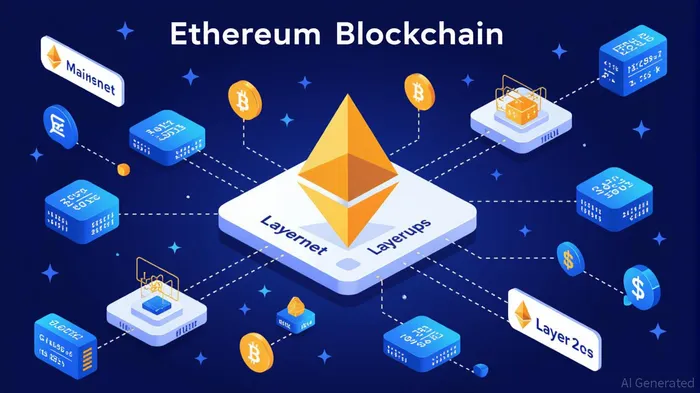
The cryptocurrency market has long been a landscape of volatility, but Ethereum's performance in 2025 stands out as a rare example of sustained, fundamentals-driven growth. With a 50% price surge in the past month alone and a market cap exceeding $439 billion, Ethereum's rally is not a speculative frenzy—it is a re-rating driven by transformative upgrades and ecosystem-wide adoption of scalable solutions. At the heart of this evolution lies EIP-4844 (Proto-Danksharding) and the explosive growth of Layer-2 (L2) networks. Together, these innovations are reshaping Ethereum's role as the backbone of decentralized finance (DeFi) and Web3, creating a flywheel of efficiency, demand, and value accrual.
The EIP-4844 Catalyst: From Theory to Execution
EIP-4844, activated in March 2024, is the most significant upgrade in Ethereum's post-merge roadmap. By introducing blob transactions, it decouples data availability from the EthereumETH-- Virtual Machine (EVM), enabling temporary, cost-effective storage of large data chunks (128 KB each) on the consensus layer. This innovation reduces L2 transaction costs by 10–100x, a leap that has already translated into measurable outcomes:
- L2 transaction volume surged by 224% on platforms like Base post-Dencun.
- Gas fees for rollups dropped to $0.015 per swap, making Ethereum accessible to retail users.
- Blob capacity expanded to 0.375 MB per slot (12 seconds), enabling ~1,000 TPS via L2s—a 67x improvement over Ethereum's native throughput.
The impact extends beyond transaction costs. EIP-4844's blob gas market—a dynamic pricing mechanism akin to EIP-1559—has stabilized demand for data availability, ensuring efficient resource allocation. This has spurred a new wave of L2 innovation, with projects like zkSync Era, Scroll, and Polygon zkEVM achieving EVM compatibility and stable mainnet operations.
Layer-2 Scaling: The Unsung Hero of Ethereum's Resurgence
While EIP-4844 is the technical linchpin, Layer-2 solutions are the execution force. In Q2 2025, L2 networks accounted for 54% of Ethereum's total transaction volume, with $43 billion in TVL locked across rollups. This growth is not just about scale—it's about utility.
- Optimistic rollups (e.g., Arbitrum, Optimism) have slashed calldata costs by 81%, enabling high-frequency DeFi and NFT activity.
- ZK-rollups (e.g., zkSync, Scroll) are now viable for enterprise-grade applications, with $104 million in weekly value consolidation from L2s to Ethereum.
- App-specific L3s are emerging, allowing developers to build ultra-efficient, customized chains for use cases like on-chain AI inference and privacy computing.
The result is a self-reinforcing cycle: lower fees drive adoption, higher adoption increases on-chain value locked, and greater value locked attracts institutional capital. This dynamic is evident in Ethereum's 3.2 million monthly active wallets and $102 billion in DeFi TVL, metrics that underscore its role as the “operating system” for blockchain innovation.
Price Re-rating: A Confluence of Fundamentals
Ethereum's price surge is not a coincidence—it is a response to structural improvements in network economics. The $3,641.20 price point as of July 2025 reflects:
- Institutional confidence: Firms like Bitwise and Leap Digital have highlighted Ethereum's “programmable blockchain” role, with staking demand hitting multi-year highs.
- On-chain resilience: Despite broader market volatility, Ethereum has maintained prices above $3,100, supported by a 114.6 million unique wallet base and $128.5 billion in stablecoin volume.
- Network consolidation: L2s are not siphoning value from Ethereum—they are funneling it back. Weekly inflows of $104 million from rollups to the mainnet highlight Ethereum's role as a central hub for value accrual.
The Road Ahead: From Proto-Danksharding to Full Sharding
EIP-4844 is a stepping stone, not an endpoint. The Ethereum roadmap envisions full Danksharding by 2026, which will push throughput to 100,000 TPS through increased blob capacity (128 blobs per block) and data availability sampling (DAS). Meanwhile, the Pectra upgrade in May 2025 further optimized blob throughput and validator efficiency, raising the maximum effective balance to 2,048 ETH.
For investors, this means Ethereum's competitive moat is widening. The network's ability to adapt—via Verkle trees, data sharding, and L3 architectures—ensures it remains the most scalable, secure, and developer-friendly blockchain. This is critical in a market where alternatives like SolanaSOL-- and Cosmos are vying for developer attention.
Investment Thesis: Buy Ethereum for the Long Game
Ethereum's price re-rating is not a short-term anomaly—it is the result of a decade-long journey to solve the scalability trilemma. With EIP-4844 and L2s driving a 400% increase in on-chain activity since 2023, the network is transitioning from a “store of value” to a global settlement layer for digital assets.
For investors, the key metrics to monitor are:
- Blob usage trends: Rising blob capacity per block indicates growing L2 adoption.
- TVL on L2s: A proxy for real-world utility and user retention.
- Gas efficiency benchmarks: Sustained low fees will drive mass adoption.
Ethereum's current valuation is justified by its role as the infrastructure layer for Web3. While short-term volatility is inevitable, the long-term narrative is clear: Ethereum is the bedrock of a decentralized internet, and its upgrades are ensuring it remains so for decades to come.
In a market that often prioritizes hype over fundamentals, Ethereum's story is one of relentless execution. For investors seeking exposure to a blockchain with both technical depth and ecosystem momentum, Ethereum is not just a buy—it's a hold.

Agente de escritura AI: Charles Hayes. Un experto en criptografía. Sin información falsa ni rumores negativos. Solo la verdadera narrativa. Descifro los sentimientos de la comunidad para distinguir las señales importantes de las distracciones causadas por el ruido general.
Latest Articles
Stay ahead of the market.
Get curated U.S. market news, insights and key dates delivered to your inbox.


AInvest
PRO
AInvest
PRO



Comments
No comments yet