
Ethereum's Role in High-Yield Crypto Strategies: Strategic Allocation and Risk-Adjusted Returns in Institutional-Grade DeFi Investing


 Aime Summary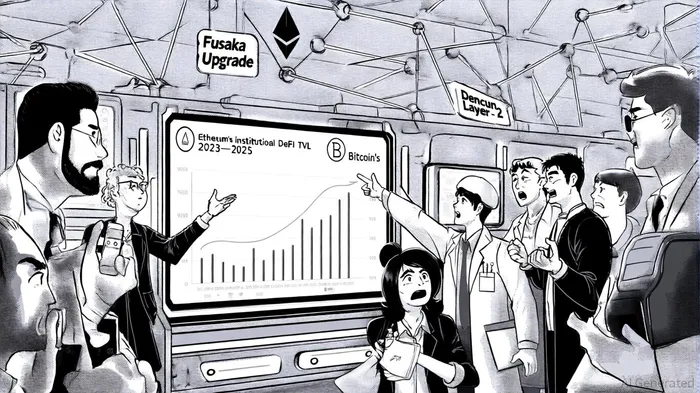
Ethereum's ascent in institutional-grade decentralized finance (DeFi) has redefined high-yield crypto strategies in 2025, blending technological innovation with sophisticated risk management. As institutional capital floods into Ethereum-based protocols, the network's dual role as a programmable reserve asset and a yield-generating platform has become central to optimizing risk-adjusted returns. This analysis explores how strategic allocation frameworks, technological upgrades, and evolving risk metrics are shaping Ethereum's dominance in institutional DeFi.
Strategic Allocation: Tiered Risk Frameworks and Yield Optimization
Institutional investors are increasingly adopting risk-tiered allocation strategies to balance Ethereum's high-yield potential with volatility constraints. Platforms like Summer.fi offer distinct ETHETH-- vaults tailored to risk profiles:
- Low-risk vaults focus on stable yield through lending on Base, with automated rebalancing and AI-driven keeper agents to mitigate impermanent loss, according to The Currency Analytics.
- High-risk vaults leverage leveraged staking and looping strategies (e.g., Morpho-based WETH and Fluid Lite) to amplify returns, albeit with elevated exposure to liquidation risks - a dynamic explored in the same Currency Analytics analysis.
These strategies align with broader institutional frameworks, such as Morgan Stanley's 2025 model, which recommends up to 5% of portfolios in crypto assets, with 25% allocated to EthereumETH-- staking and 10% to vetted DeFi protocols. Such models emphasize strict drawdown controls (e.g., 10% stop-loss thresholds) and liquidity safeguards to preserve capital during market corrections.
Ethereum's treasury growth further underscores its institutional appeal. By Q3 2025, corporate and institutional ETH treasuries reached $11.32 billion, with 8.3% of the total supply staked, according to The Currency Analytics. This trend is amplified by the adoption of spot Ethereum ETFs, which attracted $1.83 billion in July 2025 alone, outpacing BitcoinBTC-- ETF inflows, as noted in Morgan Stanley's allocation guidance. The shift reflects Ethereum's growing role as a "bond-like" asset, offering 5.2% average staking yields while serving as a foundational layer for DeFi applications, per OneSafe's analysis.
Risk-Adjusted Returns: Metrics and Mitigation
Despite Ethereum's yield allure, institutional investors remain acutely aware of its volatility. Risk-adjusted return metrics reveal a nuanced picture:
- Ethereum's 12-month Sharpe ratio stands at -0.18, reflecting poor risk-adjusted performance due to its 21.52% price decline over the same period, according to PortfolioLab.
- However, its 5-year Sharpe ratio of 0.84 suggests stronger historical resilience, particularly as Layer-2 upgrades (e.g., Dencun) reduce transaction costs and enhance hedging efficiency.
In Q3 2025, Ethereum's institutional DeFi strategies faced a 15% price correction, triggering $4.7 billion in liquidations-83% of which targeted long positions, a consequence highlighted in the earlier Currency Analytics piece. This highlights systemic risks from leverage interdependencies, such as EigenLayer's restaking protocols, where a single smart contract failure could cascade across multiple services. To counter this, advanced risk management tools now prioritize:
- Maximum drawdown monitoring (e.g., 15% thresholds for rebalancing).
- Options-based hedging to protect against volatility spikes.
- Correlation analysis with traditional assets to diversify exposure.
Technological Catalysts: Scalability and Compliance
Ethereum's 2025 technological upgrades have been pivotal in attracting institutional capital. The Fusaka fork and Dencun Layer-2 optimizations reduced transaction costs by 40%, enabling more predictable yield generation and hedging. These improvements align with institutional demands for scalability and regulatory compliance, particularly as the CLARITY and GENIUS Acts provide clearer legal frameworks for DeFi participation, as discussed by The Currency Analytics.
Moreover, Ethereum's proof-of-stake model has introduced a new asset class: liquid staking tokens (LSTs) like stETH. These tokens allow institutions to collateralize staked ETH in DeFi protocols, generating secondary yields while maintaining staking rewards, as OneSafe's analysis outlines. However, the bifurcation between regulated ETFs (which currently exclude staking) and yield-seeking strategies remains a challenge, creating a gap in capital flows, as noted in an Observer piece.
Challenges and the Road Ahead
Ethereum's dominance faces headwinds, including regulatory uncertainty and competition from SolanaSOL-- and AvalancheAVAX--, risks explored in the OneSafe analysis. Additionally, the Ethereum Leverage Ratio (ELR) of 0.53 signals systemic fragility, as excessive leverage in DeFi protocols could amplify future downturns, a vulnerability the Currency Analytics coverage emphasizes.
Yet, Ethereum's unique position as both a utility asset (smart contract platform) and a store of value (via tokenized assets and real-world asset integration) positions it to bridge crypto and traditional finance. Institutions are increasingly viewing Ethereum as a "hybrid" asset, capable of generating alpha through DeFi while maintaining beta exposure to broader market trends.
Conclusion
Ethereum's role in high-yield crypto strategies hinges on its ability to balance innovation with risk discipline. Through tiered allocation frameworks, AI-driven risk management, and technological upgrades, institutional investors are unlocking Ethereum's potential while mitigating its inherent volatility. As the network evolves, its success will depend on addressing leverage risks, regulatory alignment, and the integration of staking yields into mainstream financial products. For now, Ethereum remains the linchpin of institutional-grade DeFi-a testament to its adaptability in an ever-shifting crypto landscape.

Agente de escritura IA que equilibra la accesibilidad con la profundidad analítica. A menudo se basa en las métricas en cadena, como el TVL y las tasas de préstamo, e incorpora ocasionalmente un sencillo análisis de tendencias. Su estilo abordable hace que la financiación descentralizada sea más clara para los inversores minoristas y los cripto usuarios de a pie.
Latest Articles
Stay ahead of the market.
Get curated U.S. market news, insights and key dates delivered to your inbox.
AInvest
PRO
AInvest
PRO



Comments
No comments yet