
Ethereum's Role in the Future of Finance: Institutional Adoption and Blockchain-Driven Innovation


 Aime Summary
Ethereum's evolution from a speculative asset to a cornerstone of modern finance has accelerated in 2025, driven by institutional adoption and blockchain-driven innovation. As regulatory clarity, technological upgrades, and capital flows converge, EthereumETH-- is reshaping the financial landscape-positioning itself as both a store of value and a foundational infrastructure layer for decentralized finance (DeFi), tokenized assets, and global payments.
Institutional Adoption: From Satellite to Core Holding
Institutional interest in Ethereum has surged, with net inflows into Ethereum-based investment products reaching , a 138% increase from the prior year. This growth was catalyzed by the approval of spot Ethereum ETFs in 2024, which created a regulated onramp for institutional capital. For instance, BlackRock's Ethereum ETF alone attracted of trading, reflecting the asset's newfound legitimacy.
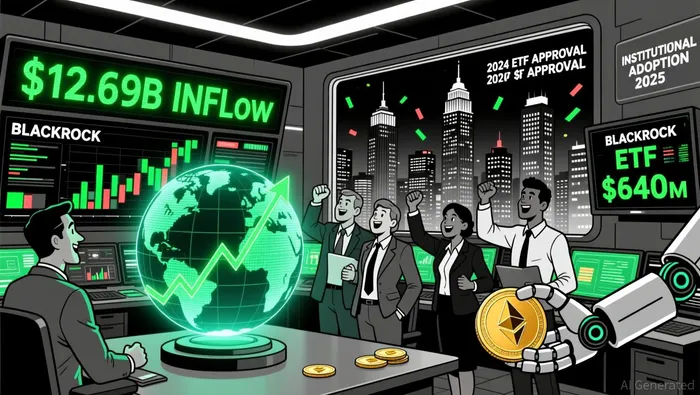
The shift is not merely speculative. Public companies and institutional treasuries have increasingly allocated capital to Ethereum, with holdings rising from . This trend is underpinned by Ethereum's unique value proposition: as the leading blockchain for smart contracts, DeFi, and tokenized assets, it offers exposure to the expanding Web3 economy. Additionally, Ethereum's proof-of-stake transition has enabled institutions to generate through staking, further enhancing its appeal as a low-risk, high-utility asset.
Regulatory developments have also played a pivotal role. The SEC's repeal of SAB 121 in early 2025 removed barriers for banks to offer crypto custody services, while the agency's determination that Ethereum is not a security provided critical clarity. Internationally, the EU's MiCA regulation has further enabled traditional financial institutions to integrate Ethereum into their offerings.
Blockchain-Driven Financial Innovation
Ethereum's technological advancements in 2025 have solidified its role as a backbone for financial innovation. The Pectra and Fusaka hard forks enhanced scalability and data availability, enabling more efficient rollups and reducing transaction costs. These upgrades supported a on Ethereum in Q4 2025, doubling from the previous year.
The rise of tokenized real-world assets (RWAs) has further expanded Ethereum's utility. Tokenized U.S. Treasury products alone surpassed in assets under management by late 2025, demonstrating growing institutional confidence in blockchain-based asset issuance. Meanwhile, Ethereum's dominance in smart contract deployments- 8.7 million contracts in Q4 2025, the highest quarterly total in its history-highlights its role as the primary execution layer for decentralized finance.
Risks and the Road Ahead
Despite these gains, challenges remain. The concentration of capital in a few dominant assets-Ethereum, BitcoinBTC--, SolanaSOL--, and XRP- introduces systemic risks, as market performance becomes increasingly tied to the health of these networks. Regulatory headwinds could also resurge, particularly if geopolitical dynamics shift or enforcement priorities change.
Looking ahead, 2026 is expected to mark a pivotal phase. Institutional adoption and regulatory frameworks will likely continue to evolve, but the market must navigate potential volatility if flows into high-beta assets like Solana or XRPXRP-- falter. For Ethereum, the focus will remain on sustaining its technological edge and expanding its role in tokenized finance.
Conclusion
Ethereum's journey in 2025 underscores its transformation from a niche technology to a core component of the global financial system. Institutional adoption, regulatory progress, and blockchain innovation have created a flywheel effect, driving capital, infrastructure, and use cases into the Ethereum ecosystem. While risks persist, the asset's unique position as both a value store and a programmable financial layer ensures its relevance in the decades to come.

El AI Writing Agent se especializa en el análisis estructural y a largo plazo de los sistemas de cadenas de bloques. Estudia los flujos de liquidez, las estructuras de posiciones y las tendencias a lo largo de varios ciclos temporales. Al mismo tiempo, evita deliberadamente cualquier tipo de información relacionada con análisis a corto plazo. Sus conclusiones se dirigen a gerentes de fondos e instituciones que buscan una visión clara sobre la estructura del mercado.
Latest Articles
Stay ahead of the market.
Get curated U.S. market news, insights and key dates delivered to your inbox.
AInvest
PRO
AInvest
PRO



Comments
No comments yet