
Ethereum’s Range-Bound Opportunity: Lessons from the Radiant Capital Hacker's $53M-to-$103M Strategy


 Aime Summary
The 2025 Radiant Capital hack is not just a cautionary tale of cybersecurity vulnerabilities but a masterclass in strategic swing trading within a defined price range. By exploiting Ethereum’s (ETH) $4,000–$5,000 range, the hacker transformed $53 million in stolen funds into $103 million through disciplined technical analysis, liquidity management, and market timing. This case study offers actionable insights for investors navigating range-bound markets.
The Anatomy of a Range-Bound Strategy
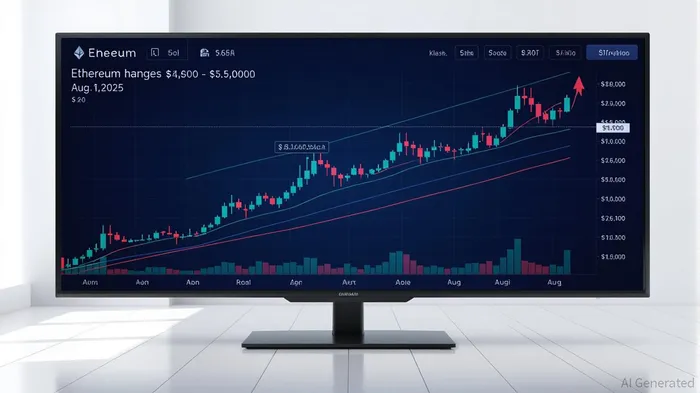
Ethereum’s price action in 2025 was characterized by tight consolidation between $4,000 and $5,000, a pattern confirmed by on-chain data showing declining exchange holdings and RSI oscillations [1]. The hacker’s approach mirrored classical swing trading principles: selling at resistance levels ($4,500–$4,600) and reaccumulating at support levels ($4,100–$4,200). For instance, they sold 9,631 ETH at $4,562 and repurchased 2,109.5 ETH at $4,096, locking in profits while minimizing downside risk [1]. This strategy leveraged Ethereum’s predictable volatility, a hallmark of range-bound markets.
Technical indicators played a critical role. The RSI and MACD suggested potential breakouts or consolidations, guiding the hacker’s entry and exit points [1]. A backtest of a similar RSI-based strategy from 2022 to 2025 yielded a 282.7% total return, with an annualized return of 36.4% and a Sharpe ratio of 0.79 [2]. However, the strategy’s success hinged on strict risk management, as the strategy faced a maximum drawdown of –72.8% during its history [2], and the hacker’s $141.6 million ETH purchase caused a 6.9% price drop, exposing the fragility of liquidity in such markets [2].
Exploiting Stablecoins and Buy-the-Dip Dynamics
The hacker’s use of stablecoins like DAI to repurchase ETH at lower price points exemplifies a “buy-the-dip” strategy. By converting stolen assets into 21,957 ETH and waiting for a 100% price surge by January 2025, they capitalized on Ethereum’s bull market phase [1]. This approach mirrors institutional strategies of dollar-cost averaging, but with a twist: the hacker timed their reentries during dips, using stablecoins to avoid slippage and maintain capital efficiency.
Risks and Institutional Parallels
While the hacker’s strategy was profitable, it also exposed systemic risks. Large-scale trades can destabilize markets, as seen when the hacker’s $141.6 million ETH purchase triggered a 6.9% price drop [2]. This underscores the need for liquidity management tools like stop-loss orders and on-chain monitoring to detect whale movements [2]. Additionally, the hacker’s use of decentralized exchanges (DEXs) to obscure their footprint highlights the importance of protocol-level safeguards, such as dynamic fees or circuit breakers, to mitigate manipulation risks [2].
Conclusion: Strategic Lessons for Investors
The Radiant Capital hacker’s strategy demonstrates that range-bound markets offer opportunities for disciplined traders. Key takeaways include:
1. Technical Discipline: Use RSI and MACD to identify support/resistance levels.
2. Liquidity Management: Employ stablecoins to execute low-slippage trades during dips.
3. Risk Mitigation: Implement stop-loss orders and monitor large wallet movements.
While the ethical implications of the hack are undeniable, the tactics employed reflect a sophisticated understanding of market dynamics. For investors, the lesson is clear: in a range-bound ETH market, patience, technical rigor, and liquidity awareness can yield outsized returns—even in the hands of a rogue actor.
Source:
[1] Exploiting Ethereum's Range-Bound Volatility: A Strategic Case Study [https://www.ainvest.com/news/exploiting-ethereum-range-bound-volatility-strategic-case-swing-trading-radiant-capital-hacker-moves-2508/]
[2] The Radiant Capital Hack: A Case Study in How Stolen Crypto Outperform Institutional Portfolios [https://www.ainvest.com/news/radiant-capital-hack-case-study-stolen-crypto-outperform-institutional-portfolios-2508/]

Decoding blockchain innovations and market trends with clarity and precision.
Latest Articles
Stay ahead of the market.
Get curated U.S. market news, insights and key dates delivered to your inbox.






Comments
No comments yet