
Ethereum's Price Surge: A Confluence of Network Upgrades and Institutional Adoption


 Aime Summary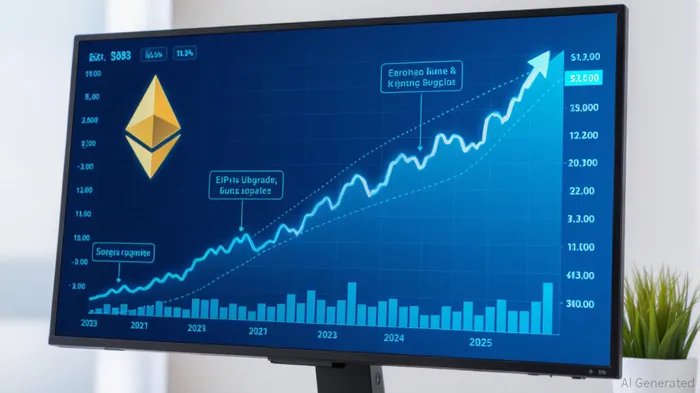
Ethereum's recent price surge isn't just a fleeting crypto rally—it's a seismic shift driven by a perfect storm of technical innovation, institutional validation, and regulatory clarity. As the second-largest cryptocurrency by market cap, ETH is no longer a speculative gamble but a foundational asset in the evolving digital economy. Let's dissect why this momentum is more than a short-term story and why investors should view EthereumETH-- as a long-term play.
The Technical Tailwinds: Efficiency Gains and Scalability
Ethereum's post-merge upgrades have been nothing short of transformative. The EIP-4844 (proto-danksharding) implementation in early 2024 slashed gas fees by up to 90% for Layer 2 rollups, making the network not just faster but affordable for mass adoption. This isn't just a technical fix—it's a strategic pivot that positions Ethereum as the backbone for decentralized finance (DeFi) and enterprise-grade applications.
The Pectra upgrade in May 2025 further cemented this narrative. By raising the maximum validator balance to 2,048 ETH, the upgrade pushed staked ETH to 35.7 million, or 29.6% of the total supply. This not only enhances network security but also reinforces Ethereum's deflationary model, with annual supply reductions of ~1.32% due to reduced validator rewards. For investors, this scarcity dynamic mirrors Bitcoin's halving logic but with added utility.
Institutional Adoption: From Speculation to Strategic Asset
The institutionalization of Ethereum is the second pillar of its long-term value. Over 69 major firms now hold 4.1 million ETH ($17.6 billion), with companies like BitMine ImmersionBMNR-- (BMNR) and CoinbaseCOIN-- (COIN.US) leading the charge. BMNR's pivot from BitcoinBTC-- to Ethereum—acquiring 1.15 million ETH for staking—generated $87 million in annual yields, proving that Ethereum isn't just a speculative asset but a yield-generating one.
This shift is mirrored in the broader market. The launch of U.S. spot Ethereum ETFs, including BlackRock's ETHA, has unlocked $27 billion in assets under management (AUM) within a year, rivaling Bitcoin's ETF growth. These products have attracted both retail and institutional capital, with inflows of $2.2 billion in a single week. The CME's physically settled Ether futures have further enhanced Ethereum's appeal for hedging and portfolio diversification.
Regulatory Clarity: The SEC's Role in Legitimacy
Regulatory uncertainty has long been crypto's Achilles' heel. But in 2025, the U.S. Securities and Exchange Commission (SEC) under Chair Paul Atkins classified Ethereum as a commodity, aligning it with Bitcoin. This decision removed a critical barrier for institutional participation, allowing banks, asset managers, and public companies to invest without legal risk.
The GENIUS Act's passage in the U.S. House of Representatives further solidified this trend by regulating stablecoins—tokens often issued on Ethereum. This legislative clarity has turned Ethereum from a “wild west” asset into a regulated, institutional-grade product.
Ethereum's Expanding Utility: DeFi and Real-World Assets
Beyond staking and ETFs, Ethereum's dominance in DeFi and tokenized real-world assets (RWAs) is a game-changer. As of Q2 2025, Ethereum's DeFi total value locked (TVL) stands at $50 billion, or 60.88% of the global DeFi market. This isn't just about apps—it's about Ethereum becoming the infrastructure for the next generation of finance.
Moreover, Ethereum is now tokenizing everything from corporate debt to gold-backed assets and U.S. Treasury bills. These RWAs are turning Ethereum into a bridge between traditional finance and blockchain, creating a flywheel of demand that transcends speculative trading.
The Investment Thesis: Why Ethereum Is a Must-Have
For investors, Ethereum's current momentum is a rare confluence of technical, institutional, and regulatory tailwinds. The network's efficiency gains ensure it remains competitive with newer blockchains, while its institutional adoption and ETF-driven inflows provide a floor for price appreciation.
The deflationary supply model, combined with growing utility in DeFi and RWAs, creates a virtuous cycle: higher demand, lower supply, and recurring yield potential. This is a stark contrast to Bitcoin's purely speculative narrative.
Actionable Advice:
1. Allocate to Ethereum ETFs for regulated exposure, particularly those with low expense ratios and strong institutional backing (e.g., ETHA).
2. Monitor staking yields as a proxy for Ethereum's institutional adoption. Firms like BMNR and COIN.US are key indicators.
3. Diversify into Ethereum-based RWAs as the market matures, focusing on tokenized assets with real-world collateral.
In a crypto landscape rife with volatility, Ethereum's structural advantages make it a compelling long-term investment. This isn't just a bet on a coin—it's a bet on the future of finance.

Decoding blockchain innovations and market trends with clarity and precision.
Latest Articles
Stay ahead of the market.
Get curated U.S. market news, insights and key dates delivered to your inbox.




Comments
No comments yet