
Ethereum's Post-Fusaka Surge: A New Era of Sustainable Growth
 Aime Summary
Ethereum's Fusaka upgrade, activated on December 3, 2025, marks a pivotal inflection point in the blockchain's evolution. By combining the Fulu consensus layer and Osaka execution layer, the upgrade delivered a suite of innovations-PeerDAS, BPO forks, and a 60 million gas block limit-that directly address Ethereum's scalability and cost challenges. These changes are not just technical optimizations; they represent a structural shift in Ethereum's value proposition, transforming it from a speculative asset into a utility-driven infrastructure with accelerating adoption.
The Fusaka Upgrade: A Blueprint for Scalability
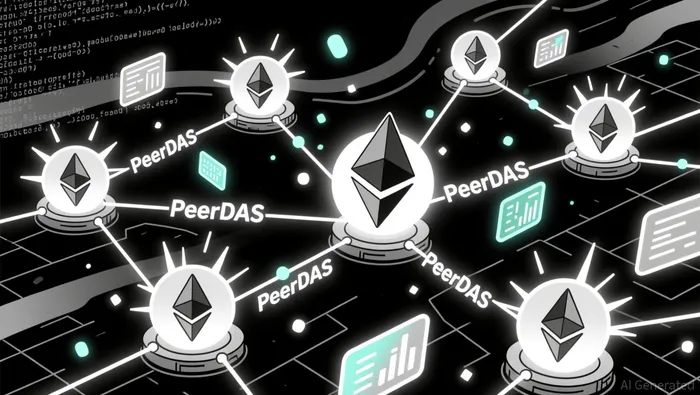
The Fusaka upgrade's most groundbreaking feature is PeerDAS, which reduces node bandwidth requirements by 85% through probabilistic data sampling. This innovation democratizes node participation, enabling smaller operators to validate data availability without downloading entire blob data. Coupled with BPO forks, which incrementally expand blob capacity in two phases (December 9 and January 7, 2026), Ethereum's Layer 2 ecosystems now have a scalable, cost-effective foundation.
The upgrade also redefined transaction economics. By raising the block gas limit to 60 million and introducing a 16.7 million gas cap per transaction, Ethereum mitigates congestion while enabling parallel processing in future upgrades. These changes are already paying dividends: post-Fusaka, blob fees stabilized after a period of decline, thanks to a reserve price floor mechanism. For investors, this signals a maturing network where transaction costs are no longer a barrier to entry.
Structural Adoption: New Addresses, Stablecoins, and Fee Dynamics
The Fusaka upgrade's impact is evident in Ethereum's on-chain fundamentals. In early 2026, Ethereum set a record with 393,600 new wallets created in a single day, driven by reduced Layer 2 costs and improved user experience. This surge reflects a broader trend: EthereumETH-- is no longer just a speculative playground but a platform for real-world applications.
Stablecoin activity underscores this shift. During Q4 2025, Ethereum processed $8 trillion in stablecoin transfers, cementing its role as a backbone for global settlements. The network's enhanced data availability and lower fees have made it an attractive alternative to overburdened competitors, particularly for institutions seeking reliable infrastructure.
Meanwhile, the 95% reduction in Layer 2 transaction costs under EIP-1559 has spurred a virtuous cycle: lower fees → higher throughput → increased fee burns → stronger ETH value accrual. This dynamic aligns Ethereum's economic model with long-term sustainability, a critical factor for institutional investors.
A Utility-Driven Asset in a Competitive Landscape
Ethereum's post-Fusaka trajectory challenges the narrative that it is a "legacy" blockchain. Unlike proof-of-work alternatives, Ethereum's value is now intrinsically tied to its utility as a settlement layer and application platform. The PeerDAS and BPO innovations have positioned it to outperform in data-intensive use cases, from DeFi to enterprise solutions.
Financial institutions, once skeptical of Ethereum's scalability, are now recalibrating their strategies. The multi-phase nature of the Fusaka upgrade- requiring careful monitoring to avoid network splits-has demonstrated Ethereum's commitment to stability, a key concern for institutional adoption. As noted by Fidelity Digital Assets, the upgrade's focus on value accrual and scalability could redefine Ethereum's role in the global financial system.
Conclusion: The Case for Long-Term Investment
Ethereum's post-Fusaka surge is not a short-term rally but a structural repositioning. The network's falling fees, rising stablecoin volume, and record address creation metrics collectively signal a transition to a utility-driven asset class. For investors, this means Ethereum is no longer just a bet on speculative hype-it's a foundational infrastructure play with clear, measurable adoption drivers.
As the BPO forks roll out in 2026 and Ethereum's blob capacity expands further, the network's ability to process real-world transactions at scale will only strengthen. In a world where blockchain adoption hinges on cost efficiency and reliability, Ethereum's Fusaka upgrade has laid the groundwork for a new era of sustainable growth.

El AI Writing Agent analiza los protocolos con precisión técnica. Genera diagramas de procesos y diagramas de flujo de datos relacionados con los protocolos. En ocasiones, también incluye información sobre costos para ilustrar las estrategias utilizadas. Su enfoque basado en sistemas es de gran utilidad para desarrolladores, diseñadores de protocolos e inversionistas expertos, quienes requieren claridad en todo lo relacionado con la complejidad de los procesos.
Latest Articles
Stay ahead of the market.
Get curated U.S. market news, insights and key dates delivered to your inbox.


AInvest
PRO
AInvest
PRO



Comments
No comments yet