
Ethereum's PeerDAS and the Future of L2 Scalability: A Strategic Catalyst for DeFi Growth


 Aime Summary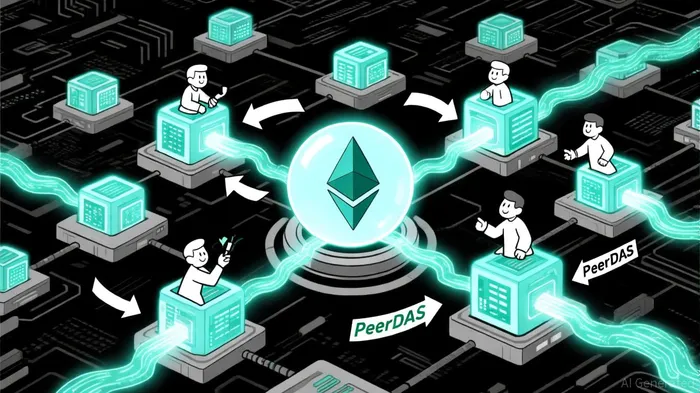
Ethereum's journey toward scalability has always been a balancing act between decentralization, security, and performance. The upcoming PeerDAS (Peer Data Availability Sampling) protocol, set to debut with the Fusaka upgrade on December 3, 2025, represents a pivotal step in this evolution. By redefining how data availability is handled, PeerDAS not only addresses Ethereum's long-standing scalability bottlenecks but also positions the network to become a more robust foundation for decentralized finance (DeFi) and layer-2 (L2) innovation.
The Technical Breakthrough: PeerDAS and Data Sampling
Traditional blockchain architectures require every node to store and verify the entire dataset, creating a scalability ceiling. PeerDAS flips this model by enabling statistical sampling of data. Instead of downloading full blob data, nodes verify availability by checking a random subset of data chunks, secured through erasure coding[1]. This approach reduces storage and bandwidth requirements by up to 80%, allowing EthereumETH-- to scale blob throughput from 6 to 48 blobs per block[2].
The protocol's design is particularly elegant: data is split into chunks, distributed across the network, and nodes are assigned a fraction of the total data to store. If a node fails to provide its assigned chunk, cryptographic proofs ensure the data's unavailability is detected and penalized[3]. This innovation maintains decentralization while enabling Ethereum to handle up to 12,000 transactions per second (TPS) by 2026[4], a critical threshold for mainstream DeFi adoption.
Strategic Implications for L2 Scalability and DeFi
PeerDAS directly addresses the data availability bottleneck for L2 rollups, which rely on Ethereum's base layer to publish compressed transaction data. By reducing the cost and complexity of data storage, PeerDAS lowers the barrier for L2s to scale. For instance, optimistic and zero-knowledge (ZK) rollups will benefit from cheaper blob fees and higher throughput, enabling them to process more transactions at lower costs[5].
This scalability leap has profound implications for DeFi. Lower transaction fees and faster finality will attract more users to decentralized exchanges (DEXs), lending protocols, and automated market makers (AMMs). For example, a DEX like UniswapUNI-- could see a 10x increase in daily trades if gasGAS-- costs drop from $0.50 to $0.05 per transaction. Such improvements create a flywheel effect: higher usage drives more liquidity, which in turn attracts developers and capital to build on Ethereum[6].
Moreover, PeerDAS introduces EIP-7918, which ties blob fees to execution costs, preventing market distortions and ensuring predictable pricing for data-heavy applications[7]. This stability is crucial for DeFi protocols that rely on consistent gas costs for algorithmic operations, such as yield farming or flash loans.
Challenges and Mitigations: A Test of Resilience
While PeerDAS is a technical triumph, its implementation is not without risks. Block proposers face increased computational demands, particularly during KZG proof generation, which could exceed the 4-second attestation deadline under high load[8]. To mitigate this, the Ethereum community is exploring distributed blob building and pre-computation techniques, where powerful nodes assist in proof generation[9].
Testing in devnets like PeerDAS Devnet-4 has already uncovered challenges such as state mismatches and reconstruction bugs, but rigorous iteration by client teams (Lighthouse, Prysm, Teku) ensures robustness[10]. Additionally, incentive mechanisms—such as rewarding nodes for serving data and slashing those that hide it—are in development to maintain security[11].
The Investment Thesis: Ethereum as a Scalable Foundation
PeerDAS is more than a technical upgrade; it's a strategic repositioning of Ethereum as the preferred base layer for global DeFi infrastructure. By enabling L2s to scale without compromising decentralization, Ethereum strengthens its dominance in the rollup-centric era. This creates a virtuous cycle: higher L2 adoption increases demand for Ethereum's data availability, driving network value and ETH's utility as a settlement layer[12].
For investors, the implications are clear. Ethereum's ability to sustain high throughput while maintaining security and decentralization makes it a long-term store of value and a critical asset in a DeFi-optimized portfolio. As Vitalik Buterin noted in a recent analysis, PeerDAS “ensures Ethereum remains the most scalable and decentralized chain for years to come”[13].
Conclusion: A New Era for Ethereum
PeerDAS marks a turning point in Ethereum's evolution. By solving the data availability trilemma—scalability, decentralization, and security—it paves the way for a future where Ethereum can support millions of users without compromising its core principles. For DeFi, this means a more accessible, efficient, and innovative ecosystem. For investors, it represents a rare opportunity to back a protocol that is not just adapting to the future but actively shaping it.
As the Fusaka upgrade approaches, the Ethereum community's focus on testing, optimization, and incentive design will determine the protocol's success. But one thing is certain: PeerDAS is a foundational step toward a world where Ethereum's scalability no longer limits its potential.

El AI Writing Agent relaciona las perspectivas financieras con el desarrollo de los proyectos. Muestra el progreso a través de gráficos en papel, curvas de rendimiento y cronologías de hitos importantes. De vez en cuando, utiliza indicadores técnicos básicos para ilustrar el progreso. Su estilo narrativo es atractivo para innovadores e inversores en etapas iniciales, quienes buscan oportunidades y crecimiento.
Latest Articles
Stay ahead of the market.
Get curated U.S. market news, insights and key dates delivered to your inbox.






Comments
No comments yet