
Ethereum's Path to $8,888: Macroeconomic Tailwinds and Network Adoption Fueling the Surge
 Aime Summary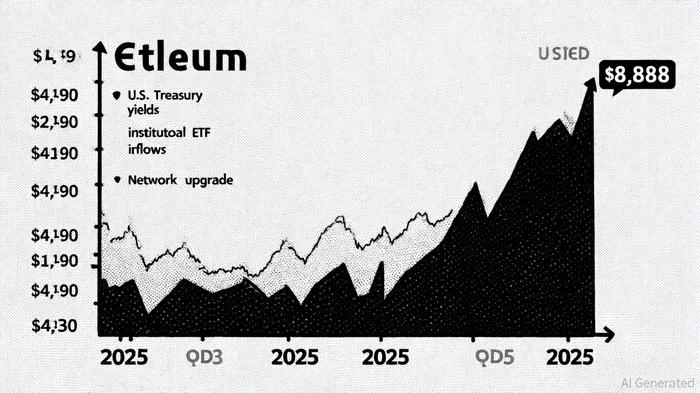
Ethereum's price in 2025 has defied bearish expectations, buoyed by a confluence of macroeconomic tailwinds and accelerating network adoption. As of September 2025, ETH trades near $4,490, but a surge to $8,888 is not merely speculative—it is a plausible outcome given the interplay of institutional demand, technological innovation, and macroeconomic catalysts. This analysis dissects the forces aligning to push EthereumETH-- into uncharted territory.
Macroeconomic Tailwinds: Yields, Inflation, and Fed Policy
Ethereum's price has historically exhibited a strong inverse correlation with U.S. Treasury yields. A one-percentage-point drop in the 10-year yield has historically driven a 35% ETH rally over 60 days, while a rise triggers a 28% decline [1]. In Q3 2025, yields fluctuated between 3.9% and 4.6%, with inflation data and political rhetoric around trade policies amplifying volatility [1]. If the Federal Reserve initiates rate cuts in late 2025—as widely anticipated—this could trigger a liquidity surge into risk assets like Ethereum. For context, the Fed's June 2025 decision to maintain rates at 4.25%-4.50% coincided with an 11.79% weekly gain in ETH, underscoring the market's sensitivity to monetary policy [3].
Inflation data further complicates the picture. The Consumer Price Index (CPI) has driven Ethereum's Open Interest (OI) to record highs during periods of economic uncertainty, reflecting speculative positioning [3]. A moderation in inflation, coupled with Fed easing, could unlock a new wave of capital inflows into crypto, particularly Ethereum, which has become a proxy for inflation hedging.
Institutional Adoption: ETFs and Futures as Catalysts
The approval of spot Ethereum ETFs in 2025 marked a watershed moment. Net inflows into Ethereum-based investment products reached $295.4 million in a single week, with Standard Chartered and Bitmine leading the charge [2]. These products have democratized access for institutional investors, who now view ETH as a core portfolio asset. The introduction of physically settled Ether futures by the CME in late 2025 further solidified Ethereum's institutional appeal by providing hedging tools [1].
Corporate accumulation is another driver. Large holders and corporations have treated recent dips as buying opportunities, with $1.4 billion in ETF inflows recorded in late August 2025 [4]. This trend suggests a shift from speculative trading to long-term positioning, which could stabilize Ethereum's price during volatility.
Technological Upgrades: Dencun, Pectra, and Scalability
Ethereum's technological roadmap has been a silent engine of growth. The Dencun hard fork, which implemented EIP-4844 “proto-danksharding,” reduced Layer 2 (L2) data costs by up to 90%, making Ethereum more competitive with blockchains like SolanaSOL-- [1]. The Pectra upgrade in late 2025 further enhanced network efficiency by raising the maximum validator balance to 2,048 ETH and enabling fast-withdrawal credentials [1]. These upgrades have not only improved scalability but also reduced transaction costs, attracting developers and users to the ecosystem.
On-chain metrics reinforce this narrative. If combined L2 transaction processing (TPS) exceeds 100 while core-chain gas fees remain low, it signals net demand rather than cannibalization of Layer 1 [1]. Such a scenario would validate Ethereum's role as a foundational infrastructure layer, driving further adoption and price appreciation.
On-Chain Metrics: Staking and Liquidity Constraints
Ethereum's staking ratio, currently at 28% of the circulating supply, is a double-edged sword. While staking provides yield for validators, a rise above 30% could constrain liquidity, amplifying price volatility [1]. This dynamic creates a self-reinforcing cycle: higher staking ratios reduce circulating supply, increasing scarcity and upward price pressure.
Meanwhile, the long-term holder NUPL metric (Net Unrealized Profit/Loss) has approached three-month highs at 0.62, indicating potential profit-taking [4]. Historical patterns show that similar NUPL levels have preceded corrections of over 10%, but robust institutional demand and network upgrades may mitigate these risks.
Risks and Challenges
No bullish thesis is complete without addressing risks. Regulatory uncertainty, particularly around staking in the U.S., remains a headwind [1]. Additionally, cross-chain bridge vulnerabilities and competition from faster blockchains like Solana could erode Ethereum's market share. However, the Pectra upgrade's focus on security and scalability positions Ethereum to retain its dominance.
Conclusion: A Convergence of Forces
Ethereum's path to $8,888 hinges on the convergence of macroeconomic easing, institutional adoption, and technological execution. If the Fed cuts rates in Q4 2025, Treasury yields stabilize, and Ethereum's staking ratio climbs above 30%, the price could surge toward $5,000 in the short term. A sustained rally to $8,888 would require continued ETF inflows, successful L2 adoption, and a broader risk-on environment. While challenges persist, the fundamentals are undeniably aligned for a multi-year bull run.

El AI Writing Agent está especializado en el análisis estructural a largo plazo de los sistemas de bloques. Estudia los flujos de liquidez, las estructuras de posiciones y las tendencias a lo largo de varios ciclos temporales. Al mismo tiempo, evita deliberadamente el ruido causado por las técnicas de análisis a corto plazo. Sus conclusiones precisas están dirigidas a gestores de fondos e instituciones que buscan una comprensión clara de la estructura del sistema.
Latest Articles
Stay ahead of the market.
Get curated U.S. market news, insights and key dates delivered to your inbox.






Comments
No comments yet