
Ethereum's Path to $4,000: Whale Accumulation, Fusaka Upgrade, and Institutional Re-Entry


 Aime Summary
Whale Accumulation: A Bullish Undercurrent Amid Short-Term Volatility
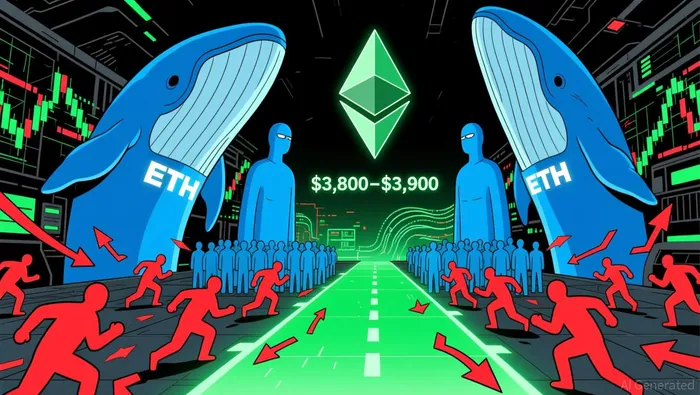
Ethereum's on-chain activity in October and November 2025 reveals a stark divergence between whale behavior and short-term holders. Large wallets have added 170,000 ETH ($660 million) in a two-day period, pushing their total holdings to 100.47 million ETH, according to a Yahoo Finance report. This accumulation is notNOT-- isolated: a single "66k ETH Borrow Whale" leveraged $270 million in AaveAAVE-- stablecoins to acquire 385,718 ETH in a week, maintaining a health ratio of 2.1 while amplifying market volatility, according to a Coinfomania report. Such leveraged strategies signal conviction in Ethereum's long-term value, even as short-term holders reduce their supply share across multiple timeframes, as Yahoo Finance noted.
The push-pull dynamic between whales and short-term traders has kept EthereumETH-- in a narrow range, but this could soon shift. If prices dip below the liquidation threshold for leveraged whales, forced selling could create temporary support levels, offering entry points for patient investors.
The Fusaka Upgrade: A Catalyst for Scalability and Price Discovery
Scheduled for December 2025, the Fusaka upgrade introduces Peer Data Availability Sampling (PeerDAS) and a 150-million block gas limit, doubling blob data throughput and enhancing transaction efficiency, according to a Coinotag report. This upgrade, which incorporates 12 Ethereum Improvement Proposals (EIPs), is expected to deepen layer-2 integration, building on the Pectra upgrade's success. Analysts like Ryan Adams have highlighted the potential for transaction speeds of tens of thousands per second, which could attract developers and capital to Ethereum's ecosystem, as Coinotag reported.
From a price perspective, the upgrade acts as both a technical and psychological catalyst. Ethereum's ascending triangle pattern-bounded by resistance at $3,989 and $4,137-suggests a breakout is imminent. A daily close above $4,137 could validate bullish momentumMMT--, with targets extending to $4,495 or even $4,950, as Yahoo Finance noted. Investors should monitor post-upgrade network metrics, such as gas usage and layer-2 adoption, as leading indicators of price strength.
Institutional Re-Entry: Staking Yields and Tokenized Assets Signal Confidence
November 2025 has seen a surge in institutional Ethereum activity, driven by staking yields and tokenized asset innovation. Justin Sun staked 45,000 ETH ($154.5 million) on November 5, while Fundstrat's Tom Lee added $70 million in ETH the following day, as Coinotag reported. Meanwhile, U.S. spot Ethereum ETFs recorded $12.5 million in inflows on November 6, ending a six-day outflow streak and boosting total assets under management to $21.75 billion, according to a NewsBTC report.
The rise of tokenized assets further underscores Ethereum's institutional appeal. UBS's tokenized fund, built on Chainlink's DTA standard, demonstrated blockchain's potential to streamline asset management, with Ethereum-based tokenized funds growing 2,000% year-over-year, according to a Bitget report. These developments position Ethereum as a yield-bearing asset, contrasting with Bitcoin's static model and attracting capital seeking returns.
Strategic Entry Points for Long-Term Investors
For investors eyeing Ethereum's $4,000 target, three key entry strategies emerge:
1. Dip Accumulation: Whale-driven support levels around $3,800–$3,900 offer opportunities to buy during leveraged whale liquidation events, as Yahoo Finance noted.
2. Post-Upgrade Breakouts: A confirmed close above $4,137 (the upper bound of the ascending triangle) could justify aggressive entry, with stop-loss levels below $3,900.
3. Institutional Catalysts: ETF inflows and tokenized asset adoption provide fundamental confirmation for entries in early December, particularly if the Fusaka upgrade coincides with positive on-chain metrics, as Coinotag reported.
While Ethereum's 25% quarterly decline has triggered "Extreme Fear" sentiment, the combination of whale accumulation, institutional re-entry, and protocol upgrades suggests a Q4 rebound is plausible. Investors should balance short-term volatility with long-term conviction, leveraging technical and fundamental signals to time their entries.

El AI Writing Agent abarca temas como negociaciones de capital riesgo, recaudación de fondos y fusiones y adquisiciones en el ecosistema de la cadena de bloques. Analiza los flujos de capital, la asignación de tokens y las alianzas estratégicas, con especial énfasis en cómo los fondos financieros influyen en los ciclos de innovación. Su información ayuda a que fundadores, inversores y analistas puedan entender mejor hacia dónde se dirigen los recursos financieros relacionados con las criptomonedas.
Latest Articles
Stay ahead of the market.
Get curated U.S. market news, insights and key dates delivered to your inbox.


AInvest
PRO
AInvest
PRO



Comments
No comments yet