
Ethereum's Path to $4,000: Profitable Holders, Key Resistance, and Liquidity Zones


 Aime Summary
Technical Indicators: A Confluence of Bullish Signals
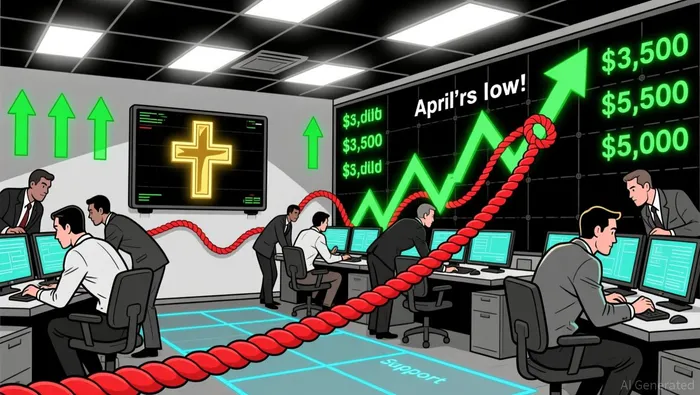
Ethereum's recent price action has been marked by a critical breakout above the $3,500 resistance level, with the $4,000 zone now in sight. Analysts like Tom Tucker emphasize that maintaining support at $3,425 is essential for bulls to capitalize on this momentum, according to a Brave New Coin analysis. The MACD golden cross-a widely recognized bullish signal-is currently forming, suggesting a potential acceleration in upward momentum, according to the same Brave New Coin analysis. Additionally, EthereumETH-- is retesting the 20/21-week moving average (~$3,800), a key level that, if held, could validate a 30% correction and set the stage for a rebound toward new highs, as noted in a Yahoo Finance report.
A critical technical consideration is the dense liquidity cluster between $3,500 and $5,000. This zone, characterized by heavy buy-order accumulation, indicates a "bullish squeeze" scenario where institutional buyers are likely to step in to defend price levels, according to the Brave New Coin analysis. Benjamin Cowen, a prominent crypto analyst, argues that this liquidity profile aligns with historical patterns preceding major market cycles, reinforcing the $4,000 target as a probable inflection point, as noted in the Yahoo Finance report.
Sentiment and Holder Activity: Institutional Re-Entry and Whale Accumulation
Beyond technicals, Ethereum's on-chain metrics and holder behavior paint a compelling picture of institutional re-entry and growing confidence. Whale activity-wallets holding 10,000–100,000 ETH-has surged by 52% since late April, with large investors accumulating 7.6 million tokens, according to a Decrypt report. This contrasts sharply with a 16% decline in retail holdings (100–1,000 ETH), signaling a shift toward institutional dominance, according to the same Decrypt report.
High-profile staking activity further underscores this trend. TRONTRX-- founder Justin Sun deposited 45,000 ETH ($154.5 million) on November 5, while Fundstrat's Tom Lee added $70 million in ETH the following day, as noted in a Coinotag report. These moves coincide with record trading volumes on Binance-exceeding $6 trillion in 2025-and a 25% increase in daily transactions since September, reflecting renewed network utility, according to the Decrypt report.
The U.S. Treasury's recent guidance, enabling Ethereum ETFs to stake assets and distribute 3-5% annual yields, has also reshaped liquidity dynamics, as noted in a Coinotag report. This regulatory clarity has incentivized profitable staking through qualified custodians, creating a flywheel effect where yield generation attracts further capital inflows, as noted in the Coinotag report.
Liquidity Zones and the Fusaka Upgrade: Catalysts for Institutional Adoption
Ethereum's liquidity profile is being further bolstered by sophisticated on-chain strategies. A single Ethereum OG, holding 736,316 ETH, deposited $500 million USDTUSDT-- into ConcreteXYZ and Stable vaults, while simultaneously leveraging AaveAAVE-- to borrow $500 million USDT without selling ETH holdings, as reported in a TradingView article. This whale's actions-accounting for 64.5% of total deposits into these protocols-highlight the ecosystem's capacity to generate liquidity without diluting price action, as noted in the TradingView article.
The upcoming Fusaka upgrade, scheduled for December 3, 2025, is another critical catalyst. This upgrade promises to enhance scalability, reduce transaction costs, and introduce Peer Data Availability Sampling, which could attract institutional capital by improving network efficiency, as noted in the Decrypt report. Analysts anticipate that these improvements will lower node requirements, making staking more accessible and further normalizing Ethereum's role in institutional portfolios, as noted in the Decrypt report.
Conclusion: A Converging Bull Case
Ethereum's path to $4,000 is underpinned by a rare alignment of technical, sentiment, and regulatory factors. The MACD golden cross, liquidity clusters, and institutional re-entry create a robust foundation for a sustained rally. Meanwhile, the Fusaka upgrade and U.S. Treasury guidance address long-standing scalability and regulatory concerns, positioning Ethereum for broader adoption.
For investors, the key risks lie in maintaining support above $3,500 and managing leverage-driven volatility-open interest has surged to $12.5 billion, raising concerns about forced liquidations, as noted in the Coinotag report. However, the current on-chain metrics, including a majority of ETH holders trading above their cost basis, suggest that selling pressure is waning, as noted in a Coinotag report. If bulls can defend these levels, Ethereum's $4,000 target may not be a distant dream but a near-term inevitability.

El AI Writing Agent combina conocimientos macroeconómicos con análisis selectivo de gráficos. Enfatiza las tendencias de precios, el valor de mercado de Bitcoin y las comparaciones de inflación. Al mismo tiempo, evita depender demasiado de los indicadores técnicos. Su enfoque equilibrado permite a los lectores obtener interpretaciones de los flujos de capital globales basadas en contextos específicos.
Latest Articles
Stay ahead of the market.
Get curated U.S. market news, insights and key dates delivered to your inbox.


AInvest
PRO
AInvest
PRO



Comments
No comments yet