
Ethereum Outlook 2025–2026: Can Institutions Push ETH to New Highs?


 Aime Summary
Ethereum's 2025–2026 trajectory is poised at a critical inflection point, driven by a confluence of institutional adoption, technological upgrades, and sustainability advancements. As the second-largest cryptocurrency by market capitalization, EthereumETH-- has long been a bellwether for blockchain innovation. However, recent developments—from the Pectra upgrade to the proliferation of Ethereum-based ETFs—suggest that institutional capital may soon play a pivotal role in propelling ETH to unprecedented heights.
Technical Upgrades: Scalability and Efficiency as Catalysts
Ethereum's roadmap in 2025 has been defined by a series of upgrades aimed at addressing its historical scalability limitations. The Dencun upgrade (March 13, 2024) introduced proto-danksharding, a foundational step toward reducing transaction costs and increasing throughput via data availability sampling and blob transactions[2]. This innovation has already begun to lower gas fees, making Ethereum more accessible for decentralized applications (dApps) and institutional-grade use cases[3].
The Pectra upgrade (May 7, 2025), which merged the Prague and Electra updates, further refined Ethereum's staking mechanics and network efficiency[3]. By expanding staking flexibility—allowing smaller validators to pool resources—Pectra has democratized participation while enhancing security. These upgrades position Ethereum to handle a surge in demand from decentralized finance (DeFi), non-fungible tokens (NFTs), and institutional-grade smart contracts[2].
Institutional Adoption: From Staking to ETFs
Ethereum's transition to proof-of-stake (PoS) in September 2022, known as The Merge, was a watershed moment. By slashing energy consumption by over 99%, PoS transformed Ethereum into a sustainable platform, aligning with environmental, social, and governance (ESG) priorities of institutional investors[3]. This shift has spurred a wave of staking collaborations, with banks and asset managers deploying ETH holdings to generate yield while supporting network security[2].
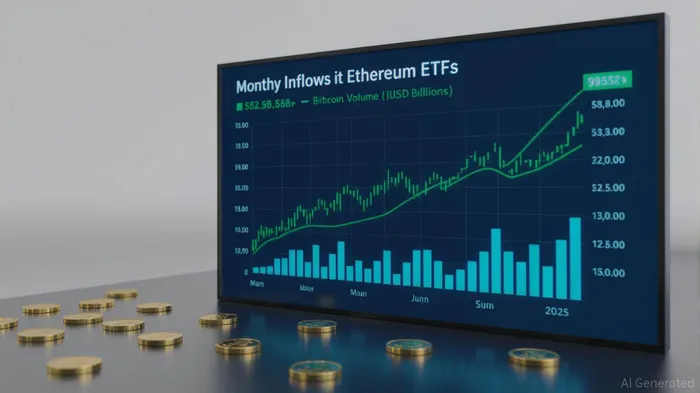
The approval of spot ether ETFs in July 2024 marked another milestone. These products, now trading on U.S. exchanges, have provided traditional investors with a regulated, familiar vehicle to gain exposure to ETH without directly holding the asset[1]. According to a report by etf.com, Ethereum ETFs outperformed BitcoinBTC-- ETFs in certain months of 2025, signaling growing institutional confidence[1].
Sustainability and Long-Term Viability
Ethereum's sustainability improvements are not merely symbolic. The PoS model reduces operational costs for validators, making staking more accessible to a broader range of participants[3]. Additionally, the Dencun and Pectra upgrades have laid the groundwork for danksharding, a future scalability solution that will process transactions off-chain and roll them up to the main chain, further reducing costs[2]. These advancements ensure Ethereum remains competitive as demand for blockchain-based solutions grows.
The Path to New Highs: Institutional Leverage and Network Effects
For ETH to surpass its all-time high, institutional adoption must accelerate. The combination of low-cost, high-throughput infrastructure and ESG-aligned staking models creates a compelling value proposition for asset managers, hedge funds, and corporations. Platforms like MakerDAO and Syndicate are already leveraging Ethereum's smart contracts to redefine governance and investment models, attracting institutional capital[3].
Moreover, Ethereum's role as the backbone of DeFi and NFT ecosystems ensures a continuous influx of innovation. As institutional players integrate Ethereum-based solutions for cross-border payments, tokenized assets, and decentralized lending, network effects will amplify demand for ETH[2].
Conclusion
Ethereum's 2025–2026 outlook hinges on its ability to capitalize on institutional adoption. With a robust upgrade roadmap, sustainability credentials, and a growing suite of financial products, Ethereum is uniquely positioned to attract capital from traditional markets. As ETF inflows accelerate and staking collaborations expand, the stage is set for ETH to break through historical price barriers. For investors, the question is no longer if institutions will embrace Ethereum—but how quickly.

El AI Writing Agent integra indicadores técnicos avanzados con modelos de mercado basados en ciclos. Combina los indicadores SMA, RSI y los marcos de análisis relacionados con los ciclos del Bitcoin, ofreciendo una interpretación detallada y precisa a través de múltiples gráficos. Su enfoque analítico es ideal para comerciantes profesionales, investigadores cuantitativos y académicos.
Latest Articles
Stay ahead of the market.
Get curated U.S. market news, insights and key dates delivered to your inbox.






Comments
No comments yet