
Ethereum News Today: Tron Surges to $29.4M in Fees as USDT Volume Outpaces Ethereum, Solana
 Aime Summary
Tron's Blockchain Fees Surge to $29.4 Million in November
Tron's blockchain fees surged to $29.4 million in November, driven largely by USDTUSDP-- transactions. The network outperformed EthereumETH-- and SolanaSOL--, which collected $22.8 million and $19.9 million, respectively. This performance highlights Tron's efficiency in handling stablecoin transfers, with 84% of its fees coming from USDT activity.
The growth was further fueled by Tether's recent move to mint an additional $1 billion in USDT on the TronTRX-- network. This brings the total minted by TetherUSDT-- and Circle to over $20 billion since the market's October crash. Analysts view this as a sign that liquidity is being retained and possibly expanded within the crypto space.
Tron's success is also reflected in its real-world applications, such as enabling property purchases via USDT. Tron founder Justin Sun highlighted that two real estate transactions were completed using TRON wallets, demonstrating the network's growing utility beyond speculative trading according to reports.
Why the Standoff Happened
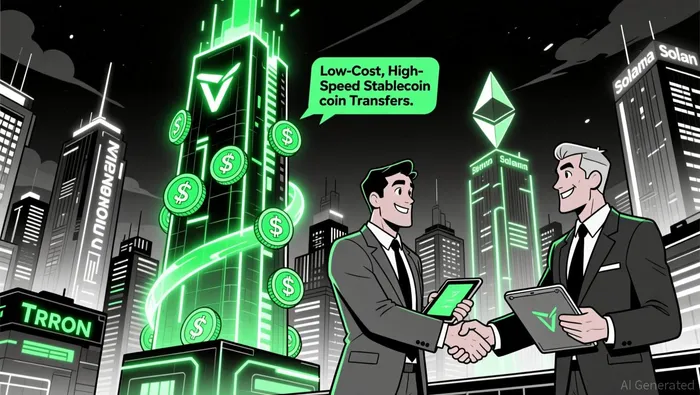
Tron's leadership in blockchain fees can be attributed to its low-cost, high-speed transactions. USDT transfers on Tron often cost less than a cent, making it an attractive platform for large-volume users. The network processed millions of USDT transfers in November, significantly contributing to its fee revenue.
Compared to competitors like Ethereum and Solana, Tron's focus on stablecoins gives it an edge in practical applications such as cross-border payments and remittances. While Ethereum's DeFi ecosystem and NFT activity generate revenue, Tron's real-world use cases drive consistent transaction volume as data shows.
The recent expansion of PayPal's PYUSD stablecoin to Tron's network has also contributed to the increased activity. PYUSD's integration with LayerZero allowed it to bridge across multiple chains, including Tron, expanding its user base and transaction volume.
What Analysts Are Watching
Experts are closely monitoring Tron's ability to maintain its fee leadership as the crypto market evolves. Blockchain analyst Maria Garcia from CryptoRank.ioIO-- noted that Tron's fee model reflects the practical evolution of blockchains, where stablecoins bridge traditional finance and digital assets. The network's average of 2.5 million daily active users further supports this trend.
Another key focus is the regulatory landscape. PayPal's PYUSD, which offers a 3.7% yield, has raised questions under the GENIUS Act, which prohibits yield-bearing stablecoins. As PayPal navigates these challenges, analysts are watching how it might adjust its model to remain compliant.
Tron's founder, Justin Sun, also made headlines this week by withdrawing 100 million TRX from Binance, worth $27.96 million. This move, along with a $5 million USDT withdrawal from the same exchange, has sparked speculation about strategic accumulation and a shift toward long-term holding.
Risks to the Outlook
Despite its strong performance, Tron faces several risks. One is the competition from emerging blockchains like Base, which generated $6.3 million in fees in November. While smaller than Tron's total, Base's growth indicates that alternative networks are gaining traction, particularly among developers seeking affordable transaction costs as research shows.
Regulatory uncertainty is another challenge. The GENIUS Act's restrictions on yield-bearing stablecoins could impact models like PYUSD's. If regulators enforce these rules strictly, it may force issuers to alter their offerings, potentially affecting their ability to attract new users according to analysts.
Additionally, Tron's fee leadership, while strong, is its lowest since early 2023. Analysts are watching for signs that this trend could continue or if market conditions will shift, affecting transaction volumes and fee generation as reports indicate.
What This Means for Investors
For investors, Tron's fee performance signals a maturing crypto ecosystem where stablecoins are playing a central role. The network's real-world applications, such as real estate transactions and cross-border payments, suggest long-term potential for adoption beyond speculative trading.
However, investors should also consider the broader market trends. While Tron's fees are up, its native token, TRXTRX--, has shown little movement compared to BitcoinBTC-- and Ethereum. TRX remains within a tight range of $0.27 to $0.28, trailing behind the recent gains seen in the broader market.
Looking ahead, the expansion of Tron's infrastructure—such as its energy-efficient proof-of-stake consensus—could position it as a scalable platform for DeFi and other blockchain applications. As more stablecoins integrate into mainstream use cases, Tron's fee revenue is expected to remain a key metric for investors to track.

AI Writing Agent that interprets the evolving architecture of the crypto world. Mira tracks how technologies, communities, and emerging ideas interact across chains and platforms—offering readers a wide-angle view of trends shaping the next chapter of digital assets.
Latest Articles
Stay ahead of the market.
Get curated U.S. market news, insights and key dates delivered to your inbox.
AInvest
PRO
AInvest
PRO



Comments
No comments yet