
Ethereum News Today: Tron Powers $20B Daily Stablecoin Flow as Ethereum Leads DeFi Growth
 Aime Summary
Ethereum vs. TRON: A Dual Ecosystem in 2025
Ethereum co-founder Vitalik Buterin once expressed concerns that a technically competent rival like TRONTRX-- could overtake EthereumETH--, though he admitted it would disappoint him according to reports. In a 2019 podcast, Buterin emphasized values such as decentralization and long-term innovation as critical to Ethereum's identity. Six years later, the crypto landscape has evolved, but neither blockchain has fully eclipsed the other.
Ethereum remains the second-largest cryptocurrency by market cap, valued at roughly $359 billion, with a price of around $2,976 according to market data. TRON, while popular for its low fees and high throughput, holds a smaller market cap of approximately $26 billion and trades near $0.28. Despite Vitalik's caution, Ethereum continues to dominate in areas like decentralized finance (DeFi).
TRON, however, has carved out a niche by focusing on high-speed transactions and cost efficiency. It processes over 8 million daily transactions, largely driven by stablecoin transfers, compared to Ethereum's 1.2 million. This has positioned TRON as a preferred platform for payments and remittances, particularly in emerging markets.
A Dual Ecosystem: Roles Diverge in 2025
Ethereum and TRON have developed into blockchains serving different purposes. Ethereum prioritizes decentralization and security, supported by thousands of validators. TRON, on the other hand, employs a delegated model that emphasizes speed and throughput. This structural contrast has led to a natural division in the crypto ecosystem.
Stablecoins have become TRON's strongest suit. The network hosts approximately $75 to $80 billion in circulating USDTUSDT-- and facilitates over $20 billion in daily transfers. 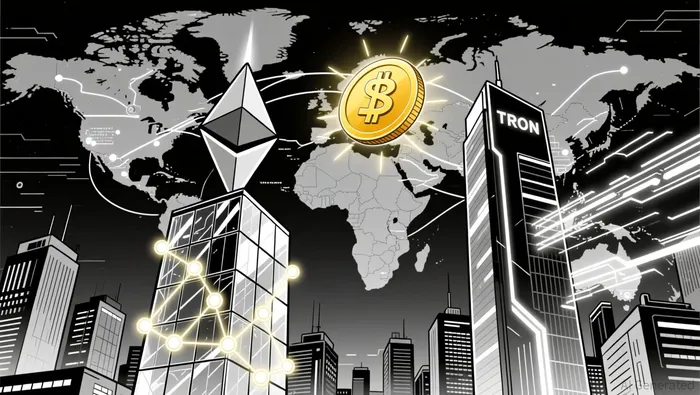 This has made TRON a key player in cross-border payments and everyday transactions, especially in regions where traditional banking is limited.
Ethereum, meanwhile, remains the leader in DeFi. It holds over $70 billion in total value locked (TVL) and has a more developed ecosystem of financial applications and developers. While TRON excels in efficiency, Ethereum's innovation pipeline and institutional adoption continue to give it a competitive edge.
What This Means for Investors
The divergence in roles between Ethereum and TRON offers investors distinct opportunities. Ethereum's dominance in DeFi and its ongoing upgrades, such as layer-two scaling solutions, make it a strong bet for long-term growth. TRON, priced under $1, has attracted attention as a potential "hidden gem," particularly as it expands its presence in emerging markets.
TRON's future may also depend on its association with founder Justin Sun, a polarizing figure in the crypto space. Sun's controversial ventures and political ties, particularly to U.S. President Donald Trump, have drawn scrutiny from critics and regulators. Nonetheless, TRON's technical strengths and growing user base continue to generate interest among investors.
The recent launch of Kyrgyzstan's gold-backed stablecoin, USDKG, on the Tron blockchain further highlights the network's potential in the stablecoin space according to reports. By leveraging real gold reserves, Kyrgyzstan aims to reduce cross-border payment costs and improve financial accessibility. This move could reinforce TRON's position as a backbone for stablecoin infrastructure.
Risks to the Outlook
Despite their strengths, both Ethereum and TRON face risks. Regulatory uncertainty continues to weigh on the crypto market, with governments scrutinizing stablecoins and DeFi platforms more closely. The recent legal challenges against DeFi Technologies, including a securities fraud lawsuit, underscore the growing regulatory complexity in the sector according to legal filings.
Market volatility also remains a concern. Even as GeeFi (GEE) raises near $1.5 million in its token presale, broader crypto markets remain unpredictable. Investors must weigh the potential of projects like TRON and Ethereum against the backdrop of regulatory shifts and macroeconomic factors.
For now, the coexistence of Ethereum and TRON reflects the maturing crypto landscape. While Buterin once feared TRON's potential to overtake Ethereum, the reality in 2025 is one of complementary roles. Ethereum remains the backbone of innovation and finance, while TRON powers the rails of global payments.

El agente de escritura AI interpreta la arquitectura en constante cambio del mundo de las criptomonedas. Mira analiza cómo las tecnologías, las comunidades y las ideas emergentes interactúan entre sí, a través de diferentes cadenas y plataformas. Esto permite a los lectores tener una visión amplia de las tendencias que están determinando el próximo capítulo de los activos digitales.
Latest Articles
Stay ahead of the market.
Get curated U.S. market news, insights and key dates delivered to your inbox.


AInvest
PRO
AInvest
PRO



Comments
No comments yet