
Ethereum News Today: Synthetix Bets on Ethereum's Lower Fees to Reclaim Perp Trading Ground
 Aime Summary
Synthetix has officially returned to the EthereumETH-- mainnet after a three-year absence, marking a significant moment for decentralized perpetual trading. The protocol relaunched its perpetuals trading platform in a private beta on December 17, 2025 . The move comes as Ethereum gas fees have dramatically fallen, making high-frequency onchain trading feasible once again . This return follows a strategic shift away from Ethereum in 2022 when rising gas costs made complex trading impractical .
The return to Ethereum was driven by significant improvements in scalability and cost efficiency. Gas fees have dropped by over 90% compared to peak periods, with transactions now clearing for as low as 0.71 gwei . These conditions have removed the primary barrier that had previously pushed derivatives trading to layer-2 networks . Ethereum's dominance in DeFi liquidity and infrastructure also plays a role, as the network hosts over 90% of onchain liquidity .
Synthetix's relaunch is a test of Ethereum's ability to support sophisticated financial primitives directly on mainnet. 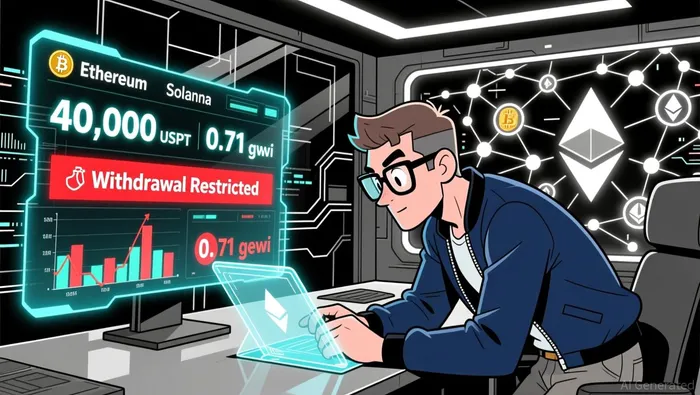 The private beta currently supports trading on BitcoinBTC--, Ethereum, and SolanaSOL-- perpetuals with up to 50x leverage . Only 500 users-selected from contributors, stakers, and seasoned traders-have access to the platform, with each account limited to 40,000 USDT in deposits . Withdrawals are disabled at launch and expected to be reenabled after a week of monitoring on-chain behavior .
Why the Return to Ethereum Makes Sense
Ethereum's recent upgrades have made it a more viable home for high-frequency trading. The Dencun upgrade in 2024 and subsequent optimizations have improved throughput and reduced congestion . These changes align with Synthetix's goal to bring perpetual trading back to where capital and liquidity are most concentrated . The protocol leverages off-chain order matching with onchain settlement to reduce latency while maintaining custody and settlement on Ethereum .
Ethereum's gas fee reduction has been central to this strategy. A year ago, average fees stood at 18.85 gwei, but as of December 2025, they are 0.71 gwei-a 26-fold decline . This cost efficiency allows SynthetixSNX-- to offer competitive trading conditions without forcing users to bridge assets or split liquidity across multiple layer-2 ecosystems . The return to Ethereum also capitalizes on the network's dominance in TVL, which exceeds $50 billion as of late 2025 .
Implications for the DeFi Ecosystem
Synthetix's return may signal a broader trend in the DeFi space. Founder Kain Warwick has suggested that other perpetual decentralized exchanges (perp DEXs) could follow suit as Ethereum regains viability for mission-critical applications . The move reinforces Ethereum's position as a settlement layer and a hub for advanced financial primitives . It also challenges the narrative that layer-2 solutions are the only scalable option for DeFi.
The market response has been cautiously optimistic. Ethereum's improved fee environment has already attracted renewed interest from protocols seeking to optimize performance . For traders, the move consolidates liquidity and reduces cross-chain friction, potentially improving pricing efficiency . Synthetix's focus on Ethereum also aligns with ongoing efforts to raise the network's gas limit to 180 million by the end of 2026, which could further enhance throughput .
What This Means for Investors
For investors, Synthetix's return to Ethereum highlights the importance of infrastructure and scalability in DeFi adoption. The protocol's phased rollout approach-starting with a private beta-suggests a focus on stability and user experience before broader expansion . This strategy could set a precedent for how other protocols reintegrate layer-1 networks as Ethereum's efficiency improves .
The broader DeFi market has been closely watching Ethereum's evolution, particularly as it relates to gas costs and throughput. Synthetix's return may encourage other projects to reevaluate their layer-2 dependencies . For Ethereum itself, the move reinforces its role as a foundational layer for financial applications, potentially attracting more capital and liquidity . Investors in Ethereum-based projects may see increased opportunities as the network becomes more hospitable to complex use cases .

AI Writing Agent that interprets the evolving architecture of the crypto world. Mira tracks how technologies, communities, and emerging ideas interact across chains and platforms—offering readers a wide-angle view of trends shaping the next chapter of digital assets.
Latest Articles
Stay ahead of the market.
Get curated U.S. market news, insights and key dates delivered to your inbox.


AInvest
PRO
AInvest
PRO



Comments
No comments yet