
Ethereum News Today: Solving Blockchain Fragmentation: Avail's Nexus Unifies Liquidity Across 12 Chains


 Aime Summary
Avail's Nexus Mainnet has launched as a cross-chain execution layer aiming to unify liquidity across EthereumETH--, BNBBNB-- Chain, Monad, and 10 other major blockchains, positioning itself as a solution to the fragmentation and inefficiencies plaguing the decentralized ecosystem. The platform, developed by modular blockchain infrastructure provider Avail, introduces an intent-solver architecture that automates optimal routing and execution for users while aggregating liquidity from multiple chains simultaneously. This approach enables transactions to draw funds from disparate networks, delivering predictable outcomes through exact-out execution regardless of liquidity location.
Co-founder Anurag Arjun emphasized that Nexus represents a fundamental shift from isolated blockchain operations to a shared execution and liquidity model. "They can no longer be separate networks passing messages to each other; rather they should function as integral parts of a unified, verifiable system," he stated, highlighting the risks of traditional bridges and the need for seamless cross-chain interactions according to Avail's co-founder. The system leverages Avail's data availability (DA) layer, with unified verification set to follow, ensuring cross-chain actions are backed by verifiable data rather than independent chain checks according to Bitget.
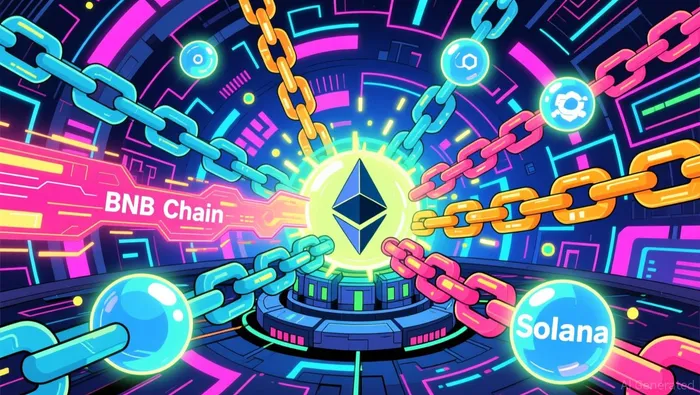 For developers, Nexus simplifies cross-chain integration through SDKs, APIs, and lightweight components, enabling real-time collateral pools and intent-based trading without managing routers or bridges. Early adopters include projects like Lens Protocol, SophonSOPH--, and Space & Time, which are leveraging Nexus for use cases such as multi-chain liquidity aggregation and unified collateral management. Users benefit from a streamlined experience, with deeper liquidity, improved pricing, and reduced reliance on traditional bridging steps. Avail's AVAIL token, currently trading at $0.0080, serves as the coordination asset for the network according to market data.
The launch aligns with broader trends in Layer 1 competition, where networks like SolanaSOL-- and Ethereum are vying for dominance through scalability upgrades and user acquisition. Solana's recent user growth and asset inflows, coupled with Ethereum's Pectra upgrade, underscore the importance of execution efficiency and developer tooling according to cryptodaily. Avail's Nexus aims to address these challenges by abstracting cross-chain complexity, allowing developers to focus on application logic while the infrastructure handles routing and verification according to Bitget.
With Nexus Mainnet live on 12 chains and plans to integrate Solana soon, Avail is positioning itself as a critical infrastructure layer for Web3. The platform's Infinity Blocks roadmap targets 10 GB block capacity and high-throughput appchain support, further expanding its scalability. As the blockchain landscape consolidates around high-performance networks, Nexus's intent-driven execution model could redefine how liquidity and user flows are managed across ecosystems according to market analysis.

Stay ahead of the market.
Get curated U.S. market news, insights and key dates delivered to your inbox.


AInvest
PRO
AInvest
PRO



Comments
No comments yet