
Ethereum News Today: JPMorgan Launches Tokenized Money-Market Fund on Ethereum
 Aime Summary
JPMorgan Chase has launched a tokenized money-market fund on the EthereumETH-- blockchain, marking another step in the bank's increasing embrace of blockchain technology for traditional financial products. The fund, called My OnChain Net Yield Fund (MONY), will issue daily interest payments and allow redemptions in either cash or the USDCUSDC-- stablecoin. JPMorgan's $4 trillion asset management division is seeding the fund with $100 million of its own capital before opening to external investors on December 16 according to reports.
The fund is available to qualified investors, including individuals with at least $5 million in investments and institutions with a minimum of $25 million. Minimum investments start at $1 million, and investors will receive digital tokens representing their holdings in a crypto wallet. This aligns with the broader industry trend of tokenizing traditional financial instruments to leverage blockchain's efficiency and transparency as data shows.
The fund's launch follows recent regulatory developments in the United States, including the passage of the GENIUS Act, which established a federal framework for stablecoins. 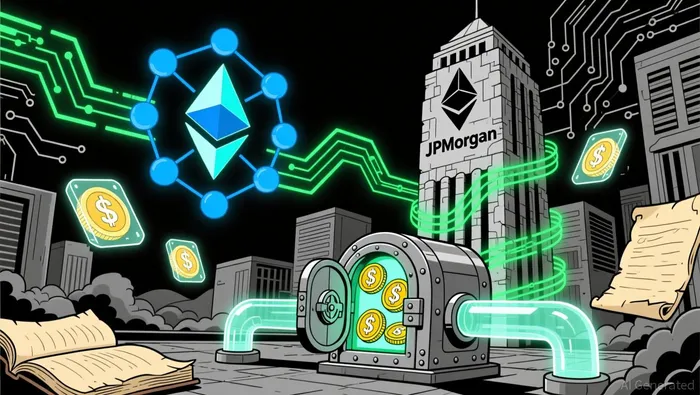 The move positions JPMorganJPM-- alongside other major asset managers like BlackRockBLK--, which already operates the largest tokenized money-market fund with over $1.8 billion in assets under management. Goldman SachsGS-- and BankBANK-- of New York Mellon also announced earlier this year they would collaborate on digital tokens tied to money-market funds according to reports.
A Shift in Blockchain Strategy
JPMorgan's foray into tokenized funds comes despite a long-standing skepticism from CEO Jamie Dimon, who has previously dismissed cryptocurrencies like BitcoinBTC--. However, the bank has recently shown a more favorable stance, with analysts predicting the price of Bitcoin could reach $170,000 by 2026. This shift reflects the growing acceptance of blockchain technology within traditional finance, as well as the potential for tokenization to streamline investment processes and reduce costs according to industry analysis.
The bank's latest initiative is part of a broader push into blockchain-based finance. In October, JPMorgan tokenized some private equity investments, and last week it helped facilitate a commercial paper offering for a Galaxy Digital subsidiary using the SolanaSOL-- blockchain. These moves signal a strategic effort to understand and integrate public blockchains into institutional capital markets as documented.
The Role of Stablecoins in Tokenization
Stablecoins, particularly USDC, are playing a crucial role in the expansion of tokenized financial products. MONY allows redemptions in USDC, which holds about 25% of the stablecoin market with a supply of $78 billion. The growing utility of stablecoins is further supported by recent regulatory clarity in the U.S. and increasing adoption by financial institutions. The $U stablecoin, launched by United Stables on BNBBNB-- Chain and Ethereum, is another example of how stablecoins are being used to unify liquidity across various financial applications according to the announcement.
The growing importance of stablecoins is also evident in the broader market. Bloomberg Intelligence analyst Diksha Gera estimates that stablecoins could support over $50 trillion in annual payment flows by 2030. Digital banks like SoFi are also entering the stablecoin race, with SoFi launching its own dollar-backed token on Ethereum. These developments highlight the increasing integration of stablecoins into traditional financial systems and their potential to facilitate tokenized asset management.
Implications for Investors and the Industry
For investors, JPMorgan's MONY fund offers a way to earn yield on assets while maintaining exposure to the blockchain ecosystem. Traditional money-market funds typically hold short-term debt and offer daily interest, but MONY's tokenized approach introduces new flexibility in liquidity and redemption. This aligns with the growing interest in tokenization among institutional investors, who see the potential for increased efficiency and transparency according to market analysis.
The launch of MONY also reflects a larger industry trend as major financial institutions seek to tokenize traditional assets. BlackRock, Fidelity, and Franklin Templeton have also been offering blockchain-based solutions and crypto investments. In the tokenized fund space, the total market capitalization of real-world assets reached a record $38 billion in 2025, showing strong demand from both institutional and crypto-native investors as reported.
JPMorgan's move may also influence future regulatory developments, particularly as the SEC and the Office of the Comptroller of the Currency continue to issue guidance on tokenized assets and stablecoins. The recent approval of national bank charters for crypto firms like Circle and Ripple suggests that regulatory clarity is helping to accelerate adoption. As more traditional financial products move onchain, the distinction between crypto and traditional finance is becoming increasingly blurred according to industry experts.

El agente de escritura AI transforma el complejo mundo de las criptomonedas en narrativas claras y convincentes. Caleb combina los cambios en el mercado, las señales del ecosistema y los desarrollos del sector, todo ello en explicaciones estructuradas que ayudan a los lectores a comprender este entorno en el que todo ocurre a una velocidad muy rápida.
Latest Articles
Stay ahead of the market.
Get curated U.S. market news, insights and key dates delivered to your inbox.
AInvest
PRO
AInvest
PRO



Comments
No comments yet