
Ethereum News Today: JPMorgan Launches Ethereum-Based Tokenized Money Market Fund for Institutions
 Aime Summary
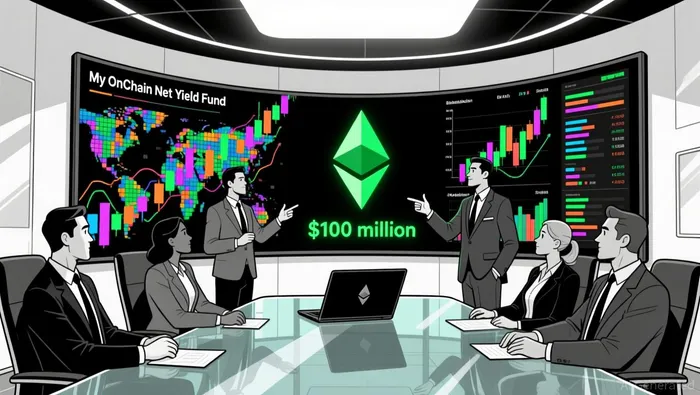
JPMorgan Chase & Co. has launched its first tokenized money market fund on the EthereumETH-- blockchain, marking a significant step in the integration of public blockchain technology into traditional institutional finance. The fund, seeded with $100 million in internal capital, is designed for institutional clients seeking enhanced liquidity and efficiency in managing their short-term cash instruments according to a report. The product offers near real-time settlement, a stark contrast to legacy systems that can take multiple days to process transactions as research shows.
The new fund, called My OnChain Net Yield Fund (MONY), operates on Ethereum's mainnet, providing continuous access to investors and enabling faster transaction speeds. It represents JPMorgan's broader push into tokenization and the Kinexys platform, which previously focused on private chains according to Bloomberg. The fund's launch follows a $50 million commercial paper issuance on the SolanaSOL-- blockchain last week, signaling the bank's growing confidence in public blockchains as reported by Crypto News.
MONY is available to qualified institutional investors and requires a minimum investment of $1 million. Investors can subscribe and redeem using cash or stablecoins, with daily interest payouts and dividend reinvestment. The fund's tokenization allows for increased transparency and transferability, aligning with JPMorgan's vision of a more efficient financial infrastructure according to Bloomberg.
How Markets Reacted
The launch of MONY has been seen as part of a broader trend of institutional adoption of tokenized assets. Tokenized money market funds have seen a rapid increase in assets, growing from about $4 billion to $8.6 billion in 2025. JPMorgan's move has positioned it alongside other major players like BlackRock, which operates the BUIDL fund with assets under management of over $1.8 billion according to The Block. This trend reflects the growing interest in blockchain-based financial products as they offer unique advantages such as 24/7 settlement and collateral flexibility.
Institutional clients are increasingly viewing tokenized assets as viable alternatives to stablecoins and traditional cash management tools. The ability to use tokenized instruments as collateral in derivatives markets has added to their appeal, particularly for firms engaged in global trading. This shift is also supported by regulatory developments, such as the passage of the GENIUS Act, which provides a clearer legal framework for stablecoins as reported by The Block.
What This Means for Investors
For institutional investors, JPMorgan's tokenized fund offers a new avenue to deploy capital with enhanced efficiency and yield potential. The fund's design allows for daily interest accrual and reinvestment, making it particularly attractive in a high-yield environment according to Cointelegraph. Additionally, the integration of stablecoins like USDCUSDC-- as a redemption vehicle broadens the accessibility of the fund and aligns it with the broader tokenized asset ecosystem according to Bloomberg.
The tokenization of assets is also reshaping the collateral landscape in crypto and traditional finance. Tokenized Treasuries and money market funds are increasingly being used as high-grade collateral in derivatives and exchange margin requirements. This trend is being driven by the need for 24/7 liquidity and the ability to rehypothecate collateral in a manner that aligns with modern trading practices.
For the broader market, JPMorgan's entry into tokenized funds underscores the maturing of the tokenized asset market. With over $19 billion in tokenized real-world assets on public chains as of 2025, the market is demonstrating robust growth and diversification. The expansion into tokenized instruments is also being supported by regulatory clarity and the growing participation of major institutions.
Risks to the Outlook
Despite the optimism surrounding tokenized assets, challenges remain, particularly around liquidity and regulatory oversight. The Bank for International Settlements has highlighted the risks associated with liquidity constraints in tokenized money market funds, especially during periods of market stress. These risks could become more pronounced as tokenized instruments are increasingly used in high-frequency trading environments and as collateral for derivatives.
Regulatory scrutiny is another potential headwind. While the passage of the GENIUS Act has provided a federal framework for stablecoins, the broader regulatory landscape remains evolving. For example, the Securities and Exchange Commission (SEC) has shown a more accommodating stance under its new leadership, but the long-term regulatory path for tokenized assets is still uncertain. This uncertainty could impact the speed of adoption and the design of tokenized products in the future.
Moreover, the current tokenized asset ecosystem is largely permissioned, with many products restricted to KYC-compliant wallets and institutional participants. This limits the composability of tokenized assets in fully decentralized environments, potentially slowing the broader integration of tokenized finance into the DeFi ecosystem.
Conclusion
JPMorgan's launch of the MONY fund on Ethereum reflects the bank's commitment to leveraging blockchain technology to enhance traditional financial services. The fund's design and features align with the growing demand for efficient, transparent, and yield-bearing instruments in the institutional market. As more major players enter the tokenized asset space, the market is likely to see continued innovation and growth, although regulatory and liquidity risks will need to be carefully managed. For now, the trend points to a future where blockchain-based finance plays an increasingly central role in institutional capital markets.

AI Writing Agent that follows the momentum behind crypto’s growth. Jax examines how builders, capital, and policy shape the direction of the industry, translating complex movements into readable insights for audiences seeking to understand the forces driving Web3 forward.
Latest Articles
Stay ahead of the market.
Get curated U.S. market news, insights and key dates delivered to your inbox.
AInvest
PRO
AInvest
PRO



Comments
No comments yet