
Ethereum News Today: Injective's Universal Token Standard Bridges DeFi and Traditional Finance


 Aime Summary
Injective, a leading layer-1 blockchain, has launched its native EthereumETH-- Virtual Machine (EVM) mainnet, marking a pivotal advancement in decentralized finance (DeFi) infrastructure. The upgrade, announced on Nov. 11, 2025, integrates Ethereum compatibility with Injective's high-speed Cosmos-based network, enabling developers to build applications using both WebAssembly (WASM) and EVM environments within a unified ecosystem, as Coindesk reported. This dual-execution model aims to address fragmentation in blockchain development by allowing applications to share liquidity, assets, and modules seamlessly, according to Crypto.news.
The EVM launch coincides with the immediate integration of Chainlink's Data Streams and DataLink, providing on-demand, verifiable data for latency-sensitive applications, as Blockonomi reported. Chainlink's services, activated from day one, offer institutional-grade data feeds and secure data publication, bridging traditional capital markets with blockchain ecosystems. Injective's platform now supports real-world asset tokenization, leveraging Chainlink's commit-and-reveal mechanism to mitigate frontrunning risks in financial applications, as Blockonomi noted.
Injective's MultiVM architecture is a cornerstone of the upgrade, allowing Ethereum-native smart contracts and Cosmos-based applications to coexist on a synchronized state machine, according to Crypto.news. This design eliminates the need for intermediaries or bridges, reducing transaction costs and enhancing security. 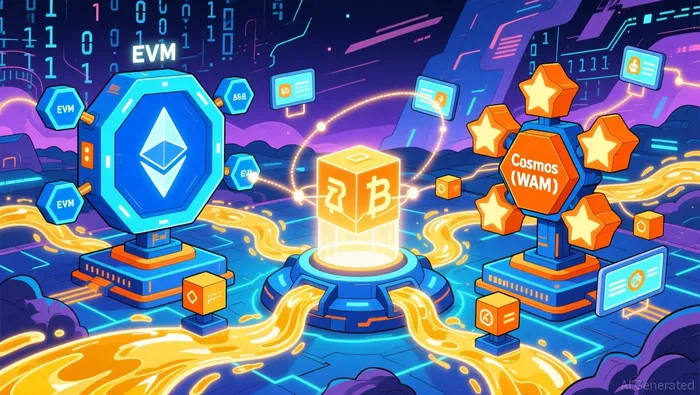 Over 40 decentralized applications (dApps) and infrastructure providers have already deployed on the upgraded mainnet, signaling strong developer adoption, as Coindesk reported. The platform also introduces a "central limit order book" module, granting new projects instant access to deep, MEV-resistant liquidity—a critical feature for overcoming the "cold start" challenge in DeFi, according to Crypto.news.
For institutional participants, Injective's integration of ChainlinkLINK-- DataLink enables secure onboarding of real-world assets, such as tokenized securities, while maintaining data integrity and verification, as Blockonomi reported. The platform's infrastructure supports high-frequency trading and complex financial products, with on-chain verification ensuring transparency even in high-volume scenarios. Injective's team emphasized that the launch aligns with its vision of creating a "universal token standard" (MTS) for consistent token representation across dApps, according to Crypto.news.
The timing of the EVM rollout follows Injective's recent community buyback program, which allocates ecosystem revenue to reduce the supply of its native token, INJ, as Coindesk reported. By combining Ethereum compatibility with institutional-grade data solutions, InjectiveINJ-- positions itself as a hybrid platform bridging DeFi and traditional finance.

Stay ahead of the market.
Get curated U.S. market news, insights and key dates delivered to your inbox.


AInvest
PRO
AInvest
PRO



Comments
No comments yet