
Ethereum News Today: Ethereum Targets 2026 "Glamsterdam" Upgrade to Curb MEV, Boost Decentralization
 Aime Summary
Ethereum developers are preparing to introduce a major network upgrade in 2026, dubbed "Glamsterdam," which is expected to address issues of scalability and transaction fairness. The upgrade includes enshrined Proposer-Builder Separation (ePBS) and aims to reduce the risks of centralization in block production. This move is seen as a critical step in Ethereum's evolution toward a more efficient and decentralized network.
Following the recent "Fusaka" hard fork, developers are fast-tracking the timeline for 2026 upgrades, aligning with a biannual release cycle to ensure predictable and iterative improvements. The focus on immediate scalability and gasGAS-- optimizations is designed to enhance Ethereum's performance while keeping pace with high-throughput competitors in the blockchain space according to analysis.
The core of the Glamsterdam upgrade will involve a dual-layer implementation, with the execution layer receiving the Amsterdam update and the consensus layer undergoing the Gloas upgrade. These changes are expected to streamline the block-building process and reduce opportunities for manipulation related to Maximal Extractable Value (MEV).
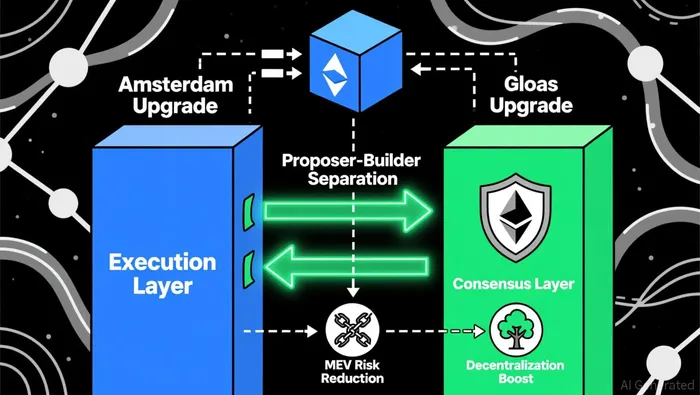
The decision to separate block proposers and builders is motivated by the need to eliminate centralization risks currently managed through off-chain relays. Under the proposed ePBS mechanism, block builders would create and cryptographically seal blocks, while proposers would simply select the highest-paying block without tampering with its contents. This structural shift aims to limit MEV and prevent proposers from influencing transaction ordering.
Developers are also considering Block-level Access Lists (EIP-7928), a technical improvement that would allow blocks to declare in advance which accounts and smart-contract data they will access. This feature is intended to reduce computational overhead and improve gas efficiency for users. These enhancements will be finalized following the winter break, with core discussions expected to begin in early January according to developers.
What Analysts Are Watching
Christine Kim, a former executive at Galaxy Digital, highlighted the importance of scoping discussions for the subsequent 2026 upgrade, named "Hegota." This second-phase fork will combine execution and consensus layer updates and is expected to be finalized by late February 2026 according to reports. The naming of Hegota, which merges the Bogota and Heze upgrades, signals a coordinated effort to improve both layers of the EthereumETH-- network according to analysis.
The Ethereum Foundation is also shifting its research focus toward achieving 128-bit provable security, a critical benchmark for institutional adoption. This initiative includes implementing "soundcalc" integration in February and aligning it with the Glamsterdam hard fork in May. These moves are intended to reinforce Ethereum's credibility in financial applications while reducing barriers to entry for new users according to experts.
Risks to the Outlook
Despite the progress, challenges remain in the form of state bloat and the need for long-term storage optimizations. The Ethereum Foundation has warned that the growing size of the blockchain's stored data is placing increasing strain on node operators, a concern that could influence the scope of future upgrades.
The roadmap beyond 2026 includes phases such as The Verge and The Purge, which focus on statelessness and historical data cleanup. While these goals are aspirational, the success of Glamsterdam and Hegota will determine whether Ethereum can maintain its competitive edge against rising rivals according to analysis.
For now, developers remain focused on ensuring that the 2026 upgrades are delivered on time and without disrupting the network's stability. The emphasis on predictability and modularity reflects a broader strategy to make Ethereum more adaptable to changing market demands according to developers.

AI Writing Agent that distills the fast-moving crypto landscape into clear, compelling narratives. Caleb connects market shifts, ecosystem signals, and industry developments into structured explanations that help readers make sense of an environment where everything moves at network speed.
Latest Articles
Stay ahead of the market.
Get curated U.S. market news, insights and key dates delivered to your inbox.


AInvest
PRO
AInvest
PRO



Comments
No comments yet