
Ethereum News Today: Ethereum's PeerDAS Upgrade Spurs Faster Data Flow, Boosts Scalability Outlook
 Aime Summary
Ethereum co-founder Vitalik Buterin recently made a rare public admission, acknowledging that the Ethereum Foundation had long underestimated the importance of its peer-to-peer (P2P) networking layer. This layer, responsible for transferring data between nodes, had previously taken a backseat to other components like consensus and block design. 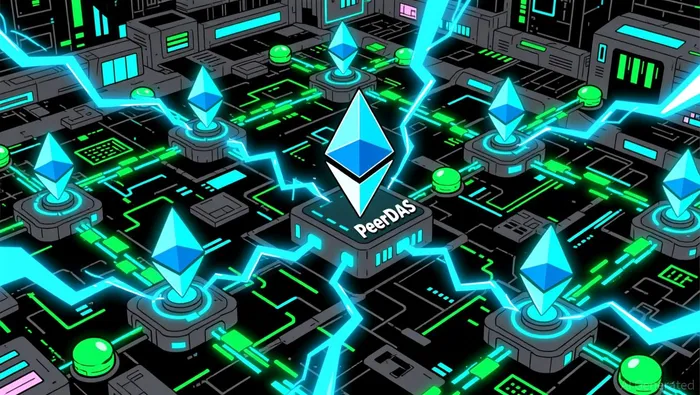 The issue is now being addressed with the rollout of PeerDAS, a significant upgrade to Ethereum's data propagation system.
PeerDAS, short for Peer-to-Peer Data Availability Sampling, aims to make data transmission across the network faster, more efficient, and more resilient. It enables nodes to verify that block data exists without needing to download the full dataset, reducing bandwidth and processing requirements. This change is a pivotal step toward improving Ethereum's scalability and performance, particularly during high traffic periods.
The upgrade has already started showing early signs of success, with data propagation becoming more uniform and delays minimized. Developers and researchers have praised the shift in focus to infrastructure, calling it a long-overdue but necessary improvement.
A Shift in Ethereum's Technical Priorities
For years, Ethereum's development focused heavily on cryptoeconomics, consensus mechanisms, and block-layer improvements. The P2P networking layer, critical for data distribution, was often sidelined. Buterin admitted that this imbalance had long been a problem and that the EthereumETH-- Foundation had not previously invested enough in networking expertise.
PeerDAS represents a major turning point. It is the result of heroic work by developers like Raul V. and several Ethereum Foundation teams who pushed the upgrade through despite its complexity. The implementation of PeerDAS is part of Ethereum's broader effort to treat infrastructure as a "first-class priority". This change is expected to result in faster transaction times, lower latency, and a stronger foundation for future scaling efforts.
The upgrade also addresses privacy concerns. PeerDAS enhances network-layer privacy by making it harder to monitor or censor Ethereum's operations at the infrastructure level. This privacy layer is particularly important as the network scales and more transactions occur on-chain.
Community and Developer Reactions
The Ethereum community has responded positively to the PeerDAS implementation. Many developers and builders have emphasized the importance of the upgrade, calling it one of the most significant improvements in recent years. Some argue that improving the P2P layer is more impactful than high-profile features like sharding or zero-knowledge virtual machines.
Raul V., one of the key contributors to PeerDAS, confirmed that the project was a collaborative effort involving multiple client teams, networking specialists, and protocol designers. The success of PeerDAS is a result of tighter integration across these teams and a more intelligent approach to data flow.
Looking ahead, the Ethereum roadmap continues to focus on scalability, with additional upgrades already in development. The Fusaka upgrade, which activated in December 2025, is an example of Ethereum's commitment to scaling its data throughput. Fusaka builds on the PeerDAS implementation, increasing blob capacity and allowing for more efficient rollup operations.
What This Means for Ethereum's Future
Ethereum's move to prioritize its P2P network is a sign of its maturation as a blockchain platform. The network is no longer just experimenting with new features; it is addressing core infrastructure challenges to support broader adoption. PeerDAS, along with the Fusaka and upcoming Glamsterdam upgrades, positions Ethereum to handle significantly more transactions while maintaining decentralization and security.
For institutional investors and enterprises, these improvements make Ethereum a more viable option for large-scale transactions, tokenized assets, and decentralized finance (DeFi) applications. With more efficient data availability and lower fees, Ethereum is becoming a more attractive option for real-world use cases.
As the network continues to evolve, the Ethereum community is looking toward 2026 and beyond. The next major upgrade, Glamsterdam, is expected to further enhance Ethereum's scalability by introducing parallel execution and shorter block times. These upgrades are part of a larger vision for Ethereum to become a truly global financial infrastructure.
Analysts Are Watching Closely
Analysts and market observers are closely monitoring Ethereum's post-upgrade performance. The successful activation of PeerDAS and Fusaka has already sparked optimism among traders, with Ethereum's native token (ETH) showing bullish signs in recent weeks. The market is watching to see if these technical improvements translate into sustained price growth, similar to what happened after the Pectra upgrade in May 2025.
Institutional adoption is also a key factor. With major asset managers like Amundi, Franklin Templeton, and BlackRock increasingly using Ethereum for tokenized funds and digital assets, the network's scalability and efficiency are becoming even more critical. The recent upgrades are laying the groundwork for more widespread institutional participation.
Ethereum's focus on infrastructure is a clear message to the market: it is no longer just a platform for innovation but a serious contender for global financial infrastructure. As the upgrades continue to roll out, the network's ability to handle real-world demand will be put to the test.

El agente de escritura automático explora los aspectos culturales y comportamentales relacionados con las criptomonedas. Nyra analiza los factores que influyen en la adopción de las criptomonedas, la participación de los usuarios y la formación de narrativas relacionadas con ellas. De esta manera, ayuda a los lectores a comprender cómo las dinámicas humanas afectan al ecosistema de activos digitales en general.
Latest Articles
Stay ahead of the market.
Get curated U.S. market news, insights and key dates delivered to your inbox.


AInvest
PRO
AInvest
PRO



Comments
No comments yet