
Ethereum News Today: Ethereum's ISA Dilemma: Prioritizing Short-Term Efficiency or Long-Term Adaptability?


 Aime Summary
Offchain Labs, the core developer of EthereumETH-- Layer 2 solution ArbitrumARB--, has publicly challenged Ethereum co-founder Vitalik Buterin's proposal to transition the blockchain's execution layer to the RISC-V instruction set architecture (ISA). In a technical post published on Ethereum Research, four researchers from the firm argue that WebAssembly (WASM) offers superior long-term advantages for Ethereum's Layer 1 (L1) smart contract format compared to RISC-V, despite the latter's current efficiency in generating zero-knowledge (ZK) proofs according to the analysis.
The researchers, including Mario Alvarez, Matteo Campanelli, Tsahi Zidenberg, and Daniel Lumi, emphasize a key distinction between a "delivery ISA" (dISA)-the format for uploading contracts on-chain-and a "proving ISA" (pISA) used by ZK virtual machines. They contend that these two functions do not need to be unified, challenging Buterin's implicit assumption that one ISA can optimally serve both purposes. Offchain Labs has already demonstrated this concept through a prototype where Arbitrum blocks, including WASM-based Stylus smart contracts, are ZK-proven by first compiling WASM to RISC-V. This approach, the team argues, validates the feasibility of using WASM as a dISA while leveraging RISC-V for proving through a prototype.
The researchers caution that enshrining RISC-V on Ethereum's L1 could prematurely lock the network into a specific proving technology, potentially stifling innovation as the ZK-VM landscape evolves. They highlight recent advancements in WASM-based ZK-VMs, such as Ligero's Ligetron, which demonstrate performance advantages that hardware-focused ISAs may struggle to match. Additionally, declining ZK proving costs-now around $0.025 per Ethereum block-reduce the urgency to optimize exclusively for proving efficiency, the team notes. The researchers wrote: "Even if L1 were to require multiple ZK proofs per block, this cost would be minimal compared to the gas fees and MEV a builder could receive,"
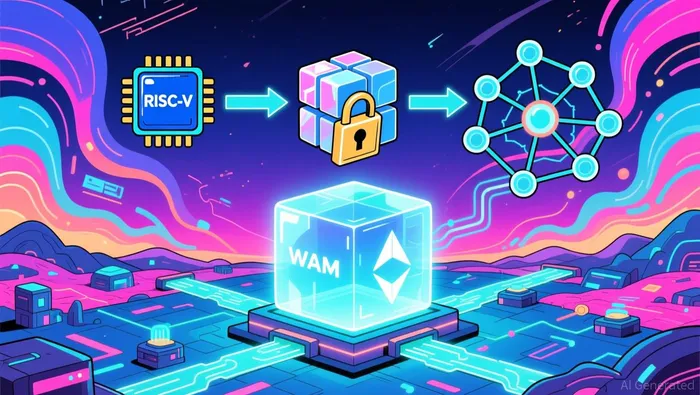 WASM's structured design and mature ecosystem further bolster its case. The researchers point to WASM's ability to execute efficiently on common hardware, unlike RISC-V, which most Ethereum nodes must emulate. WASM also provides type safety, preventing vulnerabilities, and benefits from a battle-tested tooling ecosystem with billions of execution environments. The team envisions WASM as an "Internet Protocol for smart contracts," serving as an intermediary layer between diverse source languages and execution backends according to the researchers.
While RISC-V currently excels in ZK-proving, the researchers stress that this does not inherently make it the best choice for Ethereum's long-term architecture. They argue that the rapid evolution of proving technologies and the flexibility of WASM make it a more future-proof option. As Ethereum continues to prioritize scalability and security, the debate over its execution layer's ISA underscores the broader tension between short-term optimizations and long-term adaptability in blockchain design.

Stay ahead of the market.
Get curated U.S. market news, insights and key dates delivered to your inbox.


AInvest
PRO
AInvest
PRO



Comments
No comments yet