
Ethereum News Today: Ethereum's Crypto Overhaul: Higher Gas Costs for Quantum-Resistant Future


 Aime Summary
Vitalik Buterin, co-founder of EthereumETH--, has reiterated that zero-knowledge (ZK) proofs alone cannot ensure post-quantum security and must be combined with technologies like fully homomorphic encryption (FHE) to address critical vulnerabilities. In a recent discussion, Buterin emphasized that ZKZK-- systems lack resistance to coercion in applications such as voting, necessitating hybrid architectures involving trusted execution environments (TEEs), multi-party computation (MPC), or FHE to maintain robust privacy guarantees Vitalik: ZK alone cannot provide Post-Quantum Security; it needs to be combined with additional techniques such as FHE. This stance aligns with broader concerns in the cryptographic community about the limitations of ZK in isolation, particularly as quantum computing advances threaten to undermine traditional encryption methods.
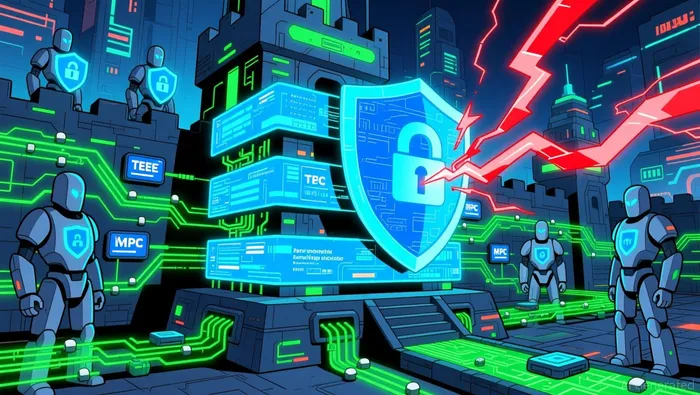 Buterin's focus on ZK-FHE integration underscores a larger push to modernize Ethereum's cryptographic infrastructure. The Ethereum co-founder has also highlighted the modexp precompile—a legacy feature for modular exponentiation—as a major bottleneck for ZK scalability. He argues that modexp's hardcoded implementation increases computational complexity for ZK-EVM proofs by up to 50 times compared to standard blocks, stifling the efficiency of ZK-rollups and other scaling solutions Vitalik Buterin Proposes Replacing Ethereum’s Modexp Precompile to Aid ZK Scalability. In a November 3 X post, Buterin described modexp as "by far the worst offender" in ZK prover inefficiency and called for an Ethereum Improvement Proposal (EIP) to replace it with equivalent EVM code, despite the anticipated rise in gas costs Vitalik Buterin Flags Modexp as ZK Scaling Bottleneck.
The modexp precompile, introduced in Ethereum's early days to optimize RSA encryption and digital signatures, has become a relic in the era of SNARK-based systems. Buterin noted that only a handful of applications still rely on modexp, including RSA verification and cross-chain bridges, which could transition to modern cryptographic protocols without performance loss. Removing modexp would streamline ZK-rollup development, reducing proof generation time and enabling faster transaction finality. However, the trade-off involves higher gas fees for affected transactions, estimated at 15-25% increases, though Buterin argues the network-wide benefits justify this cost Vitalik Buterin Proposes Replacing Ethereum’s Modexp Precompile to Aid ZK Scalability.
Ethereum's cryptographic modernization extends beyond modexp. Buterin has championed protocols like GKR (Gatekeeper-Reduced), which accelerates complex mathematical verification on consumer-grade hardware, and advocated for clearer performance metrics in ZK and FHE systems. His vision prioritizes scalability and security, aiming to phase out outdated precompiles and adopt modular architectures that align with Ethereum's post-Merge ethos. Community feedback from developer forums and events like Devcon has largely supported this direction, with many acknowledging that maintaining legacy features like modexp hinders progress Vitalik Buterin Flags Modexp as ZK Scaling Bottleneck.
For developers, the modexp replacement signals a shift toward self-sufficient EVM code, reducing dependency on specialized precompiles and enhancing cross-chain compatibility. Users stand to gain from lower transaction fees as ZK-rollups mature, though adoption will depend on the successful implementation of proposed EIPs. Buterin's call to action reflects Ethereum's commitment to continuous innovation, ensuring the network remains a leader in secure, scalable blockchain solutions.

Stay ahead of the market.
Get curated U.S. market news, insights and key dates delivered to your inbox.


AInvest
PRO
AInvest
PRO



Comments
No comments yet