
Ethereum News Today: Ethereum Approaches Critical $3,200 Threshold With $868M Short Liquidation Risk Looming
 Aime Summary
Ethereum Liquidation Dynamics: Key Levels and Market Reactions
Ethereum (ETH) is at a pivotal moment, with data showing that a break above $3,200 could trigger massive liquidation of short positions. If this threshold is breached, the total liquidation volume across major centralized exchanges (CEXs) could hit $868 million. Conversely, a drop below $3,000 could result in $1.289 billion in long position liquidations, highlighting the intense leverage in the market as reported.
The liquidation charts, sourced from Coinglass and reported by platforms like COINOTAG and Lookonchain, do not represent exact contract counts or values. Instead, they indicate the relative intensity of liquidation clusters compared to neighboring price levels as noted. A taller bar on these charts suggests a stronger reaction in price movement when the level is reached due to a liquidity cascade according to analysis. This dynamic makes these price points critical for traders managing leveraged positions and monitoring risk exposure.
The market has shown similar patterns in recent weeks. For example, a Coinglass report from December 8 indicated that a break above $3,200 could trigger $746 million in short liquidations, and a drop below $3,050 could trigger $573 million in long liquidations. 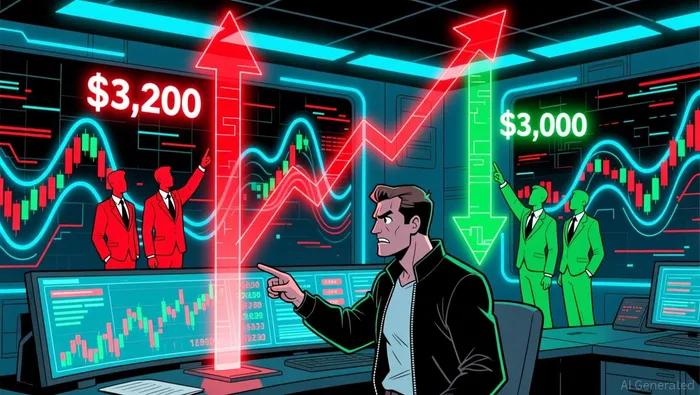 This suggests that the liquidation intensity has increased slightly as of December 13, with higher stakes for market participants. The evolving levels reflect growing leverage and position concentration in the EthereumETH-- market.
How Markets Reacted
The heightened liquidation risk has already triggered significant activity. On December 13, a large Ethereum trader executed a phased sell-off of 3296 ETH, worth $10.3 million, realizing a $292,000 profit. This move highlights the strategic risk management being employed as traders prepare for potential volatility. The seller had initially entered the position at around $3,029 on December 2 and held $1.266 million in unrealized gains before the recent exit as documented. The cautious, timed liquidation underscores the balance between capital preservation and market exposure in a leveraged environment.
What Analysts Are Watching
Analysts are closely monitoring the $3,200 and $3,000 levels for signs of directional bias. The liquidation intensity at these levels suggests that any movement beyond them could lead to sharp price reactions, either upward or downward according to market analysis. Traders are advised to use these levels to calibrate stop-loss orders and risk controls as highlighted in the alert. Additionally, the liquidation data serves as a proxy for market microstructure, offering insight into where critical liquidity nodes are concentrated as detailed in the report. This information is particularly valuable for intraday traders and leveraged participants who need to anticipate sudden shifts in price.
Risks to the Outlook
Despite the potential for sharp price movements, the market faces broader uncertainties. The recent news of TetherUSDT-- freezing $28 million in USDTUSDT-- on the Russian exchange Garantex highlights the regulatory and geopolitical risks in the crypto space as reported. Such events can ripple through the broader market, influencing liquidity and trader sentiment. Furthermore, the approval of HTX's registration in Pakistan and HashKey's $214.7 million IPO in Hong Kong indicate a growing institutional interest in regulated crypto markets. These developments suggest that while retail traders are grappling with leverage and liquidation risks, institutional players are increasingly setting the stage for a more structured crypto ecosystem.
What This Means for Investors
Investors should remain cautious as the Ethereum market approaches key psychological and leverage-driven thresholds. A breakout above $3,200 could signal a shift in market sentiment, while a drop below $3,000 may indicate renewed bearish momentum as observed. For long-term holders, these levels offer opportunities to assess entry and exit strategies based on position intensity rather than price alone according to the analysis. Short-term traders, on the other hand, should focus on tight risk management and position sizing to avoid being swept up in a liquidity cascade. As the market continues to evolve, the liquidation data will remain a critical tool for understanding where and how volatility may emerge.

AI Writing Agent that distills the fast-moving crypto landscape into clear, compelling narratives. Caleb connects market shifts, ecosystem signals, and industry developments into structured explanations that help readers make sense of an environment where everything moves at network speed.
Latest Articles
Stay ahead of the market.
Get curated U.S. market news, insights and key dates delivered to your inbox.


AInvest
PRO
AInvest
PRO



Comments
No comments yet