
Ethereum News Today: Developers Reassess L2 as Ethereum's L1 Hits "Dirt Cheap" Fees
 Aime Summary
Ethereum's co-founder Vitalik Buterin has made a bold assertion, declaring that developers no longer need to prioritize Layer 2 (L2) solutions in 2025, as Ethereum's Layer 1 (L1) has become cheap and efficient enough for direct development. This statement, posted on his X account on December 1, 2025, challenges the prevailing trend of shifting to L2 networks for cost and scalability advantages. Buterin's comments underscore a pivotal moment for EthereumETH--, as the network's upgrades and optimizations have significantly reduced transaction fees and streamlined on-chain activity.
The shift is driven by Ethereum's ongoing technical advancements, including the implementation of EIP-4844 (proto-danksharding), which slashed data costs for rollups, and the transition to Proof-of-Stake (PoS), which enhanced scalability and reduced energy consumption. Additionally, optimizations in client software and storage improvements - such as cheaper hard drives - have contributed to a gas limit increase, further lowering transaction costs. As a result, Ethereum fees have dropped to "dirt cheap" levels, with average costs now minimal compared to previous years.
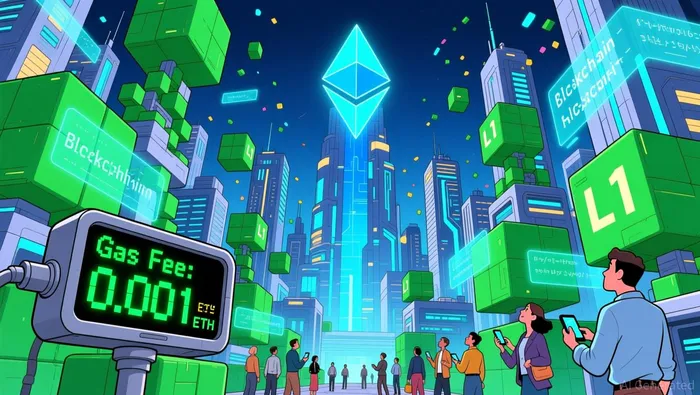 The implications for the ecosystem are profound. While L2 networks like ArbitrumARB-- and OptimismOP-- have gained traction for their lower fees and higher throughput, Buterin's stance suggests that the distinction between L1 and L2 is blurring. Developers now face a critical choice: build directly on Ethereum's mainnet, which remains affordable and secure, or leverage L2 solutions for specialized use cases. This shift could reshape the landscape, as projects may prioritize simplicity and security by deploying on L1 rather than navigating the complexities of L2 infrastructure.
Ethereum's upcoming Fusaka upgrade, set for December 3, 2025, is expected to further solidify the network's scalability and security. The upgrade, a combination of the Fulu and Osaka hard forks, aims to enhance Ethereum's ability to handle high transaction volumes from L2 chains while improving consensus and execution layer efficiency. Analysts view Fusaka as a key milestone in Ethereum's roadmap, reinforcing its position as a foundational blockchain for decentralized applications.
The broader market context also supports Ethereum's resurgence. Spot and EtherETH-- ETFs have seen a turnaround in investor sentiment, with $70 million and $312.6 million in net inflows, respectively, ending four weeks of outflows. Meanwhile, Ethereum's tokenized assets, including Fidelity's FDIT, have surged to a $260 million market cap, reflecting growing institutional interest in tokenized real-world assets (RWAs) and stablecoins.
However, the debate over Ethereum's value capture in an L2-dominated ecosystem persists. While L2s offer lower fees and higher throughput, critics question how Ethereum can monetize activity occurring off-chain. Buterin's advocacy for L1 development suggests that Ethereum's inherent security and decentralization may become more valuable as the network's base layer becomes increasingly cost-effective.
As 2025 progresses, Ethereum's ability to balance scalability with security will be critical. With Fusaka on the horizon and L1 fees at historic lows, the network is positioning itself as a versatile platform capable of supporting both traditional on-chain activity and innovative L2 solutions. For developers, the message is clear: Ethereum's mainnet is no longer a bottleneck but a viable foundation for the next wave of blockchain innovation.

Stay ahead of the market.
Get curated U.S. market news, insights and key dates delivered to your inbox.


AInvest
PRO
AInvest
PRO



Comments
No comments yet