
Ethereum News Today: Consumer GPUs Enable Ethereum's Affordable, Decentralized Scaling


 Aime Summary
Ethereum's scalability ambitions took a significant leap forward as zkSync's Airbender prover demonstrated the ability to generate a full L1 block proof using just two consumer-grade RTX 5090 GPUs. The breakthrough, confirmed ahead of the Ethproofs Day event in Buenos Aires, drew high praise from EthereumETH-- co-founder Vitalik Buterin, who called it a "huge milestone" for the network's roadmap. The achievement underscores a shift in Ethereum's scaling trajectory, where proving full L1 blocks—once thought to require specialized hardware—can now be accomplished with off-the-shelf components according to reports.
Ethereum Foundation researcher Justin Drake highlighted the implications, suggesting the breakthrough could enable "gigagas L1," a term describing a dramatic increase in Ethereum's gas limit. This would allow more transactions per block, reducing congestion and lowering fees across the ecosystem. Developers anticipate L2 fees nearing zero and making Ethereum more accessible to everyday users. The Airbender team plans to showcase the prover live at Ethproofs Day, where developers will discuss advances in zero-knowledge (ZK) technology according to announcements.
Vitalik Buterin, while lauding the progress, cautioned against over-optimism. He noted that proving times often vary by up to 60 times between average and worst-case blocks, emphasizing the need for sustainable solutions. He proposed repricing gas for computationally intensive operations like RSA verification, raising costs for niche workloads to avoid an "arms race" while maintaining a higher gas limit overall. This trade-off, he argued, is essential as Ethereum moves toward a future where block proving remains cheap and decentralized, even under heavy usage according to analysis.
The momentum in ZKZK-- innovation extends beyond zkSyncZK--. Succinct's SP1 Hypercube zkVM achieved real-time proving for 99.7% of L1 Ethereum blocks under 12 seconds using 16 RTX 5090 GPUs. The team, which previously made history with real-time proving in May 2025, emphasized the importance of balancing speed with security. 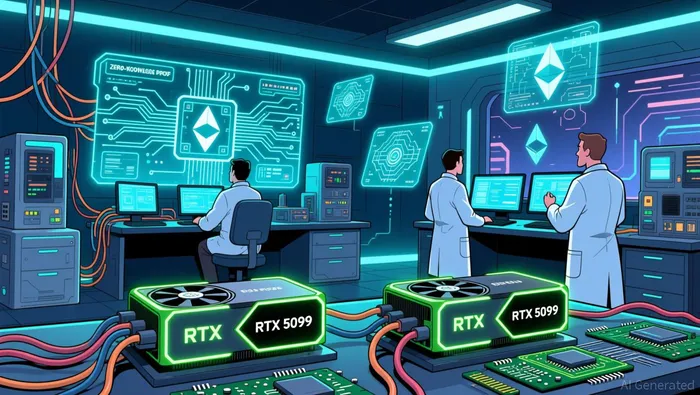 SP1 Hypercube's formal verification of RISC-V constraints and elimination of reliance on unproven mathematical assumptions further solidify its production-readiness. The project, now in its final audit phase, aims to integrate with platforms like OP SuccinctPROVE-- and ArbitrumARB--, enhancing cost, performance, and security for users according to development plans.
Together, these advancements signal a pivotal moment for Ethereum's scaling strategy. While challenges like worst-case proving times persist, the ability to perform ZK proofs on consumer hardware accelerates the path to decentralized, affordable block validation. As Ethproofs Day brings builders together to demo these innovations, the stage is set for Ethereum to redefine its role as a scalable, user-friendly blockchain.

Stay ahead of the market.
Get curated U.S. market news, insights and key dates delivered to your inbox.


AInvest
PRO
AInvest
PRO



Comments
No comments yet